Showing posts with label Study: MicroGravity. Show all posts
Wednesday, May 15, 2019
Pillownaut Muse
After my follow-up DEXA Bone Scan last winter, and the nice article NASA's Human Research Program published about me and other past pillownauts in preparation for the new simulation protocols, I didn't expect much more to happen. It's been many years since my studies, and my blog is now only rarely updated.
I pondered perhaps "over-hauling" this site to be a #SciComm hub -- but honestly, I think there are so many great existing Science Communication sites, and I will work to amplify those. I figured I'd had my 15 minutes of fame, and decided to leave my old blog "as-is" as a historical record of how I lived through the unique experiences of Space Flight Simulations projects at NASA.
But. Every time I think I'll never hear about it again, another author or press outlet comes knocking. Last time it was Charles Wohlforth, and you should definitely still read his great book, "Beyond Earth: Our Path To a New Home in the Planet." My father was very impressed they devoted more space to me than to Neil Armstrong, so we may have to put that on my tombstone.
Along came Minute Number 16...
Muse Magazine asked to feature my studies and chose the same title, just spelled a bit differently! In "Beyawned Earth," writer Jen Mason compiled many of my past blog excerpts, a few older press turns, and many of my personal photographs from quarantine into an exceptional article designed to teach students about space flight and how it affects the "biological packages" that travel in spacecrafts.
Reading the finished product, I was definitely the happiest I've ever been with an interview. I've had TV and radio stations ask me exhaustingly inappropriate questions; sometimes even reputable outlets go for the sensationalist spin by giving the study clever little [incorrect] nicknames or dwelling on incidental details, like how we manage to shower during simulations, or that we cannot have sugar or caffeine or salt in quarantine. Sure, those things are challenging, but not life-threatening. They pale in the quest for good data.
However, MUSE Magazine hired a skilled and serious writer who truly nailed the science. After literally a decade of interviews in varied formats, and even being featured on the NASA website itself, this was really the first full-length article that revolved around MY OWN WORDS REGARDING MY OWN EXPERIENCES. This is the closest article to what I would have written myself. Maybe someday, some outlet will invite me to do so. Hope springs eternal.
I was gratified that this particular entity put the science in detailed and accurate terms, because it's directed at students and young adults potentially getting started in scholastic concentrations, and beginning to think about choosing majors.
Issue came out in March, and I was thrilled to receive copies by May, after I returned from my 6-week trek in Europe. You can order back issues of Muse Magazine yourself, or subscribe your teens, at Cricket Media.
My entire list of articles has been updated to include the last 2 years.
Thursday, June 27, 2013
NASA Bedrest Double Duty
Following updates on the European Space Agency flight simulations, I'm happy to say I see new press about JSC sims too! Rooms in the NASA facility are full again!
Justin Ciaciura of Conroe, Texas completed a 105-day study. 70 days were spent tilted, so he beat my time by a whopping 15 days. I have so much admiration for this dedicated man, who epitomizes the doctors' assurances about the program quality: "We do our best to identify people who are motivated to participate in the study. People don't do this for the money; they have a higher commitment."
The money... is... freaking awesome, however: $5,000 per month, which is great if you've just graduated, can't find a job, are between jobs, or just plain love space exploration and want to add to the databanks of scientific and medical knowledge!
So says Justin, "The novelty wears off pretty quick. This is hard work. But knowing you're actually making a contribution to NASA’s space program is very rewarding."
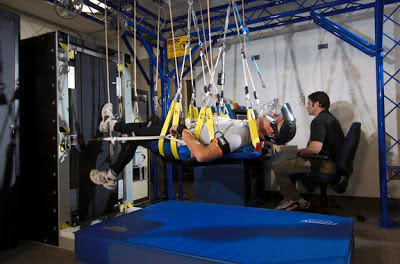
Why lying down? Well, certain things that happen to the body in the micro-gravity of space also happen identically when one lies down for extended periods. Bones, as measured by DEXA Scans, can lose mineral density and mass, plasma volume can decrease, heart and surrounding muscles can change, and your sense of balance and depth perception, as measured by posturography, can go... what's the technical term? Totally wonky.
These studies seek countermeasures to keep astronauts more healthy, with a mind to reaching Mars someday. That will take 2 years in space, and we have yet to work our astronauts up to 1 year! Adapting to the weightless environment is no easy task. Later, re-adapting to Earth gravity can be equally demanding. So, while grounded from manned flight, these studies are crucial to many space agencies.
Incredibly, while googling for the specs on the newest studies, I found yet another subject in the press, compliments of podcasters Mike Danforth and Ian Chillag. Their Tumblr archive of "How To Do Everything" contains a fantastic recording of "70 Days in Bed with Howard".
Howard survived the 105-day program at NASA which required 70 days of spaceflight simulation! During his time "play astronaut", Mike & Ian thrice featured him in their podcasts: day 21 of tilt, then day 32, and finally day 90, once he "returned to Earth" and was rehabilitating his muscles.
Many questions were predictable: "So, are you starting to go crazy?!" -- and I loved Howard's answers. Like him, I'm a very active person, so it's difficult to be restricted, but many of us are willing to do it for the sake of future space exploration. Howard described his typical days, with all the little things one must cope with in studies, both good and bad.
Further along in the podcast, NASA principal investigator Dr. Ronita Cromwell weighed in with scientific descriptions of things the studies explore about bone, muscle, and bodily fluids.
Howard and Dr. Cromwell list behavioral and medical tests -- many of which are analogs of everything done to astronauts before, during, and after spaceflight. I found the third segment the most interesting, where Howard describes returning to normal gravity, noting things the body must "re-learn" in order to walk, resume daily tasks, drive a car, etc. Adaptation in both directions can be eye-opening!
Contrary to some web forum myths about these studies, neither of the men were half-dead, depressed, crippled or compromised for life. I did three of these programs, and am robustly healthy. Pregnant women go on bedrest, sometimes for months, and do not suffer for life. So, don't believe fearmongering on the internet; read stories like these about people who have actually completed them.
Only active, healthy people with strong bones and great blood pressure are selected in the first place, and we are HIGHLY motivated to get back into shape again afterwards. Every participant gets us one step closer to Mars!
Friday, February 15, 2013
Snurk Beddengoed!
You read right... Snurk Beddenoged! Or, in Dutch, Snoring Bedding. This is the very first company to release a genuine, literal PILLOWNAUT product! Behold:
It's all too magical. Designed for single beds with children in mind, the new Astronaut bed sheet and pillow case set will be sold in March 2013, but space enthusiasts can pre-order now for €59,95 (about 80 American dollars or 145 Yen) and inspire your youngsters with, as Gizmodo calls this, the one fantasy job that always manages to beat out professional athlete and ninja!
A simple drawing of a space suit costume? Heck no, this amazingly detailed illustration on cotton & velour was a genuine space suit, photographed at the Space Expo Museum in Noordwijk, The Netherlands.
After March, you can also check out any stores worldwide that sell Snurk products.
We definitely should have had these in the NASA ward during the bedrest studies! These would be perfect for the beds at the Galveston unit where Flight Analogs to the Astronauts perform their medical tests.
If these sell, I am sure Snurk might consider offering double, Queen or King sets for space fans! You can use their contact page to suggest such sets, as I have.
Designed in Holland and manufactured in Portugal, their collection of amusing comfort oddities also includes the Target Squirrel, knitted Granny Cushions,the Yawn collection, the White Bra and... Bob. Yeah, just Bob.
Friday, January 18, 2013
Astronaut of the Pillow
Last post, I mentioned the newest Space Flight Simulation, in which the European Space Agency sponsors a study program for 12 participants of both genders, at an ESA facility in Toulouse, France.
Four pillownauts will spend 21 days in bed while engaging in recumbent weight-training and a vibrating exercise contraption. Another foursome will engage in the same, but add whey protein to their diets to see if there is any difference in muscle building. A final four will spend the same amount of time in bed, but lacking any of these attempts at "countermeasures". Throughout the program, they will undergo various tests and experiments.
The infamous TILT TEST
I was thrilled to hear from healthy volunteer Vladyslav Atavin,who has created very informative and picture-saturated descriptions of his experiences! Vlad's blog, entitled Astronaute sur l'oreiller: histoire du sujet "L", literally translates into English as "Astronaut on the Pillow: The History of Subject L".
I guess "L" was his identifier in the study! We had numbers at NASA, but very seldom saw our names on things, unless we made it public ourselves.
Beginning this past November, Vlad described his screening process for SpaceFlight Simulations, his many bouts of medical activities, funny stories such as falling asleep during a DEXA Scan (oops!), and he was even brave enough to allow a camera in their shower facility (SFW).
All For Science!
Many protocols are identical to those used at NASA: -6 degree tilt, food regimen, calculated fluid intake, blood tests and urinalysis, plasma volume measurements, DEXA bone scans to score bone mineral density, and neurological balance tests; and also minor details, such as having to shave certain body areas to accommodate electrodes, and having massages to prevent thrombosis.
There were a few differences in their program, such as the timing and sequences of tests, use of a vibrating platform to stimulate muscle and bone in one control group, and more advanced ocular testing. Also, they got ginger tea and evening snacks. NASA testers never got those! Must lodge a complaint!
They had a much larger array of French, Irish, Austrian, German, and Italian scientists running experiments, and had to endure far more invasive procedures, such as a biopsy, which a non-squeamish researched caught on film (WARNING: Do not click if blood or medical procedures makes you queasy!).
Oh my, what a rough life, eh?
Their full study will take places in 3 major phases throughout 2013. Vlad wrote about the first phase in French (easily translated through Google), will write about the second phase in English, and the third phase in Russian.
He is happy to field comments and questions on his Astronaute sur l'oreiller blog in any of these languages, so please hop on over to give him your support! :)
Wednesday, January 16, 2013
Pillownauting Across the Atlantic!
PILLOWNAUT has crossed the pond! Well, would you look at that, I [accidentally] coined a word that hopped continents.
Back in 2008, when I began flight simulations at NASA, I named my blog "Pillow Astronaut" as a joke. Bedrest to be an analog to weightlessness? And our best luxury was a pillow? It's a nonsense combination of Latin and Greek root words, and then I made it worse by shortening it to "pillownaut" for the web URL.
The Original Pillownauts
Devin, me, Candace & Deron - 2008
A few NASA writers hopped on board, and also used the term when reporting about our project on the NASA.gov servers. Then, FOX news got hold of us, and publicity spread to many parts of the world. Over the next year, both Wired.com and POPSCI would also use the term in articles about various NASA projects in the Flight Analog Program.
Our little press crew certainly weren't the first analogs, but for some odd reason, the stories struck a nerve with folks at that time, and we happened to become the most visible. Sometimes that was great (astronauts came to visit!) and other times, that had a significant downside (wow did I get freaky emails from a lot of random goofballs!)
Pillownauts Getting Up!
Kjell, Devin (back!), me & Marcus
The studies are still going strong at the NASA facility where we once lived, and such research projects have eexploded to even greater public attention with the Mars500 simulation, a joint project between the ESA, Roskosmos and CNSA.
It was with no small amount of amusement that I see the ESA's newly announced bedrest study calls their participants... wait for it... PILLOWNAUTS.
As of December 2012, the announcement came for the first of three phases for a long term study: Six Degrees of Inclination. The newly created Bedrest Study website of the ESA has a myriad of juicy details and goals
Happily, one of the participants in the newest ESA study found my blog and emailed me about his experiences! I'll be sharing those later this week, so stay tuned for Pillownauts, the European Version...
Tuesday, November 20, 2012
Bed Rest Studies Revisited
Many moons ago, the European Space Agency operated bedrest studies as "space flight simulations" in Toulouse, France, which were very similar to those conducted by the scientists at NASA's Johnson Space Center. They specialized in data based on women's needs at the time, as the trials also served pregnancy-related bedrest concerns and osteoporosis.
Space-Travel.com reported recently that the ESA will be re-starting a new program for 12 participants of both genders that will stretch into 2013.
Four will spend 21 days in bed while engaging in recumbent weight-training and a vibrating exercise contraption. Another group of four will engage in the same, but add whey protein to their diets to see if there is any difference in muscle building. A final four will spend the same amount of time in bed, but lacking any of these attempts at "countermeasures".
21 days in bed may sound like a lot. I once spent 54 days in bed for the sake of a similar Space Flight Simulation, so I like to think 21 would be no problem. However, any amount of bedrest can be a challenge to the body!
As we age, our bodies lose bone density and muscle strength. Astronauts in space suffer similar changes but at a much faster rate than on Earth.
Finding ways to combat this process is important to space agencies, hospital patients and everyone who plans on growing old.
That would be... all of us. So, hey, all in the name of science, right? My kudos and congrats to the amazing people who screens and qualified for this wonderful project. NASA should soon be announcing their new bed rest flight sims for 2013 as well! Stay tuned for news if you want to apply!
Friday, October 19, 2012
The 10 Most Bizarre Space Experiments
My first appearance in a textbook! After numerous turns on the internet, radio and television, I'm truly proud that I've been able to contribute to an educational resource for children. Hopefully it will serve to initiate a fascination with space research for some young minds.
Rubicon Publishing has recently released "The 10 Most Bizarre Space Experiments", a fun and fascinating look into various space projects around the world... and off the world!
TheCanadian company who writes "The 10" series of books contacted me with a request for personal photographs insights into my personal experience with bedrest studies. These programs are used to simulate spaceflight so scientists and doctors can study changes in human bodies in prolonged weightlessness.
It was refreshing to talk about the details of the studies again, since of course it's been quite awhile now since I did extended quarantine with spaceflight protocols. Happily, however, these studies are still going strong, and many new studies are also developed each year for new participants. Johnson Space Center is still seeking healthy paid volunteers for studies like the one I shared here with Rubicon, and new programs involving the newest space station treadmill.
Ah, memories... but, I was not the star of the tiny tome by any means. A complete list of all the featured stories include:
- LEGO on ISS
- Six-legged Astronauts
- Newts in Space
- Cola Wars
- Mars500
- The Bedrest Experiment
- Balloon Jump From Space
- Moon Bricks
- Space Underwear
- Telepathy From Space
One of my favorite simulations, performed as a joint project by the European and Russian space agencies, is the Mars500. I followed all three of their missions for years! My feature ends on page 5, and the Mars500 feature begins on page 6! What an absolute honor to be in the same pages of a book with them. Of course, perhaps they would also consider it an honor to be included with a book of long-term space experiments and yeeeeeeears of comparable NASA studies.
I sure wish I could give a link to where the book can be purchased that would work for everyone! However, the target audience is Canadian educators, so it won't be made widely available. However, if anyone has connections to any of the experiments and would like a look at the particular pages, please let me know!
Friday, August 24, 2012
NASA Bedrest Studies: Then And Now
Very special thanks to longtime supporter and reader, Joe Neigut, for bringing my attention to some great new videos on YouTube! I admit, I don't often "surf" that particular site unless I have a video to upload – and even then, I'm more likely to get stuck on Monty Python skits for hours ;)
Many moons ago, I featured some articles on space agency bedrest studies: one paid $100 per week in 1968; another in the same era recruited prison inmate volunteers, and both were considered early milestones in the attempt to understand effects of extended weightlessness on the human body.
Life Sciences at the Manned Spacecraft Center in 1973
This short clip shows bedrest and tilt tests, as part of a broader view into the physiological sciences that accompanied the post-Apollo and Skylab era of the space age. The entire program is available on another channel, and you can click here for Part 1 (13 minutes long) and click here for Part 2 (14 minutes long).
Current studies pay more than ten times the money now, at $1075 per week, and there are definitely no more prison volunteers allowed by NASA's modern ethics committees. Screening, of course, is also more rigorous, and psychological testing is also included. It takes a physically hardy and mentally sturdy person to withstand this particular sort of friendly quarantine, even if it looks like just "lying around".
Clip of modern NASA bedrest studies in 2011
Interestingly, even after 45 years worth of these studies, while the details have been altered in various ways via comparison control groups, the overall drill is the same: micro-gravity simulation to examine changes in bone production, muscle tissue, blood flow and plasma volume.
It's amazing to see how these studies have evolved over the years as we've tried to achieve greater accuracy and learned more about the body while trying different counter-measures.
We've come a long way!
Wednesday, August 15, 2012
Next Step: HUMANS ON MARS
I'm leaping, sure. I'm arguably so over-excited about a 6-wheel drive science lab on the Red Planet, that I hope people are energized to support space exploration! Come on, even Britney Spears tweeted about the Curiosity Rover.
We have the admiration of the president, the attention of the nation -- indeed, of many nations. Can we suggest a truly renewed effort to get HUMANS to Mars?

Most space enthusiasts, from Neil deGrasse Tyson on PBS to anyone attending the average Star Trek Con (that would be me) can tell you the iconic "5 Greatest Challenges In Getting Humans To Mars"...
1. Need for quicker propulsion craft with less fuel
2. Long duration weightlessness causes bone and muscle deterioration
3. Radiation, radiation, radiation
4. Appetizing and non-perishable food
5. Meteoroids pummeling the spaceship along the way...
And of course, the unspoken elephant in the rooms are always the massive costs and collaboration of nations.

As to the technical difficulties, from NASA bedrest studies to Hawaii's new space food trials, from Franklin Chang-Diaz's plasma rocket to Mars500 and other analog simulations, agencies and universities all over the world are trying to tackle these problems from all angles.
I personally participated in the bed rest studies as a form of "space flight simulation", mimicking the body processes that change during weightlessness. While I appreciated the Earthbound uses for the data in terms of osteoporosis and pregnant women on bedrest, my primary reason for participating was for the sake of getting humans to planet Mars, no doubt.
The same can be said for all these bodies of research. Real-world applications? Absolutely. Yet, the primary reason they inspire and go forward is the long-term dream of planetary exploration.

Or, if you're of the "Reality Television" type, click here ;)
However you do it, support these initiatives! Even if you just comb SPACEHACK and look for a project to engage in from your laptop -- hey, tweet it, Facebook it, get the word out! Support research and support space agencies! In terms of survival and progress, they are the bet Bang For Buck the Earth has ever known...
Thursday, January 19, 2012
Astronaut in the NASA Ward
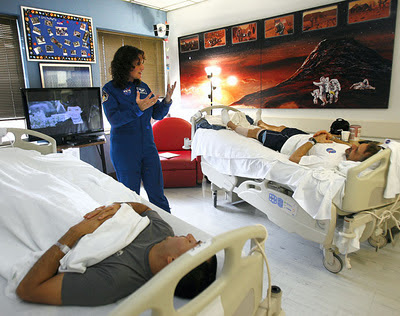
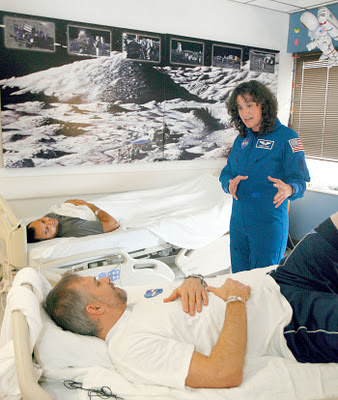
Dr. Serena M. Auñón (35) of League City, TX was one of the two flight doctors chosen in the last astronaut selection. The Galveston Daily News reported on her visit to the NASA ward at the University of Texas Medical Branch, where she visited with study subjects in the current flight simulation programs.
Participants David Sarmiento and William Widener were in the long-term bed-rest study in the Flight Analog Research Unit at the time, in the now-famed Head-Down Tilt. In this position, participants show physiologic changes similar to those expressed by astronauts in microgravity. Changes in blood pressure and blood plasma volume result when the heart works about 15-20% less, and of course the creation of bone mineral density in the body also changes.

Sarmiento, 35, a commercial diver from Maryland &
Widener, 42, a fitness instructor from North Carolina
Like many subjects before them, the newest recruits attest to a new appreciation of how astronauts cope with weightlessness on their missions, as they find the studies are both physically and mentally demanding. Said one new participant: "I have a greater understanding of the physical effects of zero gravity. It's not just floating. It affects your whole body."
Astronaut Auñón, who completed residencies in both internal medicine and aerospace medicine at UTMB, so she knows a little something about the value of the NASA studies:
"We learn a tremendous amount from astronauts and their experiences aboard the Space Station. Those numbers are small and a larger body of evidence is needed. Head-down bed rest is one of our best analogues. The women and men who volunteer to take part as subjects in the bed rest facility provide invaluable data regarding physiological changes in a 'weightless' environment."
It's also an amazing way to do your part for space exploration, and everything scientists learn about human bodies in these studies gets us closer to planet Mars. Still, it must have been nice to get some personal recognition from an astronaut! They of all people know how much sacrifice can be involved in the stringent protocols. Testing yourself in the way astronauts train? Not for sissies!

Other articles in the past few months regarding the studies have been very positive! We are truly seeing gratifying results in term of how space studies further our knowledge of how to live in micro-gravity, but also the practical benefits that can be applied to life on Earth:
July 13, 2011: Sentara Offers NASA-Developed Treadmill For Therapy
Space study treadmill used for orthopedic patients, senior rehabilitation conditioning, military members endurance and strengthening, etc.
November 29, 2011: Bed Rest Study Provides Invaluable Data for NASA
Information on exercise, muscles, bones and hearts to keep astronauts healthier.
December 21, 2011: From Here To Maternity
Months in bed to stop miscarriage? Practical considerations to involuntary bedrest.
January 2012: Rehab: Space Technology Helping to Heal & Strengthen
Space mission technology adapted and approved by the FDA for use in injury rehabilitation, Neuro-Muscular control, pre- and post- joint replacement surgery conditioning and athletic training.
These have also all been added to the archive of Articles on Pillownaut.com.
Tuesday, August 3, 2010
Call Sign: Rezac
I'm always excited when I convince someone to overcome natural camera-shyness, because frankly, I'd do a "NASA Employee Spotlight" once a week if I could get away with it. Most folks are too modest, and longtime NASAman Ed Rezac is no different, but he was kind enough to share stories and photos!
Starting in 1976, Ed supported Space Shuttle era Extravehicular Mobility Unit (EMU) development at ILC Dover and astronaut hardware development at ILC Space Systems in Houston. Then up into the 1980s, he was a Payload Integration Engineer at JSC & KSC, supporting NASA Life Science Space Lab payload development.
Feel like a slacker yet? I was getting ready for my senior prom around the time he became a Space Station Utilization Engineer at Grumman Aerospace, and had just earned my first college degree when he moved to the Center for Space & Advanced Technology at NASA Headquarters to manage the subcontract in support of Microgravity and Life Sciences in the early 90s.

Standing in the High Fidelity Mechanical Simulator (HFMS, a full size mock-up of the Hubble Space Telescope's aft shroud) in Building 29 at the Goddard Space Flight center in Greenbelt, Maryland
For the last decade, he's been at Lockheed Martin as an EVA Systems Engineer, working with engineers, scientists and NASA astronauts to plan, train for, and execute servicing missions to maintain the Hubble Space Telescope.
I could spend about 18 blog posts pestering him with questions about any number of tasks he performed at any of these jobs, but for the sake of him actually being able to escape my evil clutches and get back to work, I'll just share a few episodes in line with my blog themes of simulations and ground testing.
Hence, my favorite photo sets:

Ed again, with what he lovingly calls his "Ron Burgundy moustache."
Sweet Lincoln's mullet! (click to embiggen)
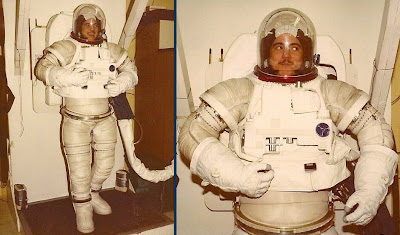
Above is a shot of Ed in 1980, as a suited tester. Definitely click to see the larger version, and see all the details of this EMU.
You were probably sitting in a theatre somewhere, watching Caddyshack. Then maybe you went home and played your Atari 2600 or the new Andy Gibb album. Yeah, Ed was conducting actual certification runs of the pre-flight testing of astronaut Bob Crippen's gloves that were flown on STS-1 in April 1981!
When I emailed Ed to ask if I could use these wonderful pictures on my blog, he replied:
"I suspect that what you may find more interesting than the activities of 30 years ago are the more recent hardware design, procedure development, and crew activities conducted in preparation for the Hubble Space Telescope (HST) Servicing Mission. I was the HST Project's EVA Lead for two of the tasks completed during the last Hubble servicing; changing out the three Rate Sensing Units (RSUs) that contain the gyros that keep the telescope steady during viewing operations, and repair of the Advanced Camera for Surveys (ACS) science instrument."
"Both tasks required design, development and testing of hardware; development of both nominal and contingency procedures; and instruction, training and on-orbit choreography development for the astronaut crew and ground personnel. I worked with the astronaut instructors at JSC to train the astronauts using 1-G simulators, VR, the Neutral Buoyancy Laboratory, and put in many hours "on the loops" at Mission Control for pre-mission simulations as well as actual flight console support."

L to R: Mike Good, John Grunsfeld, Ed, Mike Massimino & Drew Feustel.
The STS-125 spacewalkers in front of the mock-up HST aft shroud following a training session in Houston, TX.
I was going to do a "write-up" on all that, but it actually works better in Ed's own words, and all the amazing photographs truly speak for themselves. Click on any to move to a page where you can see the whole photo sets, Hubble mockups, astronauts and all!
Thanks so much for giving folks a view into your world, Ed... we love having looks behind the scenes at the real people who keep the space program running!
Tuesday, January 5, 2010
Scotty's Farewell
Last journal entry for Mr. Scott! Then he was treated to some "real world" food before flying home to his family in Florida. It's a fascinating look at the full rehabilitation period and follow-up medical tests, and I was particularly intrigued with his descriptions of how just the simple act of walking outside was exciting!
First stop, Chick-Fil-A!
After nearly two months in the test facility, breathing cool fresh air and seeing the sky over your head... well, these are things we all take for granted until we lose them for awhile, and enjoy the wonderment in rediscovery!
Scott also brings up an interesting point in one of his final entries, after seeing a high school acquaintance on Facebook:
"[This] girl I went to school with was on Survivor... who knew?! I mean, it’s no NASA study but at least she was on television. This study might make a good reality show but then again, we can't even have sugar in our food, let alone the kinds of debauchery commonly found in most so-called reality shows. Maybe if some washed up 80s rocker stayed here for a few months..."
SO! CALLING WASHED UP 80s ROCKERS! Think we could get Tommy Lee in on this? He was in the news lately for cheapskate-crowdsourcing, so perhaps we could talk him into a study if he's that hard-up for cash. Bret Michaels is diabetic, so he's out. Ozzy's blood-alcohol-content is higher than my college grade point average, no go. How about Metallica? Are they clean yet? And I'll bet David Lee Roth has some free time on his hands. Other suggestions welcome.
In all seriousness, the environment of a NASA study clearly isn't scandalous enough for reality TV, so we're all still poised to see George Clooney's next move...

You miss it when it's over...
Upon release, Scott also had his photographs developed, so definitely visit the NASA Ward gallery on the Picasa Albums site to see some of his tests, his bedrest phase and of course, his ceiling tile.
Thanks for sharing your experiences with everyone, Scott! :)
Tuesday, December 29, 2009
Almost Done, Mr. Scott!
Highlighting Scotty again today, partly because so many readers are finding his journal fascinating... and partly because he may be my only friend on Facebook who isn't whining about gaining weight over the holidays!
Having spent both Chanukah and Christmas in the NASA study ward on a decidedly less-than-festive diet (well, at least according to someone hates cheese... but ironically wants a pizza when he leaves), Scott still seems to be in pretty good spirits -- and only has a couple days now before he gets to return home to Florida. Great job in the study, Scott!

Click here for the next journal entries, detailing his rise from the -6 degree tilt and ensuing effects, post-bedrest medical tests and muscle rehabilitation!
Thursday, December 17, 2009
Innerspace
Click here for Scott's continuing saga, as parts 9 and 10 of his journal are now online. We're almost caught up! You'll laugh, you'll cry... you'll be very glad you've never had to take a SmartPill.

Not actually the SmartPill, but close
He's the first person with whom I've been in contact who spent a major family holiday in the NASA study... and I have to say, I was wondering if the South Six Kitchen would modify the menu for Thanksgiving!
One of the menu items on the usual rotation is a turkey dinner (Day 10), but I thought it was nice that they moved it to Thanksgiving day for those folks who celebrate. They're happily busy putting up holiday decorations now...
SCOTT QUOTE OF THE WEEK: "This is the longest I've gone without wearing shoes, going outdoors, being exposed to natural light, driving, eating chocolate, or drinking a caffeinated beverage."
Well, Scott... the space program and all its fans definitely appreciate your sacrifices! The "detox" seems tough at the time, but when we do land on Mars, you'll be able to say you were a small part of NASA's ongoing work to make that a reality.
And speaking of NASA's wide-ranging work...

If you have time today, don’t forget to vote for Top NASA News Story of the Year!
Monday, December 14, 2009
Status, Mr. Scott?
Two more entries have been added to Scott Saslow's index, completing parts 7 and 8 of his ongoing journal. Nurse Michael was also kind enough to take a recent photograph of Scott so we can observe him in all his gravity-less glory...!

Wow, does that ever bring back memories! Many moons ago, after I had been evacuated due to Ike, longtime reader Ray Robinson left a comment on a post-rehab blog post:
"You might consider prompting others at the study to take up the mantle of blogging. Considering the attention this blog generated, it would be a shame that this window into NASA activities be closed."
I agreed! But boy, it took a long time to find another dedicated writer who was in it for the long haul. Now that I finally have, I also get to relive what it was like on the ward... I can certainly relate to the "not wanting to ask for help all the time."
Space sickness is different for everyone, though I also got backaches and nausea at first…followed by the same leaky tear ducts. And I also used my stomach as a mousepad during two of my studies – that truly made me laugh aloud. Even just small daily challenges like getting through the water pitchers, and filling the time with movie after movie after movie after movie, LOL... those sound easy at first, but you do still have to make it through each day, following all the strict protocols with your sanity intact.
Thanks for sharing your journey with us, Scott!
Monday, December 7, 2009
Scotty Part Deux
Well, I'll be publishing Scott's continuing journal entries in pairs -- so, to be more precise, it's parts trois and quatre, but who's splitting hairs.
And I've tried, to no avail, to get Scott to write an introduction of his own for the link re-directs, so I guess he'll just have to be subject to whatever whimsey I dream up in the mornings. I neglected to tell him I gave up caffeine after the last study, so for the next intro, he may reconsider ;)
Awesome.
As more test subjects join the mix, more monitors are assigned different shifts and it can be a real challenge to keep track of the population! Join Scott again for his meals, balance posturography, psychologist visits, cycle ergometrics, his philosophical thoughts on his scientific journey for the space program and the ongoing daily quest to stay busy and entertained while in bed on the NASA ward!
Subscribe to:
Posts (Atom)