Showing posts with label NASA Kennedy. Show all posts

Wednesday, February 12, 2020

Thy Chariot Does Not Await

Here we go again! The chariot story is circulating anew on the Twitterz. In not one but two strings, well-meaning authors are attempting to persuade us that the earliest styles of vehicles pulled behind beasts of burden ultimately set the standard from ancient times up through the space program. 

So say these champions of consequential causality, the span of two horses side-by-side (about five feet) was the original measure of uniformity. Roman roads were thus created to accommodate wheeled carriers of this width, which then spread across Asia, Europe, and the Americas. When roads became railroads, all the tools and surveys were standardized to continue engineering such widths. 

When the Space Shuttle was being developed, its Solid Rocket Boosters (SRBs) had to travel by train from their manufacturer to the launch pad. No matter how large or powerful NASA may have wanted them, they had to fit on flat train cars, and through train tunnels. And so the size of modern rocket boosters were determined by ancient Roman horse-drawn chariots.

Such a simple choice in ancient times, and yet, it had a huge impact on the world. Or did it? Sometimes, we just innocently enjoy believing stuff because it sounds cool. (But, you know, don't.)
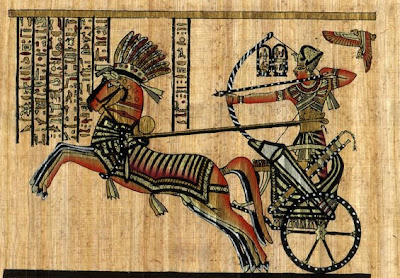
 Egyptian Chariot

One of many different designs of chariot
 

Our brains are primed to enjoy the neat, circular narrative. We love a satisfying story, and as evidenced by how far these tweet-strings travel -- often circulated thousands of times, they are almost impossible to counteract. Case in point, my polite explanation received only a fraction of the retweets. Even for the most patient of teachers, the effort is always an uphill battle.  

This urban legend has circulated every decade since the Space Shuttle program began in the late 1970s. 

The first thing to note is that Romans did not invent chariots. Second, the earliest roads over all kinds of terrain were simply human footpaths. The ground wasn't waiting around to say "hey, I'm a road now!" until chariots were invented (though certainly wheels did indeed carve ruts more effectively).

The third claim is objectively not true. Distances between railroads tracks (known as "gauge") have varied widely over the last two centuries, with three standards in the United States alone. The standard gauge used today is based on engineering practicalities, not ancient Italian equine technology.

 
Chances are, you will wear a white gown at your wedding. Roman brides did too. We still use plenty of things invented by the early Roman Republic and the later Roman Empire: candles, scissors, postage, showers, umbrellas, heating systems, street lights, rampant economic inflation, and so on.  

So, to say that ancient standards are still alive in the modern world isn’t all that exciting. Humans are well-known for sticking with certain things that work, and equally notorious for sticking with certain things that don’t. 

Archaeological evidence suggests the existence of chariots in far more ancient cultures: Chinese, Sumerian, Greek, Persian, etc. The Romans were late-comers, though they fancied-up chariot production with trigas (pulled behind three horses) and quidrigas (pulled behind four horses). So, while we can credit their empire with widespread road systems, they weren't overly attached to the simple metric of dual-equine-derrieres. 

 Methods and means of transportation have, throughout history, been designed different ways to carry different things and accommodate many different vehicles. Some have been dictated by creation costs, others by limitations of nature. From gravel paths to 14-lane freeways, a single lane often accomodates a car as small as a Mini-Cooper, or an 18-wheel rig.
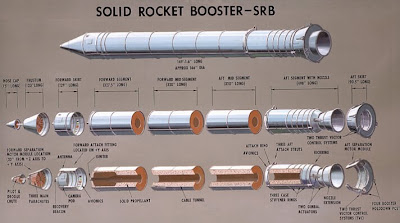
Solid Rocket Boosters
Commonality of construction
is no more bizarre here than the idea that all current automobiles have steering wheels – regardless of brand, model, size, number of doors, or color. The Romans would have called such specification: "desideratum" – colloquially, that which is essential is desired

At the height of the railway era, over a hundred US companies manufactured three different gauges of track, showing a decided lack of standardization. The Chariot-to-Shuttle tale also assumes that any tunnel would only accommodate a single set of tracks, or only clear the train's mass with no room to spare. Also notice the mysterious mountain tunnel in question is never mentioned by name –- but between where the rocket boosters are built (Utah) and where they are ignited (Florida), there are actually 50+ tunnels.

Skepticism is the new black

We could muse at length over the patterns and rhythms of urban legends, but rest assured NASA takes travel into account when designing hardware specifications, but to my knowledge, NASA has never been crippled by the slightly-less-than-five-foot span of railroad tracks. No fewer than 20 companies contributed to the many parts of solid rocket boosters, so even if transport was the main event, much of the hardware is already delivered in segments, and "Some Assembly Required" is already a given on the launch pads of Cape [Kennedy] Canaveral. 


Tuesday, November 12, 2019

Lunar Ponderings


A stunning anniversary just passed: 50 years since Apollo 11. We have 6 more Apollo lunar anniversaries to go, (7 overall in this program if one counts the non-lunar Apollo-Soyuz Test Project). For years, I've tracked statistics of Apollo missions and astronauts as they aged. And each time I have to update my records, the solemnity of the loss halts all activity in my brain.

On December 19, 1972, upon the splashdown return of Apollo 17, there were 12 men on planet Earth who knew what it was like to walk on the surface of our Moon. This fact remained true for true for 18 years and 7 months.


Then, in August 1991, James Irwin (Apollo 15) died of a heart attack at age 61.

In 1998, Alan Shepard (Apollo 14) died of leukemia at age 74.

In 1999, Pete Conrad (Apollo 12) was killed in a motorcycle crash at age 69.

In 2012, Neil Armstrong (Apollo 11) died of heart failure at age 82.

In 2016, Ed Mitchell (Apollo 14) died in his sleep at age 85.

In 2017, Gene Cernan (Apollo 10 and 17) died of long-term illness at age 82 and Dick Gordon (Apollo 12) died of cancer at age 88.

In 2018, John Young (Apollo 10 and 16) died of pneumonia at age 978, and Alan Bean (Apollo 12) died of sudden illness at age 86.

Today, as we approach more 50th anniversaries of lunar landings, there are just 4 men left who remember traveling to and working on the Moon.

  • Buzz Aldrin turns 90 years old in January 2020.
  • David Scott is 87. 
  • Jack Schmitt and Charles Duke are both 84.
Among the other Apollo (orbiting or CSM pilot) astronauts, all are now octogenerians, with youngest Ken Mattingly reaching the age of 84.

Even if the youngest of them make it in to their 90s or to 100, will they see another Moon mission? Will they watch astronauts who are American or Chinese? Male or female?  Will it be just as inspiring to the world?

L to R: Charlie Duke (Apollo 16), Buzz Aldrin (11), Walter Cunningham (7), Alfred Worden (15), Rusty Schweickart (9), [Harrison] Jack Schmitt (17), Michael Collins (11), and Fred Haise (13).
PHOTO CREDIT: Felix Kunze/The Explorers Club

Some think we could pull off a Moon mission by 2024, though with how administrations roll (I've seriously been watching various plans and cancellations across my entire lifespan now), it will be more like 2027.
  • At that point, Buzz Aldrin will be 97. 
  • David Scott will be 94. 
  • Jack Schmitt and Charles Duke will be 91. 
  • Every living Apollo astronaut will be a nonagenarian. 
I wonder, will they make it? Statistically, the deaths in this tiny club are accelerating, and we can expect to lose a few more before we see a return to the lunar surface, given that even the best technological developments never seem to last past early stages. Anything could suffer cancellation again, in favor of Mars, Asteroids, or on the altar of war, economic depression, or unforseen disaster.

So, when we return to the Moon, if we return to the Moon, will anyone alive personally remember what it was like to visit the Moon?

Something to ponder.

Wednesday, July 24, 2013

Blast (Off) From the Past


Can't believe what I found in a box of books, under years of dust. I'm sure I haven't seen this souvenir since I was a teen. It's still in good shape, too!

Kennedy Space Center

This the John F. Kennedy Space Center booklet from 1976. Note the old "Worm" logo, and the cost in the lower right corner... 50 cents! The cover shows the Vehicle Assembly Building, tour buses, tourists, and the Saturn V rocket when it was still on display outdoors. What a treasure of history!

My father bought this for me when I was 7 years old, upon my first trip to KSC Visitor Center (which was much smaller, then). This was one of our Florida stops on a much larger cross-country trip to celebrate America's Bicentennial.

KSC Tour Book

Kennedy Center's Director at the time was Lee R. Scherer (served 1975-1979). The year he took over the position, the Apollo-Soyuz Test Projectsaw the first hand-shake in space between the super-powers of America and Russia.

The booklet features photographs of all the major heavy launch vehicles that blasted off from Cape Canaveral, as well as summaries the Mercury, Gemini and Apollo programs.

The one thing that stands out in my mind from visiting Kennedy was the Lunar Rover on display. Really? We went to the Moon... and took a car? I thought that was so very cool... but I thought they should have taken something more hip, like my Dad's '69 Camaro! ;)

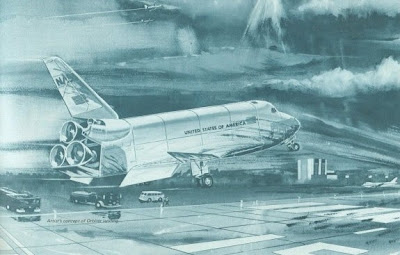
Early Space Shuttle Drawing

My favorite part of the book now is the artist's rendering of the "future Space Shuttle".  In 1976, it had been planned, budgeted, designed, and the first orbital vehicle prototype had just been built!  It would be 7 months before Space Shuttle Enterprise performed her first test flight.

It's stunning to think that I have seen four launches of these beautiful shuttles now, and seen three in museums after retirement. At the time this book was purchased, I had never laid eyes on one.  The first STS mission was still 5 years in the future, and none of us could imagine the 30 years of Shuttles to come!

Kennedy Space Center Book

Another favorite page is the map of Cape Canaveral, listing all the launch pads, and which missions (up to that date, of course) launched from each spot.

According to the tallies in the book, by 1976, there had been 31 manned flights, with 43 participating astronauts -- adding up to 22,500+ cumulative man-hours in space (or on the Moon).  In contrast, as of today, there have now been 211 manned missions, with 310 participating astronauts... and number 312 will head to the ISS in September!

Click on any of the pictures above to see full-size originals of the entire (non-copyrighted) booklet!

Monday, July 1, 2013

NASA Beauty Pageants 1952-1973

Share

Perhaps you thought the NASA bedrest studies were the goofiest thing you ever saw at the space agency, but did you know NASA once held beauty pageants?!

NASA Beauty Pageants
Click to see the original 2-page spread in the archives

This is one of those anomalous things I thought "everyone knew about," and I don't get the urge to research or write about in terms of historical accuracy -- until someone argues with me. You know who you are. And I won't rub it in or anything, but these definitely are not myth or legend. While the events are not exactly well-documented in the NASA archives, proof absolutely does exist.

Beginning at their Spring Dance in 1952, the Jet Propulsion Laboratory in Southern California held annual "Miss Guided Missile" pageants. There's definitely a "misguided" joke sitting right smack in the middle of all this -- but heck, it was the 1950s, what can you do?!

Miss Guided Missile Alane Hine
Miss Guided Missile 1955, Alane Hine, employee of JPL Solid Rockets section

When I first heard of this, I thought perhaps it was an unofficial lark for fun at some kind of spring picnic... but no. Incredibly, managers of various departments sponsored coronation candidates, and developed actual campaigns to draw employee votes -- which included luncheons, and parades around the campus streets in decorated convertibles.

None other than rocket scientist and longest-serving director of the Jet Propulsion Laboratory, Dr. Walter Pickering, crowned the ladies through the years, at events sponsored by the Employees Recreation Club (ERC).

The Jet Propulsion Laboratory was transferred to NASA in 1958, the same year the Zsa Zsa Gabor film "Queen of Outer Space" was released.  The following year, JPL's pageant was similarly (and one imagines humorously) re-named, also reflecting JPL's transition from missiles to spacecrafts.

JPL Queen of Outer Space
JPL "Queen of Outer Space" in May, 1962

These perfectly-acceptable-then-but-seeming-travesties-now continued through the 1960s, only halting in 1970.  Apparently, that was around the time it was enough for the women to perform their math magic alongside men without wondering how anyone looked in an evening gown!

While I know some fellow feminists are probably gnashing their teeth reading this, it's worthwhile to note that pageants originated at JPL because they were among the first major governmental and aeronautic facilities to employ women!  JPL hired them throughout the 1940s and 1950s to compute satellite trajectories; the first female engineer was hired in 1961 to work on the Ranger and Mariner mission tracking teams.  So, in a weird way, the road to equality was paved with marginalizing... but then, when it is ever not?

Miss NASA 1971
Miss NASA 1971 with Apollo 8 at Lewis Research Center

While NASA never had an agency-wide pageant comprising women from all centers, and certainly never sponsored these events as a rule across any centers, the Lewis Center in Ohio crowned a "Miss NASA" each year between 1968 and 1973.

NASA Lewis Research Center was founded in 1958, and renamed NASA John H. Glenn Research Center at Lewis Field in 1999.  Today, we generally refer to it as "NASA Glenn". Same set of buildings.

Miss NASA 1973
Miss NASA 1973 Merri Fahnenbruck with Apollo Moon rock

The pictures, with precious few details, are easily found by keyword in the NASA Archives, just don't tell anyone you're searching for a tomato in a tiara, standing next to an RL-10 engine. You might get a bad reputation.

Click on any of the pictures above to see the entire collection of NASA beauty pageant photographs, or click this Pillownaut domain link.


Tuesday, July 26, 2011

The First At The Last

Share

On the morning of the Atlantis STS-135 launch, we were treated to a talk by four-time Shuttle vet Robert Crippen, who piloted STS-1, and commanded STS-7, STS-41C, and STS-41G (once on Columbia and thrice on Challenger). We media nerds had just settled back into the Tweetup tent after watching the Astrovan take the shuttle crew to the launch pad when he strolled in!

So, at a little after 8:30am in the morning, we were literally listening to the first Shuttle pilot speak right when the last Shuttle pilot was being strapped in for take-off! Quite chilling. Bob Crippen spoke for perhaps 30 minutes about his experiences with different orbiters and astronauts, garnering both laughter and tears from the crowd – and from himself, when he choked up a few times speaking about the end of the shuttle program.


"When the solid rockets light, you know they're headed
someplace… and you just hope it's in the right direction!"

Columbia STS-1 scrubbed once, and lifted off on the second attempt on April 12, 1981. This maiden flight of the most complex space craft built to-date was, of course, also the precise 20th anniversary of Yuri Gagarin's first space flight. In 37 orbits around the Earth, Bob Crippen and John Young performed thorough checks of all the shuttle systems, recorded the orbiters "stresses" and overall performance, and returned to Earth safely, proving the space-worthiness of a craft that would take us to LEO for the next three decades.

In his retrospective above, Bob also scored a few points with the ladies, as indicated by the cheers, for being all space-feministy. We appreciated the nod to Sally Ride (first American woman in space) and Kathryn Sullivan (first American woman to perform an EVA).

John Young and Bob Crippen in 1981

Interestingly, in a related six-degrees-of-separation kinda thing, I once interviewed a Hubble guru at NASA Goddard named Ed Rezac, who tested Bob Crippen's space suit gloves in 1980, prior to their first true christening on STS-1.

And on this same trip, after many moons on Facebook and email, Ed and I finally got to meet at the epic Endless BBQ in Florida! Social Media has truly made the world a much smaller place! So if you are a space fan, and you have not yet attended one of the NASA center media events or Tweetups, keep an eye on the @NASATWEETUP feed for when new ones are announced! You will be amazed at how they bring people together from all over the world, and all throughout the space industry!

Endless BBQ
Space Geeks Unite!


Tuesday, July 19, 2011

Final Shuttle This, Final Shuttle That

Share

Final Final Final! I'm getting pretty sick of that word, but still can't seem to tear myself away from NASA television anytime I have a decent WiFi connection.

Yester eve, I stopped on my cross-country road trip to tune into NASA television and watch the closing ceremonies of the final Shuttle un-docking. After being attached to the ISS for 7 days for the unloading its 9,400 pounds of cargo from the Raffaello module and subsequent packing of other items for return to Earth, the unberthing commenced.

The all-American, all-spaceflown-veteran crew of STS-135 discussed the unique and historical nature of the mission, whereby the population of the ISS dropped from 10 to 6 again as the STS-135 folks thanked their orbiting hosts and departed.

Space Shuttle Atlantis
A pivotal moment in manned spaceflight, and in human history, to be sure. Currently, the last shuttle landing is due at Cape Canaveral, when Atlantis will touch down at 5:47 Eastern time, early tomorrow morning (Thursday, June 21st). Be sure to watch on NASA TV if you're up!

Astronaut Mike Fossum showed a small model of the space shuttle brought to the station by Atlantis, and that will now stay on the ISS. Astronaut Sandy Magnus snapped many pictures as the Expedition 28 crew bid everyone farewell, but the real kicker happened just before all the hugging started.

Expedition 28
Turns out, STS-135 was carrying a small American flag which had flown on STS-1 back in 1981, saying that it "represented our national pride and honor." They left the flag on Node 2, also known as Harmony, saying that it will remain there until the next astronaut on an American-made craft docks to retrieve it. Wow.

Certainly we all have high hopes for budget changes or commercial companies to fill the gap, but so many unknowns remain; the flag being left behind with that sort of open-ended question was terribly moving, and I found myself crying even more during this broadcast than the launch itself.

Shuttle Un-Docking
So gratifying to see American, Russian and Japanese crew members all embracing one another, wishing each other well on their various mission objectives. It's amazing how far we have come in terms of human relations in our space efforts, so let's hope we can get back on track now with hardware and construction concerns!

Anyone can review the mission milestones at the NASA multimedia gallery for STS-135, including the final Shuttle wake-up songs, President Obama's call, education talks to schools, EVAs, flight day recaps and various shuttle program tributes. Have Kleenex handy.

Tuesday, July 12, 2011

Kennedy Shuttle Launch and Tweetup Pictures!

Share

"This isn't the beginning of the end,

it is the end of what was our BEGINNING."
~ Lori Garver, NASA Deputy Administrator

Ah, finally... my Atlantis Launch Day(s) Photographs! I took about 400 photos on Liftoff day (probably over a thousand on the whole trip now) ... so narrowing it down to a manageable "Top 40" was something of a trick! But click here for the entire Picasa gallery, or any of the photographs featured below in today's post.

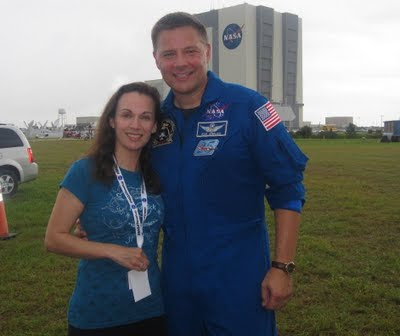
Doug Wheelock
With Test Pilot & Astronaut Doug Wheelock

But then of course we also had to include the parties afterward, namely the second "Endless BBQ" run by the Space Tweep Society -- so called because when launches scrub, they just go on and on and on.... until an actual launch, and then it counts as the wrap party, LOL!

We were lucky not to have a scrub however, just a successful trip to the ISS in the first launch window -- and even now, many of us left in Florida are still rather wandering about in a daze, saying "Did all of that really just happen?" Maybe we're all dreaming! Sometimes it feels that way. It has been a saturating space overload!

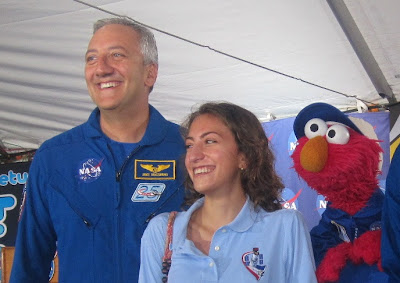
Sesame Street Elmo at STS-135
Astronaut Mike Massimino, his daughter Gabby & Elmo!

It has been a whirlwind of social media, and a truly exciting experiment of how far and wide you can spread your enthusiasm and passion for space events with other like-minded people who all came together in cyberspace! It's quite an amazing phenomenon happening all around us.

Of course, there is the usual disclaimer that I am not a photographer by trade, so set your expectations accordingly. I just take snapshots to share, but Time Magazine, I am not. Although, Time did publish a great video about the event!

Launch Pad Countdown Clock

There were tons of folks there who brought real cameras, so I definitely recommend their photo collections if you want to see more professionally rendered creations of the entire event. Among the best I've seen thus far are those Shuttle shots taken by Jason Major of Lights In The Dark, as he got some both in the early morning darkness, and far more of the launch itself.

Another interesting collection is over on Javier Pedreira's photostream, who captured some interesting imagery of the "feel" of everything around us, and ironically, also caught Jason Major taking a photo of the plume!

Lastly, if you want to see the entire environment as if you are standing in it... check out the 360-degree panorama of KSC Launch Pad 39 Press Site Complex by Shareef Jackson! This view is truly amazing!

Monday, July 11, 2011

Bear McCreary Shuttle Atlantis Fanfare

Share

Composer Bear McCreary, largely known for composing the television themes for Battlestar Galactic and Eureka, wrote the Atlantis Fanfare to honor the final Space Shuttle mission! So it seems our STS-135 launch had her very own theme song!

On Day #2 of the NASA Tweetup this past week, Seth Green introduced the song to the growing-more-emotional-by-the-minute crowd:


Shuttle Fanfare Intro by Seth Green

This second one cracked me up. It's rather poor quality, because I wasn't so much interested in filming anything in particular as just leaving the camera on for audio purposes. I wanted to get the whole song.

I figured I would just film the people around me (some of you will see yourselves!), film the video screens showing the astronauts being loaded onto Atlantis (that was happening real-time), and so on. So, as always, sorry for the shakes, but it's worth it to hear the composition!


Shuttle Fanfare Song by Bear McCreary

Right before this, I'd had my picture taken with Seth Green and spoken with him briefly. Apparently, he had the same idea. He was a few feet away, filming the crowd and the NASA TV feed. We were both moving in 360 degree circles.

Around the At around the 1:50 mark, I was filming him while he was filming me filming him, whereby he grinned and waved. Too funny!

I still think of him as the kid in "Radio Days" and the stoner teen from that funky episode of X-Files where he leads Fox Mulder through a fence onto a secret base, LOL... probably not what he hopes for when one envisions his canon of work. But, he appears to be a dedicated space enthusiast who is wants to bring attention to NASA events, so for that, I decided I automatically like him.

A fun and unique event for the Spacetweeps lucky enough to be in the twent that day! Seth also mentioned he will blog about this over on Fragile Oasis!

Saturday, July 9, 2011

Watching Shuttle Atlantis

Share

Standing beside the Countdown Clock at Kennedy Space Center, I watched Space Shuttle Atlantis, the final orbiter to launch from the United States of America, take to the heavens. She sparked, she smoked, she rumbled, she flamed, and then she disappeared into the clouds while thousands of onlookers gasped, cheered, cried, or simply had their own silent moment to ponder this event.

It's still sinking in. Both the "being right there" part and the "final shuttle launch" part. Thank you, NASA. Thank you so very much. Some of us get it.

Heather with Shuttle Atlantis
Dream. Come. True.

During the day, I saw too many American astronauts to track, four Canadian astronauts, CNN's Anderson Cooper, and Seth Green at NASA Tweetup. Kept my eyes open for Nichelle Nichols and Steve Wozniak, but missed them.

We joked with Elmo, asked questions of Lori Garver, met scientists and engineers galore in every direction, and also found time for a visit to SpaceX and some of the touristy things on Florida's Space Coast. Afterward? A kegger –- no kidding -– in the VAB where Jimmy Buffet played live!

STS-135 Launch
I still cannot believe I took this photograph.

I wisecracked on Twitter that the last time anyone saw this many reporters in one place, Paris Hilton was going to jail. I wish it was actually funny. One of the Kennedy Space Center employees mentioned that they received more press registrations for this launch than any other in the 30-year Shuttle program, topping only the 1998 flight of STS-95, where John Glenn returned to space.

My question? Why isn't every launch this well-attended and exciting? Why is Lindsay Lohan getting into trouble AGAIN worth more air time than the amazing things that this program has accomplished? I will never understand this.

Cape Canaveral
Where I WAS, rather.

I'm sorry there are no links in this post, and I haven't gotten my act or my brain together enough to speak coherently or create a photograph album. Perhaps for the next few days I will just share images and short thoughts, because there really is just too much to say about what this event meant to me… and what it means for our country.

Thursday, July 7, 2011

STS-135 Tweetup Begins!

Share

Today, the STS-135 NASA Tweetup officially begins. So here it is, the crevice of dawn, and I'm ready to roll! For the next few days, I will be at the Titusville press site for Kennedy Space Center, along with a few hundred other social media hacks and journalists, watching all the activities pertaining to the final launch of Space Shuttle Atlantis.

Kennedy Space Center
The Mothership!

I won't be doing much dedicated blogging for the next few days, because even if there is a scrub on Friday, we will have to repeat the process of fighting traffic to line up along the launch pad viewing sites for many days!

Once all the flurry dies down and Atlantis is headed for the ISS, however, I'll be describing all of our activities as KSC, our visit to the SpaceX Launch Control Center here at Cape Canaveral, and all things liftoff! Tons of pictures to come...

Local stores in Cocoa Beach are expecting huge crowds!

Follow me on Twitter to see all the fun! That is where I will be "reporting" moment to moment. Or really, follow just about ANY space geek on twitter this week. Our lives have all just completely stopped for this event! Stay tuned.