Showing posts with label NASA Johnson. Show all posts

Wednesday, May 15, 2019

Pillownaut Muse


After my follow-up DEXA Bone Scan last winter, and the nice article NASA's Human Research Program published about me and other past pillownauts in preparation for the new simulation protocols, I didn't expect much more to happen. It's been many years since my studies, and my blog is now only rarely updated.

I pondered perhaps "over-hauling" this site to be a #SciComm hub -- but honestly, I think there are so many great existing Science Communication sites, and I will work to amplify those. I figured I'd had my 15 minutes of fame, and decided to leave my old blog "as-is" as a historical record of how I lived through the unique experiences of Space Flight Simulations projects at NASA.

But. Every time I think I'll never hear about it again, another author or press outlet comes knocking. Last time it was Charles Wohlforth, and you should definitely still read his great book, "Beyond Earth: Our Path To a New Home in the Planet." My father was very impressed they devoted more space to me than to Neil Armstrong, so we may have to put that on my tombstone.

Along came Minute Number 16...

http://pillownaut.com/muse/muse.html


Muse Magazine asked to feature my studies and chose the same title, just spelled a bit differently! In "Beyawned Earth," writer Jen Mason compiled many of my past blog excerpts, a few older press turns, and many of my personal photographs from quarantine into an exceptional article designed to teach students about space flight and how it affects the "biological packages" that travel in spacecrafts.

Reading the finished product, I was definitely the happiest I've ever been with an interview. I've had TV and radio stations ask me exhaustingly inappropriate questions; sometimes even reputable outlets go for the sensationalist spin by giving the study clever little [incorrect] nicknames or dwelling on incidental details, like how we manage to shower during simulations, or that we cannot have sugar or caffeine or salt in quarantine. Sure, those things are challenging, but not life-threatening. They pale in the quest for good data.

http://pillownaut.com/muse/muse.html


However, MUSE Magazine hired a skilled and serious writer who truly nailed the science. After literally a decade of interviews in varied formats, and even being featured on the NASA website itself, this was really the first full-length article that revolved around MY OWN WORDS REGARDING MY OWN EXPERIENCES. This is the closest article to what I would have written myself. Maybe someday, some outlet will invite me to do so. Hope springs eternal.

I was gratified that this particular entity put the science in detailed and accurate terms, because it's directed at students and young adults potentially getting started in scholastic concentrations, and beginning to think about choosing majors.

Issue came out in March, and I was thrilled to receive copies by May, after I returned from my 6-week trek in Europe. You can order back issues of Muse Magazine yourself, or subscribe your teens, at Cricket Media.

My entire list of articles has been updated to include the last 2 years.

Saturday, July 13, 2013

A Festival of Flight Surgeons

Share

Longtime reader  Lisleman of A Few Clowns Short asks:
"I was wondering about health issues. Would you say that astronauts are the most monitored humans around? Do they monitor them constantly while in the ISS? Lastly, have the doctors ever prevented some illness because they noticed a warning in the monitored levels of an astronaut?"

I had a wild guess that individuals in prison might be the "most monitored", but this is an interesting avenue, both medically and operationally. I had some inklings, but called upon some friends in Mission Control to point me in the right direction.


NASA physiologist Liz Warren @Spasmunkey (also featured in my Workers At NASA section) says:
Prior to an ISS flight, I'd have to agree astronauts are some of the most medically monitored people on the planet. Millions of dollars are invested in each astronaut during training, and we ensure they don't become ill and jeopardize the mission.

During flight, astronauts have weekly meetings with their flight surgeons and psychiatrists. In terms of medical monitoring IN-FLIGHT, there actually isn't much. Exercise is monitored via a heart rate monitor. There is a portable blood analyzer on-orbit for routine analysis. Blood and urine samples gathered for research are frozen and analyzed on the ground after the crewmember goes home.

I am not aware (due to medical privacy) of any medical intervention that prevented someone from getting sick on-orbit. However, one Russian mission was aborted prematurely due to a crewmember developing a medical issue in-flight.

NASA Flight Surgeons
Dr. Jennifer Law, Flight-Surgeon, says:
 I can think of intensive care unit patients that are more closely monitored with invasive blood pressure monitors, heart rate monitors, temperature probes, and so on. Astronauts don't get this kind of medical scrutiny when they're on orbit. Prisoners may be monitored all the time in terms of their location and activity, but I don't think anyone keeps track of their vital signs and other physiological parameters.

Modern astronauts aren't monitored all the time like astronauts in the early space days were, and don't wear electrodes 24/7. They get routine physicals and are monitored during activities like exercise, EVA, and certain experiments, but the rest of the time they are not monitored per se, though like Liz said they do chat with their crew surgeon regularly so that any budding issues are addressed early.

As for medical interventions that prevent astronauts from getting sick on-orbit, we tend to focus on what we call primary prevention, e.g., astronaut selection, health maintenance, crew quarantine prior to flight, and regular exams. The irony is that when we do our jobs right, none of the astronauts get sick and we have nothing to show for it! Though I do know arrhythmias have been noted in space.


 Flight Controller Mike Allyn @FTCMike says:
Jen brings up a good point as to context of the word "monitored". I jumped to medical because of the question about preventing illness, but I can speak to monitoring the crew on a non-medical basis. Through various means of telemetry monitoring, MCC can often extrapolate what the crew is up to. Power draw always increases in the Service module when the crew starts turning on lights. We can also tell if there are crewmembers awake from the control torques on the vehicle. Rate measurements are so accurate coming from the US Rate Gyro Assemblies (RGA's) and the Russian Givus that the commands to control the torque of the Control Moment Gyro's (CMG's) react slightly to the crew bouncing off the walls.

We protect the crew's sleep and off duty time as much as we can. Being able to tell when they are awake is useful for when we need to speak to them at the earliest convenience, but perhaps not worth waking them. Another way to tell if a crew member is up and moving is by smoke detector scatter measurements. Anytime there is a tiny bit of dust detected by the many smoke detectors, they register increased scatter. One way this increases is by crewmembers working and moving in close proximity to them, which increases airflow and kicks up dust.

So there you have it, Lisleman! Hope that answers all your questions -- and very special thanks to our friendly neighborhood NASA MCC heroes for their time and expertise!

Wednesday, February 22, 2012

Shuttle Scuttle Simulator Hustle

Share

Much ado about Shuttles was the retirement theme song last year when NASA announced the new homes for Enterprise, Discovery, Endeavour, and Atlantis after they are made safe for public consumption. However, less attention was given to the many Shuttle Simulators.

Space Vehicle Mock-up Facility at Johnson Space Center
Me with FFT in the Space Vehicle Mock-up Facility, Feb 2010

While they haven't "flown" in space, they were integral to the success of the entire Shuttle program and may be even more exciting museum show pieces, since people will be able to ENTER and TOUCH them. Real shuttles? Not so much.

And so begins the "Full Fuselage Trainer Retirement Processing". Johnson Space Center's FFT is a full-sized (120-foot long) plywood replica that every Shuttle astronaut utilized in the past 32 years, serving all 135 missions.

FFT
Tim atop the 20-ton crane, looking over the FFT, Jan 2010

This huge Space Shuttle Simulator was manufactured by the Technical Services Division in 1979, and features a full-size payload bay with video system, full communication system, breathing air system, and external airlock with cooling water loops for EMU suits.

In November 2011, the FFT was separated into three sections: crew compartment and nose, payload bay, and aft section and tail. Then in January, a ceremony was held to transfer ownership to the Museum of Flight in Seattle, who eagerly await their new prize.

Full Fuselage Trainer
Now pulling apart the FFT in pieces

The cargo bay is being further cut into 30-foot sections and the payload doors will be detached prior to trucking to Houston's Ellington Field – and getting all the pieces there will require removing and lowering street signs and traffic signals to clear the shuttle mockup's height!
Later this spring, it will require up to six flights of NASA's Airbus cargo aircraft, the Super Guppy, to get all the pieces to Washington State.

It's just so strange to think of it NOT being in JSC Building 9 anymore! Also difficult to think of the SVMF having a large, empty space… even just temporarily.

Full Fuselage Trainer
Lifting out the FFT tail

All pieces will be re-assembled inside the new Charles Simonyi Space Gallery. Due to open in June 2012, their interactive "Spaceflight Academy" exhibit will tell the story of how shuttle astronauts trained for missions and how the entire Shuttle program helped prepare our species to explore farther into our solar system by teaching us to live and work in space.

Very special thanks to JSC veterans Mike Allyn (ISS Command & Data Handling) and Tim Reynolds (SVMF Operations Control) for taking and/or being in some of the great photos in today's post! To see Mike's NASA collection, go to his Flickr Photostream. To see my galleries of the SVMF, go to my Picasa Galleries!

Friday, January 27, 2012

The Fallen

Share

The end of January and beginning of February is always a solemn occasion for the space industry, in that three major NASA tragedies all occurred in different years but in the same week, and it’s important to remember the contributions of the astronauts who risked their lives for our efforts in space exploration:

January 27, 1967... Apollo 1 lost
January 28, 1986... Challenger STS-51L lost
February 1, 2003... Columbia STS-107 lost

Shuttle Challenger Memorial
Houston, Texas

"They had a hunger to explore the universe and discover its truths. We've grown used to wonders in this century. It's hard to dazzle us. We've grown used to the idea of space, and perhaps we forget we've only just begun. We're still pioneers.

And I want to say to the schoolchildren of America who were watching the coverage of the shuttle's takeoff. I know it is hard to understand, but sometimes painful things like this happen. It's all part of the process of exploration and discovery. The future doesn't belong to the faint-hearted; it belongs to the brave. The Challenger crew was pulling us into the future, and we'll continue to follow them.

I've always had great respect for our space program, and what happened today does nothing to diminish it. We'll continue our quest in space. There will be more shuttle flights, more crews and, yes, more volunteers, more civilians, more teachers in space. Nothing ends here; our hopes and journeys continue. I wish I could talk to every man and woman who works for NASA and tell them: "Your dedication and professionalism have moved and impressed us for decades. And we know of your anguish. We share it."

~ President Ronald Reagan
January 28, 1986

Challenger Memorial Park
(Click for entire Gallery)

"In an age when space flight has come to seem almost routine, it is easy to overlook the dangers of travel by rocket, and the difficulties of navigating the fierce outer atmosphere of the Earth. These astronauts knew the dangers, and they faced them willingly, knowing they had a high and noble purpose in life. Because of their courage, and daring, and idealism, we will miss them all the more.

All Americans today are thinking, as well, of the families of these men and women who have been given this sudden shock and grief. You're not alone. Our entire nation grieves with you. And those you loved will always have the respect and gratitude of this country. The cause in which they died will continue. Mankind is led into the darkness beyond our world by the inspiration of discovery and the longing to understand.

Our journey into space will go on."

~ President George W. Bush
February 1, 2003

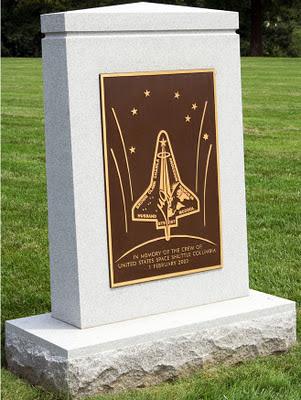
Shuttle Columbia Memorial
Columbia Memorial, Arlington National Cemetery

Please take a moment of silence today to remember all those pioneers who have given their lives to science and space exploration. See Pillownaut.com for a complete list of all fallen astronauts and cosmonauts.

Thursday, January 19, 2012

Astronaut in the NASA Ward

Share

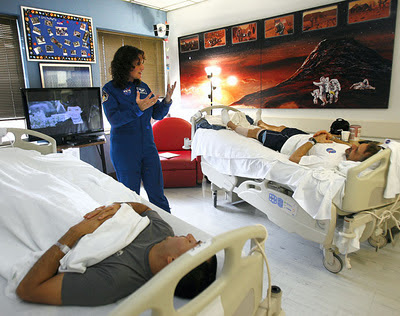
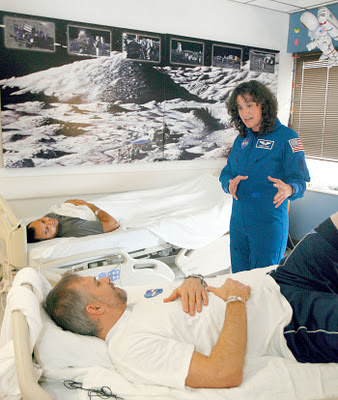
Dr. Serena M. Auñón (35) of League City, TX was one of the two flight doctors chosen in the last astronaut selection. The Galveston Daily News reported on her visit to the NASA ward at the University of Texas Medical Branch, where she visited with study subjects in the current flight simulation programs.

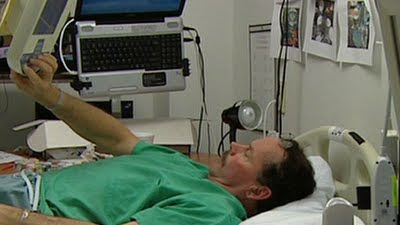
Participants David Sarmiento and William Widener were in the long-term bed-rest study in the Flight Analog Research Unit at the time, in the now-famed Head-Down Tilt. In this position, participants show physiologic changes similar to those expressed by astronauts in microgravity. Changes in blood pressure and blood plasma volume result when the heart works about 15-20% less, and of course the creation of bone mineral density in the body also changes.

Human Test Subjects Needed
Sarmiento, 35, a commercial diver from Maryland &
Widener, 42, a fitness instructor from North Carolina

Like many subjects before them, the newest recruits attest to a new appreciation of how astronauts cope with weightlessness on their missions, as they find the studies are both physically and mentally demanding. Said one new participant: "I have a greater understanding of the physical effects of zero gravity. It's not just floating. It affects your whole body."

Astronaut Auñón, who completed residencies in both internal medicine and aerospace medicine at UTMB, so she knows a little something about the value of the NASA studies:
"We learn a tremendous amount from astronauts and their experiences aboard the Space Station. Those numbers are small and a larger body of evidence is needed. Head-down bed rest is one of our best analogues. The women and men who volunteer to take part as subjects in the bed rest facility provide invaluable data regarding physiological changes in a 'weightless' environment."

It's also an amazing way to do your part for space exploration, and everything scientists learn about human bodies in these studies gets us closer to planet Mars. Still, it must have been nice to get some personal recognition from an astronaut! They of all people know how much sacrifice can be involved in the stringent protocols. Testing yourself in the way astronauts train? Not for sissies!

NASA Clinical Trials
Other articles in the past few months regarding the studies have been very positive! We are truly seeing gratifying results in term of how space studies further our knowledge of how to live in micro-gravity, but also the practical benefits that can be applied to life on Earth:

July 13, 2011: Sentara Offers NASA-Developed Treadmill For Therapy
Space study treadmill used for orthopedic patients, senior rehabilitation conditioning, military members endurance and strengthening, etc.

November 29, 2011: Bed Rest Study Provides Invaluable Data for NASA
Information on exercise, muscles, bones and hearts to keep astronauts healthier.

December 21, 2011: From Here To Maternity
Months in bed to stop miscarriage? Practical considerations to involuntary bedrest.

January 2012: Rehab: Space Technology Helping to Heal & Strengthen
Space mission technology adapted and approved by the FDA for use in injury rehabilitation, Neuro-Muscular control, pre- and post- joint replacement surgery conditioning and athletic training.

These have also all been added to the archive of Articles on Pillownaut.com.

Tuesday, January 17, 2012

More Human Test Subjects Needed!

Share

With 2012 now in full swing, it's worth mentioning that Johnson Space Center personnel are screening participants for this year's ongoing studies.

Most of my wonderful and supportive longtime readers know how to become a paid volunteer for NASA... and so many have applied and passed the modified Air Force Class III physical, it's been my great pleasure to speak with some of the recent participants in the current studies ad they are accepted!

NASA Clinical Studies
Female subjects are especially in high demand right now, simply because, in general, fewer females apply . The data on female participants is always the lighter level of the field. We just desperately need to put more women in space!

So if you know anyone who is eligible, or just in such good shape you think they might want to have a go at the NASA audition, tell me or tell them! The JSC website is continually accepting applications… and of course I should also mention that this being an astronaut screening year, completing a NASA Flight Simulation Study would look great on your astronaut application as well.

Amazingly, I still get questions about the very first study I did back in 2008, because when people go seeking information about the simulations, they more often than not run across my blog. I'm always happy to speak to people about the programs or the screening process, though it's a shame I spend the most time clearing up all the common misconceptions at first.

Screening Process for Paid NASA Studies

This year, scientists will be researching the benefits of exercise to counteract space-related heart, lung, muscle and bone issues, using various new equipment and compression garments.

As in past studies, they take baseline measurements at the beginning, try varying length of bedrest protocols (with or without stints on the "space station treadmill") and compare to resulting measurements at the end.

Two active studies are accepting applications right now, though others of differing lengths will become available soon. Come join the CFT or the ACG in 2012!

Tuesday, August 2, 2011

NASA Spaceflight Simulations Website

Share

The web site has been updated! The web site has been updated! You're not hallucinating if you detect an element of Reverse Chicken Little Syndrome in that exclamation. Every web update means brand new research studies are being conducted at the NASA Human Test Subject Facility (HTSF) at Johnson Space Center! Always welcome news.

While manned spaceflight has taken a downturn, NASA does still have an 18 billion dollar budget dedicated to various missions and wide ranges of research projects. The flight simulations are definitely a worthy area of research! And these are the kinds where you don't need to be a rocket scientist -- you just need to be healthy and motivated, and you can help your space program.

NASA Bedrest Studies
I've participated in three of these studies, and had great fun performing all the tests and procedures, so I always encourage others to check out the forms and throw their hat in the ring if they think they meet the health standards.

The screening process has remained the same over the years, and it's not always easy, but you are definitely in an exclusive group of specimens if you can pull it off! Do you know a fitness-minded person you can refer? Help NASA find some folks who can participate!

Especially now, in light of how many more scientists are studying How A Long Mission To Mars Could Kill You. In the short term, most of the studies are between 2 weeks and a few months, so there is no harm to be had. But the results of the data over time and in many individuals help NASA keep astronauts healthier.

University of Texas Medical Branch
Many of the programs, while seeking counter-measures for space flight, also benefit people with conditions here on earth, such as cardio-pulmonary and osteoporosis patients, just to name a few. (Hey, Rogaine and Viagra were both discovered by testing potential blood pressure medicines. So, there you go.)

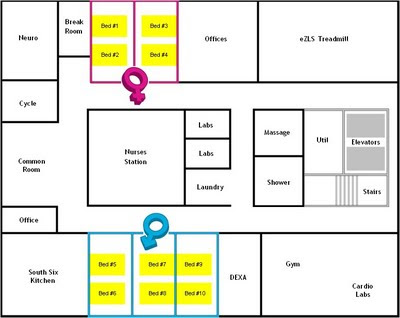
Want to see what your made of and help humanity get to Mars? Seriously, apply to the flight sim program! When the first foot steps on the red planet, you will be able to say that you helped make that happen. Do you know someone who is fit, adventurous and willing? Encourage them to apply, too. Above is the schematic of the NASA facility where all the testing takes place... help NASA fill the rooms :)

Monday, May 30, 2011

Who knew lying down was such hard work?

Share

While I'm never enamored of how news can tend to trivialize the research experience and all it entails in terms of space flight simulation, I almost always get over it long enough to enjoy any press for the NASA medical studies! The most recent film broke new ground!

For all the new readers who joined me in 2010-11, I started this whole social media bit by accident after doing two bedrest studies myself, one in head-down tilt micro-gravity, and one in up-tilt lunar gravity. I documented my experiences of playing fake Astro-NOT, while scientists tested their various contraptions, or examined my bones and muscles for changes.

Gary Conway of Seattle
Now, however, a new component has been added to the current studies. Participants in iRATS and other upcoming campaigns get to use the eZLS or enhanced Zero-Gravity Locomotion Simulator, a wall-mounted treadmill that simulates space exercise. Of course, astronauts exercise for many hours per day while in space, but it's still a challenge to maintain bone density and muscle tone in weightlessness. Gadgets such as these on Earth help fine tune new possibilities for the space station.

This television broadcast on the ABC nightly news featured the head project scientist Ronita Cromwell, whom I've interviewed before about these amazing studies; our old friend and physical trainer Brent; some ISS footage of exercise machines versus those used on Earth –- all in all, a great range of what the projects are all about.


WFAA Dallas Channel 8 Story by David Schecter
Featuring Gary Conway (Seattle) and Michael Asaf (Houston)

But... "Mad Science treadmill"?? Well, I've heard worse descriptions. Realism is more beneficial to folks who hope to apply for a chance to be part of these programs, designed to result in, as they said, "Healthier astronauts through rigorous scientific research." Well said.

But was it truly a "mentally and physically grueling" study? Not really. I took those same horizontal showers for two months myself, and they were not that difficult. Humans are highly adaptable creatures; you deal with it, you practice, you become adept, and it becomes routine. Every day isn't a rainbow, but neither is every task so grinding that you cannot function happily; like most things in life, the truth is somewhere in between.

Michael Asaf of Houston
I've seen people make remarks about side effects that aren't true either; when the article accompanying this film was released online, someone commented that "you wouldn't even be able to walk afterward." Not so. Walking was stiff and achy for awhile, but healing is a rather swift affair. With regular exercise, I was back up to running daily miles in less than a month!

If you asked either of these chaps after their study stints... they'd very likely say the same. In fact, Gary and Michael, feel free to weigh in around August or so to back me up, LOL!

Friday, February 4, 2011

Astro-NOTS

Share
Astro-NOTS Emblem
No astronauts available for Shuttle simulator testing? Hey, just catch a flight controller by the toe! They can use anyone who fits the suit and knows the drill (although, those two requirements aren't as simple as they sound)...

You may remember Liz Warren from my past post about folks who work in the Mission Control Center (MCC) in Houston, and she was also recently featured on the NASA Education site by my old friend The Other Heather. Sometimes we all just link in circles!

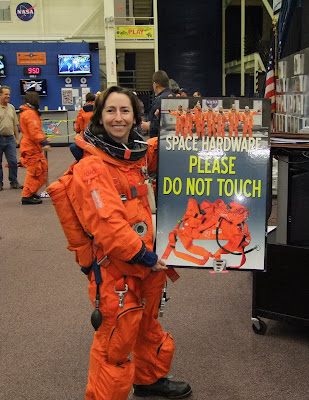
Scientist Liz WarrenThe team that straps the astronauts into the Space Shuttle prior to launch are called "The Closeout Crew", and they undergo training sessions at Johnson Space Center in the Space Vehicle Mock-up Facility, just like the astronauts.

Liz recently joined them in the SVMF for Closeout Crew Training, where she suited up to be strapped into one of the Shuttle Orbiter mock-ups -- most specifically, the CCT or Crew Compartment Trainer... that would be the one pointed skyward for these exercises.

NASA Spacesuits
Have you ever laid your clothes out on the bed the night before you wear them? It must be great to be an astronaut and have a suit specialist do it for you -- because truly, just getting into a space suit and wearing it all day is enough hard work for one body.

That's CDR Spasmunkey to you!
Wouldn't we all love to sit in this chair for a drill! I'd sure try it, any day. Ingress, pretty easy... and as for Egress? "You basically pretend like you are incapacitated and they drag you out of the orbiter." Sounds fun. And check out who else showed up for Astro-NOT duty one day:

Stephen ColbertSpecial thanks to Flight Controllers Sarah Saroy, Liz Warren and astronaut trainer Michael Grabois (in that order through the post!) for these great images. Is it possible to have too much fun?!

Monday, December 6, 2010

Fry's Space Station

Share

Today, I'm uncharacteristically featuring a "tourist attraction" of sorts near the NASA Johnson Space Center… though I wonder how many of visitors to Houston find this gem?

Technically, it's a retail store masquerading as a nerd mecca, and I'm not promoting anything it sells in particular, but it's worth a visit. The exterior is made to look like the International Space Station, and the interior features a giant scale replica of the ISS -- not accurate down to each specific piece, but darned close, down to the mechanical CanadArms!

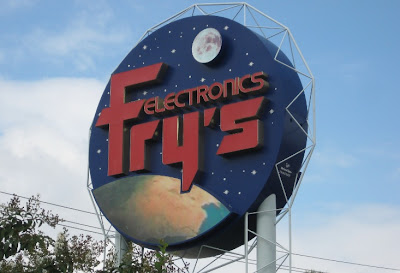
Fry's Electronics in Webster (Southeast of Houston)
The South Houston Store: ISS Theme

Fry's Electronics, Inc. was founded in Silicon Valley to supply hi-tech professionals, and now has 34 stores in nine states, ranging from 50,000 to 180,000 square feet! Each store carries its own unique theme, so they are really fun parks in a sense. Stores across the USA have Aztec, Egyptian, Roman, Mayan, Tahitian and Wild West themes… also, would you believe Atlantis and Alice in Wonderland? Of course, the Anaheim store is worth a mention here, since their theme is the NASA flight deck of Space Shuttle Endeavor, complete with launches on huge TV screens (shown on the weekends).

The store nearest Space Center Houston depicts the history of space exploration in murals and artifacts, along with the "true-to-life-sized" floating habitat. No small feat, since the ISS is now roughly equal to the length of a football field!

Fry's ISS Replica
Click to see the entire gallery...

The above photo is a view of the Russian Orbital Segment of the International Space Station, as seen from the Software section of the store. Full-scale mockups (from left to right) of the Soyuz capsule, the Zvezda ("Star") module, and the Zarya ("Dawn") module can be seen, beneath the actual-sized solar arrays.

I walked all around the store, photographing the space-themed paintings and structures, and uploaded all the results to the Houston gallery in my Picasa Albums… where you can also see the various spacecrafts, tethered space-walkers, the Japanese Kibo module, the American Unity (node 1), the Destiny Lab and all the various truss segments... some of which have been "tunneled out" to accommodate products or seating areas.

Such a novelty! I should have taken video. If anyone visits the space themed Burbank or Anaheim stores, I'd love to see your photos, too... email me!

Friday, August 13, 2010

Laura's Mission Patch

Share

On display now at Johnson Space Center's Rocket Park are various creative works (moonscapes, rocket designs, space program emblems, etc.) from a southern Texan summer camp, sponsored by the University of Houston at Clear Lake Children's Art Program.

I'm always so pleased when JSC sponsors these sorts of attractions, inviting youngsters to learn about space exploration and space science. One particular young lady contacted me to share her mission patch with me, which I just love! She designed one of the few that listed her "Crew members" names around the edges… so realistic!

Laura at Johnson Space Center
Miss Laura at Johnson Space Center

I added 7-year-old Laura's photographs to my Johnson Space Center album in my Picasa galleries, definitely check out the great close-ups! I also interviewed Laura about her experiences:

Heather: What can you tell us about your experiences at camp this summer?
Laura: Our camp theme was "The Art of Space" and it was nice. We did a lot of fun space activities. One time we even painted a picture of the moon. I drew mine with the moon buggy.

The Art of Space
Heather: Tell us about the theme of your mission patch…
Laura: The patch shows the space station, a comet and the space shuttle. There is a big orange star in the background and some names of the people on the space shuttle go around the patch. The names are friends, pets, cousins and some people I met over summer vacation. I used a purple border because it is one of my favorite colors, and the 13 is the shuttle number.

Mission Patch
Heather: Are you an artist all the time, or was this just a summer camp assignment for you?
Laura: Art is one of my favorite hobbies that I do because I think it is a good way to express your feelings.

Wonderful! I hope you will continue to express yourself through your beautiful artistic creations, and thank you so much for being willing to share with my readers. Folks, if you are touristing around Houston this summer, be sure to go see these displays around the Saturn V rocket!

Thursday, July 8, 2010

Shuttle Shuffle

Share

Did anyone think this post had the same two words in the title? Shuttle Shuttle. Shuffle Shuffle. Shuttle Shuffle. Glance quickly, they looks almost the same ;)

Anyway. With my apologies to non-Texans, or even just non-Houstonians, who may be supporting any of the current fundraisers in New York City, Austin, Seattle, Clinton, or Chicago to bring Shuttles to their areas... but today, I've joined and also choose to highlight the cause that webmasters from Space Center Houston have brought to the Lonestar public!

Bring the Shuttle To Houston
As I've discussed before, NASA is seeking permanent homes for the soon-to-be retired Shuttle fleet.

At last mention, there were 21 solid bids for four Shuttles (Enterprise, Atlantis, Discovery & Endeavour), with the only certainty being that Shuttle Discovery would be sent to the Smithsonian National Air and Space Museum.

Houston, according to the coalition of letter-writing, fund-raising supporters, should definitely be the keeper of one of these great national treasures, as detailed by the website: Bring The Shuttle Home.

Their first page is already humorously out-of-date, since they mention the program ending in 2010. With NASA's newest change to the official Launch Schedule, the Shuttle program is now due to end in early 2011.

From the first Shuttle launch in April 1981 to March 2011 when Shuttle Endeavour makes her final landing, the American Space Shuttle Program will have spanned one-month-under 30 years!

WHY HOUSTON?
Agreed.

I've also updated (again!) my "Final Five Shuttle Missions" post and moved it to the space below this post for anyone who wants to check the new details.

If you are part of another bring-the-Shuttle-to-my-city effort, and choose not to participate in the Houston effort, I still say, best of luck! Regardless of where they make their final appearances, we all know that many of us will travel wherever necessary to see them once they are "parked" at their new permanent homes!

An aside –
The last flight is certainly fraught with emotion from every corner, but you'd never know it from this view of the STS-134 astronauts, who posed for perhaps the most laid back official crew photo I've ever seen! (Seriously, why didn't they just hand them cigars and martinis??)

Saturday, April 24, 2010

Happy 20th Birthday Hubble!

Share

On April 24, 1990, STS-31 Space Shuttle Discovery lifted off on its mission to deploy the Hubble Space Telescope (HST) into orbit. This amazing astronomical observatory, a joint NASA-ESA project, has now been orbiting above Earth's atmosphere and observing celestial bodies for two solid decades!

Hubble Space Telescope 20th Anniversary
Next year, she can have a beer.

Named after astronomer Edwin P. Hubble (1889-1953), the HST is capable of taking extremely sharp images in ultraviolet, visible and near-infrared wavelengths, and many of its captures have led to incredible astrophysical breakthroughs, not the least of which is accurately determining the rate of expansion of the universe. In our own neighborhood, HST taught us a great deal about TNOs, dwarf planets and KBOs; and the very farthest objects seen, in Hubble Ultra Deep Field, or HUDF, are galaxies well over 12 billion light years away!!

To date, Hubble has observed more than 30,000 celestial targets and amassed more than a half-million pictures in its archive!

Last May, the fifth and final service mission, STS-125 Atlantis, captured Hubble to replace gyroscopes, computers, and scientific instruments over a whopping 37 hours of space walks! With that marathon upgrade, they made the telescope 100 times more powerful than when it launched. Human hands (or rather spacesuit gloves) won't touch it again, but hopefully it will last at least another decade.

Hubble Mock-up at NASA Johnson
Click to embiggen

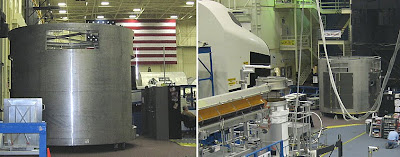
Here are some personal photos I took of the Hubble model in the Space Vehicle Mockup Facility at Johnson Space Center, where astronauts train to work with the observatory. Check the size of that sucker! 44 feet long, and 14 feet in diameter! You can hold a decent party in there, but I'm wondering if they'll sell it to the Texas State Fair now, to be used as a dunking booth.

In other news, NASA Missions released this gorgeous "Hubble 20th Anniversary Image" of Mystic Mountain in the Carina Nebula. So stunning!!

And, the Houston Chronicle interviewed NASA Astronomer and astronaut Steven Hawley, who served on STS-31's original Hubble deployment crew: "We were very conscious about not screwing it up." Ooh, bummer about that first mirror!

Hubble HST
Want to help astronomers sort out the many thousands of galaxies seen in a Hubble deep field observation? Go to Galaxy Zoo, the internet-based astronomy project where anyone can search and sort galaxies into categories (spiral, elliptical, and irregular) – a great learning experience combined with an effort to help astronomers study how galaxies relate to one another, providing overall clues that will help understand how they formed.

Friday, February 26, 2010

Triple Nerd Score!

Share

Finally got the last of my pictures formatted and uploaded to the Picasa Galleries, featuring the STS-130 Twitterati. And what a diverse crowd! Both my Follow and Follower categories on Twitter have doubled, thanks to this event, and I learned a great deal about how the Twitter options and sub-cultures work. Just what the newbie was hoping for.

Triple Nerd Score
The final part of our day was spent in the third and final Mission Control Center at JSC, where once again, John McCullough hosted the tweet crowd, and explained the finer points of MCC operations -- this time for the space station.

Apollo, Shuttle and ISS Mission Controls ... all in one afternoon, and so much activity in each center! Of course, ISS operations, unlike Shuttle missions, are 24 x 7 x 365. No rest for the orbiting!

The ISS room has been used for certain Shuttle operations in the past, and also for Skylab monitoring. Recently, this center was updated with a high-definition screen that provides a continual view into the International Space Station.


As McCullough spoke, astronauts Jeff Williams, TJ Creamer and George Zamka floated about in the background. We had just come from Shuttle MCC where we had heard their wake-up call, so they were all busy with morning tasks... and preparing for a call from President Barack Obama.

Accompanied by local school-children, Obama hooked in. Both the President and the astronauts passed phones and microphones about for a lively Q&A session -- which is now all over the web, but my clips have fun moments you won't see in the media uploaded to NASA.gov or released to the press. Granted, my informal filming isn't as steady, but I got some great crowd reaction... namely our group commenting and laughing when no astronaut wanted to answer one little girl's question!

International Space Station Mission Control
Pinch me, we got to watch this live from Mission Control!

Upon being handed the phone by the President, young Ruth of North Carolina asked, "What are some of the benefits of exploring space, as opposed to some of the other places on Earth?"

Around the 00:17 mark, you can hear us all crack up at the collective ISS response. Flight engineer and resident ISS guitarist Stephen "Stevie Ray" Robinson stepped up, and spoke about the human body's adaptability, how much we learn about how the body works in micro-gravity.

Having experienced some of these "adaptation" issues first-hand in my studies, I absolutely loved his answer!