Showing posts with label Medical Testing. Show all posts

Wednesday, May 15, 2019

Pillownaut Muse


After my follow-up DEXA Bone Scan last winter, and the nice article NASA's Human Research Program published about me and other past pillownauts in preparation for the new simulation protocols, I didn't expect much more to happen. It's been many years since my studies, and my blog is now only rarely updated.

I pondered perhaps "over-hauling" this site to be a #SciComm hub -- but honestly, I think there are so many great existing Science Communication sites, and I will work to amplify those. I figured I'd had my 15 minutes of fame, and decided to leave my old blog "as-is" as a historical record of how I lived through the unique experiences of Space Flight Simulations projects at NASA.

But. Every time I think I'll never hear about it again, another author or press outlet comes knocking. Last time it was Charles Wohlforth, and you should definitely still read his great book, "Beyond Earth: Our Path To a New Home in the Planet." My father was very impressed they devoted more space to me than to Neil Armstrong, so we may have to put that on my tombstone.

Along came Minute Number 16...

http://pillownaut.com/muse/muse.html


Muse Magazine asked to feature my studies and chose the same title, just spelled a bit differently! In "Beyawned Earth," writer Jen Mason compiled many of my past blog excerpts, a few older press turns, and many of my personal photographs from quarantine into an exceptional article designed to teach students about space flight and how it affects the "biological packages" that travel in spacecrafts.

Reading the finished product, I was definitely the happiest I've ever been with an interview. I've had TV and radio stations ask me exhaustingly inappropriate questions; sometimes even reputable outlets go for the sensationalist spin by giving the study clever little [incorrect] nicknames or dwelling on incidental details, like how we manage to shower during simulations, or that we cannot have sugar or caffeine or salt in quarantine. Sure, those things are challenging, but not life-threatening. They pale in the quest for good data.

http://pillownaut.com/muse/muse.html


However, MUSE Magazine hired a skilled and serious writer who truly nailed the science. After literally a decade of interviews in varied formats, and even being featured on the NASA website itself, this was really the first full-length article that revolved around MY OWN WORDS REGARDING MY OWN EXPERIENCES. This is the closest article to what I would have written myself. Maybe someday, some outlet will invite me to do so. Hope springs eternal.

I was gratified that this particular entity put the science in detailed and accurate terms, because it's directed at students and young adults potentially getting started in scholastic concentrations, and beginning to think about choosing majors.

Issue came out in March, and I was thrilled to receive copies by May, after I returned from my 6-week trek in Europe. You can order back issues of Muse Magazine yourself, or subscribe your teens, at Cricket Media.

My entire list of articles has been updated to include the last 2 years.

Friday, November 2, 2018

Space Travel Still Sucks


Even back when "Cracked.com" was all the rage with their irreverent lists, I wasn't always a fan of basic "Internet Top 10" lists. However, once in awhile -- and when my space blog was the hot new thing in the fledgling "Spacetweep" community -- something grabbed me that was worth commentary.

One particular article has remained on my mind through the years, and if you missed it, click graphic to read the:

6 Reasons Space Travel Will Always Suck

They weren't wrong. Space travel sucks. Space travel has always sucked. No matter what Elon Musk tries to spin, space travel will indeed continue to suck. Amazingly, most people still say they want to experience it... but upon speaking to them, it's clear that's because even people who truly support space agencies don't always know what it takes to survive off-Earth, and how sick you can become without the comforting gravity in which you evolved.

The saddest-but-truest statement starts out the article with a big bang: "We love movies about space, but are continually bored by actual space travel."

This is not what space travel will look like. Ever.
Yeah, we wish.

They drive home the point that even for far-off future generations, space travel may not meet our expectations, because...
6. There is No Sex in Space
5. It'll Be More Like a Submarine Than Star Trek
4. Life in Zero-Gravity is Horrible
3. There's Nothing to See
2. Getting Anywhere Interesting Means Never Going Home
1. In Space, On-Star Won't Do Shit For You


I read the entire article, desperately hoping I could disagree with it. Nope. They nailed it on every count.

Space Travel Will Make You Sick
Spacebarf: actually the least of your worries.

There is no way to reproduce, so we aren't going anywhere as a group. Cramped quarters, not a cruise ship. Weightlessness messes with your head, your balance, your blood, your muscles (including your heart) and your bones. I know all this first-hand from my spaceflight simulations, which I performed for Johnson Space Center between 2008-2010. At one point while adjusting to micro-gravity, even the fillings in my teeth hurt.

All that just to travel through 99.99% of blackness – perhaps to reach something that will be the last thing you ever see. That's if you make it at all, considering the massive dangers… because you're dead if even the slightest thing goes wrong.

Guys like Bas Lansdorp, Dennis Tito, Richard Branson, Jeff Bezos, Peter Diamandis, and especially Elon Musk just make me roll my eyes. It's all well and good to be rich and visionary about hardware, but they are selling a fantasy.  

I would give anything if even just one of them repeated my spaceflight simulations so that they actually understood what space flight can do to the human body.

They talk like we are leaving for Mars in a year or ten. We aren't. 

Space Travel Isn't All It's CRACKED Up To Be
Hey, suppose we go to all that trouble... and THIS
is the only thing on the other end of the journey?

Key concept: "Your life depends on your time aboard the starship being skull-crushingly boring."

So apparently, that's the funny part. The unfunny part? Underneath all the hyperbole, the message is clear: We all want the "future" of space travel to get here, but few truly understand the reality of what it takes to get us there. We have to go through many, many downers before we get to the payoff.

Why is all of this on my mind? Once upon a time, I put my body and brain on the line for science. As an astronaut analog, I spent more time in contraptions simulating micro-gravity than most astronauts have spent in actual orbit. The longest any astronauts spent on the Moon was on the Apollo 17 mission, where Gene Cernan and Jack Schmitt were on the lunar surface for 4 days. My lunar study hardware put me in 6% gravity for 7 days. 

I have a 10-year bone density DEXA scan coming up. I'll see if there were any lasting effects from my participation in the study of how leaving Earth gravity affects humans long term.


Saturday, July 13, 2013

A Festival of Flight Surgeons

Share

Longtime reader  Lisleman of A Few Clowns Short asks:
"I was wondering about health issues. Would you say that astronauts are the most monitored humans around? Do they monitor them constantly while in the ISS? Lastly, have the doctors ever prevented some illness because they noticed a warning in the monitored levels of an astronaut?"

I had a wild guess that individuals in prison might be the "most monitored", but this is an interesting avenue, both medically and operationally. I had some inklings, but called upon some friends in Mission Control to point me in the right direction.


NASA physiologist Liz Warren @Spasmunkey (also featured in my Workers At NASA section) says:
Prior to an ISS flight, I'd have to agree astronauts are some of the most medically monitored people on the planet. Millions of dollars are invested in each astronaut during training, and we ensure they don't become ill and jeopardize the mission.

During flight, astronauts have weekly meetings with their flight surgeons and psychiatrists. In terms of medical monitoring IN-FLIGHT, there actually isn't much. Exercise is monitored via a heart rate monitor. There is a portable blood analyzer on-orbit for routine analysis. Blood and urine samples gathered for research are frozen and analyzed on the ground after the crewmember goes home.

I am not aware (due to medical privacy) of any medical intervention that prevented someone from getting sick on-orbit. However, one Russian mission was aborted prematurely due to a crewmember developing a medical issue in-flight.

NASA Flight Surgeons
Dr. Jennifer Law, Flight-Surgeon, says:
 I can think of intensive care unit patients that are more closely monitored with invasive blood pressure monitors, heart rate monitors, temperature probes, and so on. Astronauts don't get this kind of medical scrutiny when they're on orbit. Prisoners may be monitored all the time in terms of their location and activity, but I don't think anyone keeps track of their vital signs and other physiological parameters.

Modern astronauts aren't monitored all the time like astronauts in the early space days were, and don't wear electrodes 24/7. They get routine physicals and are monitored during activities like exercise, EVA, and certain experiments, but the rest of the time they are not monitored per se, though like Liz said they do chat with their crew surgeon regularly so that any budding issues are addressed early.

As for medical interventions that prevent astronauts from getting sick on-orbit, we tend to focus on what we call primary prevention, e.g., astronaut selection, health maintenance, crew quarantine prior to flight, and regular exams. The irony is that when we do our jobs right, none of the astronauts get sick and we have nothing to show for it! Though I do know arrhythmias have been noted in space.


 Flight Controller Mike Allyn @FTCMike says:
Jen brings up a good point as to context of the word "monitored". I jumped to medical because of the question about preventing illness, but I can speak to monitoring the crew on a non-medical basis. Through various means of telemetry monitoring, MCC can often extrapolate what the crew is up to. Power draw always increases in the Service module when the crew starts turning on lights. We can also tell if there are crewmembers awake from the control torques on the vehicle. Rate measurements are so accurate coming from the US Rate Gyro Assemblies (RGA's) and the Russian Givus that the commands to control the torque of the Control Moment Gyro's (CMG's) react slightly to the crew bouncing off the walls.

We protect the crew's sleep and off duty time as much as we can. Being able to tell when they are awake is useful for when we need to speak to them at the earliest convenience, but perhaps not worth waking them. Another way to tell if a crew member is up and moving is by smoke detector scatter measurements. Anytime there is a tiny bit of dust detected by the many smoke detectors, they register increased scatter. One way this increases is by crewmembers working and moving in close proximity to them, which increases airflow and kicks up dust.

So there you have it, Lisleman! Hope that answers all your questions -- and very special thanks to our friendly neighborhood NASA MCC heroes for their time and expertise!

Thursday, June 27, 2013

NASA Bedrest Double Duty

Share

Following updates on the European Space Agency flight simulations, I'm happy to say I see new press about JSC sims too! Rooms in the NASA facility are full again!

Justin Ciaciura of Conroe, Texas completed a 105-day study. 70 days were spent tilted, so he beat my time by a whopping 15 days. I have so much admiration for this dedicated man, who epitomizes the doctors' assurances about the program quality: "We do our best to identify people who are motivated to participate in the study. People don't do this for the money; they have a higher commitment." 

NASA Bed Rest Study

 The money... is... freaking awesome, however: $5,000 per month, which is great if you've just graduated, can't find a job, are between jobs, or just plain love space exploration and want to add to the databanks of scientific and medical knowledge!

So says Justin, "The novelty wears off pretty quick. This is hard work. But knowing you're actually making a contribution to NASA’s space program is very rewarding." 

Why lying down? Well, certain things that happen to the body in the micro-gravity of space also happen identically when one lies down for extended periods. Bones, as measured by DEXA Scans, can lose mineral density and mass, plasma volume can decrease, heart and surrounding muscles can change, and your sense of balance and depth perception, as measured by posturography, can go... what's the technical term? Totally wonky.

These studies seek countermeasures to keep astronauts more healthy, with a mind to reaching Mars someday. That will take 2 years in space, and we have yet to work our astronauts up to 1 year! Adapting to the weightless environment is no easy task. Later, re-adapting to Earth gravity can be equally demanding. So, while grounded from manned flight, these studies are crucial to many space agencies.

NASA Research Studies

Incredibly, while googling for the specs on the newest studies, I found yet another subject in the press, compliments of podcasters Mike Danforth and Ian Chillag. Their Tumblr archive of "How To Do Everything" contains a fantastic recording of "70 Days in Bed with Howard". 

Howard survived the 105-day program at NASA which required 70 days of spaceflight simulation! During his time "play astronaut", Mike & Ian thrice featured him in their podcasts: day 21 of tilt, then day 32, and finally day 90, once he "returned to Earth" and was rehabilitating his muscles.

Many questions were predictable: "So, are you starting to go crazy?!" -- and I loved Howard's answers. Like him, I'm a very active person, so it's difficult to be restricted, but many of us are willing to do it for the sake of future space exploration. Howard described his typical days, with all the little things one must cope with in studies, both good and bad.

Further along in the podcast, NASA principal investigator Dr. Ronita Cromwell weighed in with scientific descriptions of things the studies explore about bone, muscle, and bodily fluids.

NASA Vertical Treadmill
 
Howard and Dr. Cromwell list behavioral and medical tests  -- many of which are analogs of everything done to astronauts before, during, and after spaceflight. I found the third segment the most interesting, where Howard describes returning to normal gravity, noting things the body must "re-learn" in order to walk, resume daily tasks, drive a car, etc. Adaptation in both directions can be eye-opening!

Contrary to some web forum myths about these studies, neither of the men were half-dead, depressed, crippled or compromised for life. I did three of these programs, and am robustly healthy. Pregnant women go on bedrest, sometimes for months, and do not suffer for life. So, don't believe fearmongering on the internet; read stories like these about people who have actually completed them.

Only active, healthy people with strong bones and great blood pressure are selected in the first place, and we are HIGHLY motivated to get back into shape again afterwards. Every participant gets us one step closer to Mars!

Monday, June 24, 2013

Pillownauts Across The Pond


Vladyslav Atavin is back!  Last year, in his blog, Astronaut of the Pillow, Vlad was kind enough to share his experiences while participating in the European Space Agency Flight Simulations. Their French, Irish, Austrian, German, and Italian scientists came together to conduct tests similar to those I underwent at NASA.

http://astronautesurloreiller.blogspot.com/
Oh, the things we do for science!

Last December, Vlad wrote about the first phase of their experiments in French.  In April, he completed phase two, and wrote about his medical tests in English. The third phase, set for autumn of 2013, will be recorded in Russian. FlightSim sure is turning into an international endeavour!

There are twelve individuals in their ongoing study: 10 Frenchmen, 1 Spaniard, and 1 Russian.

The entire program is ambitious in size and scope:
Four pillownauts will spend 21 days at a head-down tilt while engaging in recumbent weight-training and a vibrating exercise contraption. Another foursome will engage in the same, but add whey protein to their diets to see if there is any difference in muscle building. A final four will spend the same amount of time in bed, but lacking any of these attempts at "countermeasures."  Throughout the program, they will undergo various tests and experiments.

2011: the year the term PILLOWNAUT crossed the pond

These studies, with Mars in mind as a destination, are designed to find countermeasures to keep astronauts and cosmonauts healthier on long-duration missions. Vlad's detailed journal includes descriptions of program phases, photographs of the study facility, lists of his requirements and protocols, medical tests, and how the subjects spend their leisure time.

Many protocols are identical to those used at NASA: -6 degree tilt, food regimen, calculated fluid intake, blood tests and urinalysis, plasma volume measurements, DEXA bone scans, and neurological balance tests; and also minor details, such as having to shave certain body areas to accommodate electrodes, and having massages to prevent thrombosis.

Poor Vlad had to shave his hand, wrist, and leg for various tests, including multiple biopsies. So dedicated! He still looks great, in spite of it all! Rehab and exercise after FlightSim is no easy matter, but he met all the challenges...


Reading his daily updates brought back so many memories of my own experiences with the many tests: Posturography, Isometric muscle activities and of course, the dreaded Tilt Tests.  We did so many of the same things! (With slight differences in style and equipment.) It's been fun to compare my logs to his in terms of his work in Toulouse, France -- and my work in Galveston, Texas.

Honestly though, he does something a LOT that I never did in any of my Flight Simulation programs: he constantly gets folks to photograph him shirtless. Ladies, enjoy!

If you think you might be interested in participating in such paid studies, they tend to be very lucrative for healthy volunteers -- and now they are going on across three continents!  I used to get many international questions, and always had to break it to people that NASA only takes US citizens. But the Russian and European space agencies will now be conducting analog FlightSims, too.

Keep your eyes peeled for application promotions -- and of course, whenever I hear of a new study that is recruiting, you will see it here on my blog!


Wednesday, February 20, 2013

The Ultimate Mir Man

Share

While we're on the subject of so much fascinating news from Russia, it reminded me of a recent conversation I had with another space enthusiast; it was rather embarrassing when neither of us could recall the Russian gent who clocked the most time in space on a single mission.  It was right on the tip of our middle-aged tongues, but we came up short!

Interesting how we remember the FIRST guy in space, the FIRST on the Moon... but even astronaut groupies draw blanks at the continually changing record holders for spacewalks, multiple missions, and so on.  This week's events reminded me, and I thought this cosmonaut was worth highlighting.

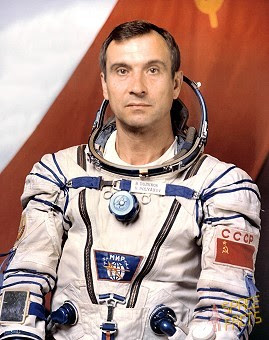
Valeri Polyakov
Валерий Владимирович Поляков

The researcher and "Doctor Cosmonaut" of the Tula Oblast, Valeri Vladimirovich, was born with the surname Korshunov, but as a teen, changed his name to Polyakov when his step-father adopted him.  A graduate of the Moscow Medical Institute, he specialized in astronautics medicine at the Institute of Medical and Biological Problems (IMBP - chaps who just did the Mars500!) and was selected by the Soviet Space Program as a cosmonaut in the IMBP-1 group in 1972.

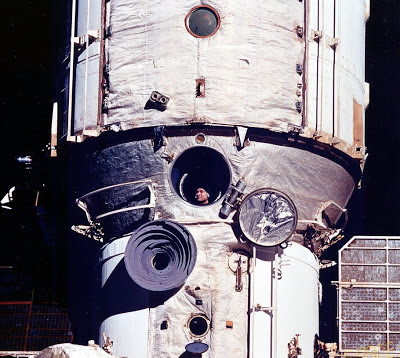
From August 1988 to April 1989, Valeri Polyakov worked on the Mir Space Station for missions EO3 and EO4, clocking 241 days.  Interestingly, part of his job as flight surgeon was to determine how long-duration spaceflight affected the human body.  He would certainly get to know that better than anyone, first hand!

Valeriy Polyakov

Years later, he returned to Mir, and stayed in orbit for more than 14 months, between January 1994 and March 1995! Wow.  His series of missions spanned Mir EO15, 16 and 17.  He orbited planet Earth 7,075 times and traveled 186,887,000 miles.

Across his two extended missions, he spent over 678 days in space. His records for overall time in space and greatest speed in space were both later overtaken by other cosmonauts, Sergei Krikalev and Sergei Avdeyev, but today, Valeri still holds the record for the most consecutive days in space at 437 days!

Polyakov retired from the cosmonaut corps in 1995 and returned to his assignment (begun in 1989) as Deputy Director of IMBP until 1997, when he became a professor at International Academy of Astronautics.  He is currently the Deputy Director of the Ministry of Public Health in Moscow, where he oversees the medical aspects of long-duration space missions. And who better?

Valeri Polyakov

He tends to offer pretty replies in official interviews, insisting that his safe and healthy return from space shows that "it is possible to preserve your physical and psychological health throughout a mission similar in length to a flight to Mars and back." (NY Times, 2009).

However, data collected from the Mars500 would seem to suggest otherwise. If anything, time spans of over a year are easily proving that even carefully selected, high-performance and motivated crews put into isolation are prone to sleep disturbances, episodic depression, and culturally-driven behavioral challenges.

Many myths follow this record-breaker, largely because he is seen in public very rarely, and when he is filmed for space documentaries (filmmaker Dana Ranga referred to him as "fragile") for sessions for the RFSA these days (such as his congratulatory video to the Mars500 crew), he is always sitting.


In the precious few instances where he is photographed standing, has he been propped up? Can he walk? Is he crippled?  Why does he not stride to podiums at state events of museum openings like Tereshkova, or other fellow cosmonauts of the Mir era?

Why won't Roskosmos make public his 50-some-odd medical publications, based on his experiments in space? What did long duration spaceflight truly to do this man's body and mind, and why is data on that subject so very hard to find?

I hate to leave any blog article hanging on a question mark, but when the it comes to Polyakov, question marks are all I am left with! And we may not know the truth until he passes away...

Friday, February 15, 2013

Snurk Beddengoed!

Share

You read right... Snurk Beddenoged! Or, in Dutch, Snoring Bedding. This is the very first company to release a genuine, literal PILLOWNAUT product! Behold:

Astronaut bedsheets

 It's all too magical. Designed for single beds with children in mind, the new Astronaut bed sheet and pillow case set will be sold in March 2013, but space enthusiasts can pre-order now for €59,95 (about 80 American dollars or 145 Yen) and inspire your youngsters with, as Gizmodo calls this, the one fantasy job that always manages to beat out professional athlete and ninja!

A simple drawing of a space suit costume? Heck no, this amazingly detailed illustration on cotton & velour was a genuine space suit, photographed at the Space Expo Museum in Noordwijk, The Netherlands.

After March, you can also check out any stores worldwide that sell Snurk products.

Snurk Beddengoed

We definitely should have had these in the NASA ward during the bedrest studies!  These would be perfect for the beds at the Galveston unit where Flight Analogs to the Astronauts perform their medical tests.

If these sell, I am sure Snurk might consider offering double, Queen or King sets for space fans!  You can use their contact page to suggest such sets, as I have.
 
Designed in Holland and manufactured in Portugal, their collection of amusing comfort oddities also includes the Target Squirrel, knitted Granny Cushions,the Yawn collection, the White Bra and... Bob. Yeah, just Bob.

Monday, January 28, 2013

NASA's Dr. Duane Graveline

Share

I'd like to extend a vast and hearty thank you to everyone who tuned into The Space Show this past Friday, when the esteemed Dr. Livingston invited me to co-host a broadcast where we interviewed the equally-esteemed former NASA astronaut, Dr. Duane Graveline.

Space Show Memoirs
NASA Group #4: "The Scientists" (Duane in top center)

And what a treat! We jumped right in with questions about his first interest in bedrest as an Air Force intern at the famed Walter Reed Army Hospital, where he first seized upon going beyond regular medical corps duties to become a flight surgeon in the mid-1950s, when concerns about "zero-gravity" on future space travelers had just begun.

The good doctor remembered clearly how he selected 10 young men in 1957, and arranged for them to have nothing to do for two weeks but lay in bed at Randolph Air Force Base Hospital. Sounds easy, right? The Air Force guys initially thought that was the world on a platter!  Dr. G conducted baseline tests, including tilt table tests & stress tests, and took measurements of muscle function and blood volume. Amazingly, as I know from my own experiences, these are still staples of all weightlessness simulation programs, 56 years later! They evolved to use different techniques in many cases, but the examination of these measures before and after spaceflight will always be crucial physiological markers.

But then, the troubles began, said Duane with a laugh, and his healthy sense of humor shines through. The subjects wanted to read in bed, they wanted to shave, they wanted to feed themselves... ah, the nerve! LOL!  Turns out, bedrest isn't so simple -- allowances do need to be made in terms of documentting the de-conditioning of space flight, but still ensuring your testers do not grow bored or stir crazy.  What's a space scientist to do?

Astronaut Hall of Fame
Astronaut Hall of Fame, Florida

Determined to find something better, Graveline began water immersion experiments in the AeroMed Lab at Wright-Patterson Air Force Base, or as he termed it, a "heaven" for any research-oriented person.  His demands were simple: 9x9x8 rooms full of water with viewing ports, with water maintained at a constant 95 degree temperature. Not too much to ask, right?  He designed a suit for use in the tank and then -- as a former test volunteer, I love this part -- he underwent a solid week of water immersion himself!

If you tune into the Space Show recoding in the archives for no other reason, listen for his experiences in the tank -- how he survived on liquids, and the testing protocols used.  An explosion of interest followed, landing him on the "Today" show, and led to his being given whole series of tests where he worked with both mice and humans in different micro-gravity simulations.

The most detailed of the sims involved specially designed pressure helmets and more complex underwater garments.  And unlike bedrest where immobility is crucial, so as not to bias the data with any influence of gravity, the aquanauts were freer to read books, play games and enjoy their unique environment while Dr. Graveline conducted electrocardiograms or recorded brain waves.

Duane Graveline SpaceDoc Memoirs
LIFE Magazine Centerfold, 1959

See that dude in the picture above? Imagine floating that way for 7 days straight! That's Dr. G to the right, looking into the custom water tank. It would many years before NASA had their own similar facilities, but both water immersion and bedrest techniques would continue to be developed over the coming decades, yielding valuable data about counter-measures in space... and also vital information as to how astronauts are best rehabilitated physically when they finally return to Earth's gravity. As a result, we are able to keep our space workers living in space for longer periods of time -- but without the potential lifelong risks that many suffered in the days of the Mir space station.

I think my favorite part was where LIFE Magazine called BioAstronautics a "bizarre new science".  Well, I guess now it's a bizarre middle-aged science.

To listen to the archived broadcast, please see Dr. David Livingston's web site for THE SPACE SHOW.

Tuesday, January 22, 2013

The Bed Pilot Pioneer

Share

The ultimate "unsung hero" to us modern pillownauts... so we're going to do some singing!

Dr. Duane Graveline was the first scientist to conduct a space flight simulation study to analyze the effects of weightlessness on the human body. He entered the USAF Medical Service in 1955 to study aviation medicine, and was granted the rating of "Flight Surgeon" in February 1957.

Graveline went to Brooks AFB Aerospace Medical Laboratory in 1960, where his specialized research involved bed rest and water immersion to study biological changes in extended micro-gravity.

NASA Astronaut
In June 1965, Dr. Graveline was selected with NASA's fourth group of scientist astronauts for jet pilot training, supporting the Mercury, Gemini and Apollo eras as a flight controller. This man who laid the groundwork for astronaut biodata (from Enos the Chimp to Alan Shepard!) also developed the lower body negative pressure device for zero-G tolerance testing – used in Skylab, Mir, Shuttles and the ISS.

Now 81, Graveline is the author of medical books, science fiction, and a fantastic website of collected medical research adn articles conducted by practicing or retired doctors who have no influence by or affiliation with any pharmaceutical companies. Anyone applying for the current studies should definitely read his essays in the Space Medicine section, particularly:
  • Astronaut Post-Flight Syncope
  • Body Fluid Changes in Space
  • Bone Demineralization
  • Musculoskeletal Deconditioning
  • Retinal Flashes and the Moon
  • Stress Exercise Dangers
  • Tilt Table Testing (You have to do this if you join a NASA study!)
  • Weightlessness
Key excerpt: "...assigned to Bruno, one of Von Braun's rigid German scientists. We were to study bed rest de-conditioning, aka couch potato assessment under the old adage: don't use it, you lose it. We would go from a two-week bed rest study to one of freely floating in a tank of water for one week. Now we have proof from MIR and the ISS of Mother Earth's gravitational demands that even with two hours of aggressive exercise daily, we are barely are able to stand on return..."

Laika Book Duane Graveline

Graveline also wrote a fascinating book about his time as an Aerospace Medical Analyst for the USAF Foreign Technology Team in the late 1950s.  The Soviets were far ahead of the USA at the time, and his unique, super-secret affiliation with their BioAstronautics program gave him some very different insights about space travel compared to other astronauts training in that early era.

He was part of a small crowd of medical scientists who reviewed preparations and steps for Laika the Dog for her ride on Sputnik2; contrary to many urban legends and conspiracy theories, he personally confirms Laika's electrocardiograms in November of 1957, and that she survived at least the first two days in orbit.  He would also get to later review the biotelemetry of cosmonauts Yuri Gagarin and Gherman Titov. Check out "From Laika With Love" on Amazon!

Friday, January 18, 2013

Astronaut of the Pillow

Share

Last post, I mentioned the newest Space Flight Simulation, in which the European Space Agency sponsors a study program for 12 participants of both genders, at an ESA facility in Toulouse, France.

Four pillownauts will spend 21 days in bed while engaging in recumbent weight-training and a vibrating exercise contraption. Another foursome will engage in the same, but add whey protein to their diets to see if there is any difference in muscle building. A final four will spend the same amount of time in bed, but lacking any of these attempts at "countermeasures".  Throughout the program, they will undergo various tests and experiments.

Vladyslav Atavin
The infamous TILT TEST

I was thrilled to hear from healthy volunteer Vladyslav Atavin,who has created very informative and picture-saturated descriptions of his experiences!  Vlad's blog, entitled Astronaute sur l'oreiller: histoire du sujet "L", literally translates into English as "Astronaut on the Pillow: The History of Subject L".

I guess "L" was his identifier in the study!  We had numbers at NASA, but very seldom saw our names on things, unless we made it public ourselves.

Beginning this past November, Vlad described his screening process for SpaceFlight Simulations, his many bouts of medical activities, funny stories such as falling asleep during a DEXA Scan (oops!), and he was even brave enough to allow a camera in their shower facility (SFW).

Vlad Bed Rest Study
All For Science!

Many protocols are identical to those used at NASA: -6 degree tilt, food regimen, calculated fluid intake, blood tests and urinalysis, plasma volume measurements, DEXA bone scans to score bone mineral density, and neurological balance tests; and also minor details, such as having to shave certain body areas to accommodate electrodes, and having massages to prevent thrombosis.

There were a few differences in their program, such as the timing and sequences of tests, use of a vibrating platform to stimulate muscle and bone in one control group, and more advanced ocular testing. Also, they got ginger tea and evening snacks. NASA testers never got those! Must lodge a complaint!

They had a much larger array of French, Irish, Austrian, German, and Italian scientists running experiments, and had to endure far more invasive procedures, such as a biopsy, which a non-squeamish researched caught on film (WARNING: Do not click if blood or medical procedures makes you queasy!).

Vlad in Bedrest Studies
Oh my, what a rough life, eh?

Their full study will take places in 3 major phases throughout 2013. Vlad wrote about the first phase in French (easily translated through Google), will write about the second phase in English, and the third phase in Russian.

He is happy to field comments and questions on his Astronaute sur l'oreiller blog in any of these languages, so please hop on over to give him your support! :)

Wednesday, January 16, 2013

Pillownauting Across the Atlantic!

Share

PILLOWNAUT has crossed the pond! Well, would you look at that, I [accidentally] coined a word that hopped continents.

 Back in 2008, when I began flight simulations at NASA, I named my blog "Pillow Astronaut" as a joke. Bedrest to be an analog to weightlessness? And our best luxury was a pillow? It's a nonsense combination of Latin and Greek root words, and then I made it worse by shortening it to "pillownaut" for the web URL.

Pillownauts
The Original Pillownauts
Devin, me, Candace & Deron - 2008

A few NASA writers hopped on board, and also used the term when reporting about our project on the NASA.gov servers. Then, FOX news got hold of us, and publicity spread to many parts of the world. Over the next year, both Wired.com and POPSCI would also use the term in articles about various NASA  projects in the Flight Analog Program.

Our little press crew certainly weren't the first analogs, but for some odd reason, the stories struck a nerve with folks at that time, and we happened to become the most visible. Sometimes that was great (astronauts came to visit!) and other times, that had a significant downside (wow did I get freaky emails from a lot of random goofballs!)

Pillownauts Getting Up!
Kjell, Devin (back!), me & Marcus

The studies are still going strong at the NASA facility where we once lived, and such research projects have eexploded to even greater public attention with the Mars500 simulation, a joint project between the ESA, Roskosmos and CNSA.

It was with no small amount of amusement that I see the ESA's newly announced bedrest study calls their participants... wait for it... PILLOWNAUTS.

As of December 2012, the announcement came for the first of three phases for a long term study: Six Degrees of Inclination.  The newly created Bedrest Study website of the ESA has a myriad of juicy details and goals


Happily, one of the participants in the newest ESA study found my blog and emailed me about his experiences!  I'll be sharing those later this week, so stay tuned for Pillownauts, the European Version...

Friday, January 11, 2013

Space Show Live!

Share

What a treat! I'll admit, I was a bit anxious at being "live" for a 90-minute radio show where anyone could call in an ask questions, but I had nothing to fear.

It was such a pleasure to be on The Space Show with Dr. David Livingston, and he kindly flattered me about being a "unique" guest, despite my lacking quite the impressive credentials of astronauts or commercial space CEOS! But I just enjoyed the good company and tried to do the best I could.

NASA bedrest studies
In bed for science!

Such a walk down memory lane! The show brought back so many memories. I participated in three NASA Spaceflight Simulations in 2008, 2009 and 2010; since then, I have tried to promote the programs as accurately as possible, making available my own medical materials and testing experiences. Sometimes it was both fun and funny, other times gritty and painful -- but at all times an amazing experience with NASA scientists who work hard to develop counter-measures to micro-gravity side-effects, so that astronauts can stay healthier in space.

The show certainly didn't seem like 90 minutes. When I first heard about the length, I didn't think I'd have anything to talk about for that long.  But, being naturally over-opinionated, and concentrating on people's questions by phone or email, I felt the time slip away quickly.

NASA bed rest study
Learning to walk again after being in bed for science!

Although a fair bit of time has passed since my studies, and new studies are being continually developed, many details came back to me easily when someone asked about a particular protocol, screening criteria, the NASA ward environment, or possible medical applications of the research.

Dr. Livingston is also a gracious host, and allowed me to speak freely, when the average CNN anchor would have cut me off.  Of course, with the well-educated, science-oriented audience of The Space Show, we were all largely "preaching to the choir" about hoping to reach Mars, the future of rocket propulsion possibilities, and usefulness of space technologies here on Earth.  These are all things we love to talk about amongst ourselves endlessly!  Someday, they will hopefully be realities.

The Space Show

If you'd like to listen to the show, please see The Space Show archives, where my interview and Q&A session is listed on January 8th.  Dr. Livingston has already invited me back for another show in February, hopefully to speak jointly with the NASA astronaut who started the simulations in the late 1950s, so stay tuned for news about that! Should be fun!

Tuesday, November 20, 2012

Bed Rest Studies Revisited

Share

Many moons ago, the European Space Agency operated bedrest studies as "space flight simulations" in Toulouse, France, which were very similar to those conducted by the scientists at NASA's Johnson Space Center. They specialized in data based on women's needs at the time, as the trials also served pregnancy-related bedrest concerns and osteoporosis.

Tilt Test

 Space-Travel.com reported recently that the ESA will be re-starting a new program for 12 participants of both genders that will stretch into 2013.

Four will spend 21 days in bed while engaging in recumbent weight-training and a vibrating exercise contraption. Another group of four will engage in the same, but add whey protein to their diets to see if there is any difference in muscle building. A final four will spend the same amount of time in bed, but lacking any of these attempts at "countermeasures".

bed rest studies

21 days in bed may sound like a lot. I once spent 54 days in bed for the sake of a similar Space Flight Simulation, so I like to think 21 would be no problem. However, any amount of bedrest can be a challenge to the body!

As we age, our bodies lose bone density and muscle strength. Astronauts in space suffer similar changes but at a much faster rate than on Earth.

Finding ways to combat this process is important to space agencies, hospital patients and everyone who plans on growing old.

That would be... all of us. So, hey, all in the name of science, right?  My kudos and congrats to the amazing people who screens and qualified for this wonderful project.  NASA should soon be announcing their new bed rest flight sims for 2013 as well! Stay tuned for news if you want to apply!

Friday, October 19, 2012

The 10 Most Bizarre Space Experiments

Share

My first appearance in a textbook! After numerous turns on the internet, radio and television, I'm truly proud that I've been able to contribute to an educational resource for children. Hopefully it will serve to initiate a fascination with space research for some young minds.


Rubicon Publishing has recently released "The 10 Most Bizarre Space Experiments", a fun and fascinating look into various space projects around the world... and off the world!

TheCanadian company who writes "The 10" series of books contacted me with a request for personal photographs insights into my personal experience with bedrest studies. These programs are used to simulate spaceflight so scientists and doctors can study changes in human bodies in prolonged weightlessness.


It was refreshing to talk about the details of the studies again, since of course it's been quite awhile now since I did extended quarantine with spaceflight protocols. Happily, however, these studies are still going strong, and many new studies are also developed each year for new participants.  Johnson Space Center is still seeking healthy paid volunteers for studies like the one I shared here with Rubicon, and new programs involving the newest space station treadmill.


Ah, memories... but, I was not the star of the tiny tome by any means. A complete list of all the featured stories include:
  1. LEGO on ISS
  2. Six-legged Astronauts
  3. Newts in Space
  4. Cola Wars
  5. Mars500
  6. The Bedrest Experiment
  7. Balloon Jump From Space
  8. Moon Bricks
  9. Space Underwear
  10. Telepathy From Space

One of my favorite simulations, performed as a joint project by the European and Russian space agencies, is the Mars500. I followed all three of their missions for years! My feature ends on page 5, and the Mars500 feature begins on page 6! What an absolute honor to be in the same pages of a book with them. Of course, perhaps they would also consider it an honor to be included with a book of long-term space experiments and yeeeeeeears of comparable NASA studies.


I sure wish I could give a link to where the book can be purchased that would work for everyone! However, the target audience is Canadian educators, so it won't be made widely available.  However, if anyone has connections to any of the experiments and would like a look at the particular pages, please let me know!