Showing posts with label TV-Films-Books. Show all posts

Friday, January 1, 2021

Star Wars Gonna Star War

 2020: the year all SciFi events were wiped off our calendar. Our R2-D2 is currently beneath a dust cover, unable to attend the Galactic Outpost, SW Celebration, or even small Comic Cons. 2021 is no  huge improvement, but we have high hopes that we might get the droid out of the house by... autumn (?)


I try not to ramble about Star Trek or Star Wars too much on my social media, because many of my dedicated readers come here for NASA updates, but until the Mars Perseverance Rover lands in February, the only true highlight of the New Year is the ongoing splash in the Star Wars Galaxy.


In our bored isolation, we clung to Disney+ and spent months re-watching all the films, delving deeper into Clone Wars lore, and hunting down Easter eggs in Star Wars Rebels. Since we’d seen all these properties before, we were really just filling time between new episodes of The Mandalorian. 

Can I just say, Grogu healed us in ways we could neither describe nor define. It went beyond the whole “death by cuteness” memes of Instagram, Twitter emoji-ography, or cooing in the watch parties. Overall, I think the key to “Baby Yoda” was the appeal of innocence: he was helpless, but a fearsome firestarter. He was sneaky in charming, goofy ways, but saved the day with masterful heroics in desperate moments.  *No obvious spoilers* to the mind-blowing finale that we’ve now viewed three times, but we weren’t going to rest for a whole ‘nother year before we knew he was in good hand. Pun intended.


True to form, the voice of Grogu (Sound Engineer Dave Acord) broke our hearts. It was often said in the 1980s that half the audience watches Star Wars for the explosions, but the other half watches for tragedy. But, before leaving us hanging, producers kept the dearest portions of innocence intact among the players. Din Djarin initially saw himself reflected in this tiny, abandoned, endangered foundling – and it may have been the only thing in his adult life to convert his customary stoicism into emotional investment. His tangle with the Dark Saber of Clan Vizsla seemed like an optional storyline, but has now clearly set up Season 3. We now all have a year to worry that Grogu will be absent, unless they craft ways for the duo to cross paths again.


It didn’t escape my attention that in the quick, explodey flashbacks of Djarin as a child, he and his parents both dressed in scarlet robes. Might they, like Lyra Erso and Chirrut Îmwe in Rogue One,  been connected somehow to the Whills? Had they lived on planet Jedha? I didn’t want to overthink the inferences, but couldn’t help wondering if the Mandalorian would eventually join Djarin and Grogu’s paths by concluding they were “destined” to find one another, by virtue of connections to Force guardians, like the Brotherhood of the Beatific Countenance.


Crafters of Star Wars stories, in particular Lucas-worshippers and combinatorial storytellers like Jon Favreau, do not utilize details in an incidental manner. There’s always a can of worms waiting to be placed on a fishhook somewhere. 

I still cannot believe my friends at Lucasfilm kept these secrets for yeeeeears at a time – but above all, Star Wars creators are dedicated to shock value. Part of the joy of watching Grogu’s story unfold was that it packed the same punch that Yoda did in The Empire Strikes Back (1980), where amid a decade of macho bullet-laden movies, we all had to wrap our brains around the most powerful magical samurai in the cosmos being a little green hermit who just wanted peace and quiet. Forty years later, his origins are still a mystery. But is it a mystery we even want solved? 

I’m torn. I’d rather know how Sabine lost the Darksaber and why Bo-Katan of Clan Kryze was so keen to find it. I’d also perhaps rather see Din Djarin land on Mandalore with the Fett, and stir up the shenanigans we know are sure to follow in that austere, fractured culture. I suspect they will lose a fair amount of viewers from the show if they simply pick up where SW Rebels left off, and don’t find some way to incorporate Grogu into the tale.


One thing is certain: this tiny character LANDED, like few others did in the most recent film trilogy. Getting Star Wars fandom to agree on any single point is nearly impossible these days, and Disney would be missing a serious opportunity if they did not design a new trilogy around this infant Force wielder who faced down a Moff and traveled the Outer Rim before his first day of school.

Are there more Little Green Men on a faraway home world somewhere, or is only one of these Jedi born every millennia or so? Will we ever get a name for the species of Yoda, Yaddle, and Grogu? Given that The Child was born the same year as Anakin, perhaps he was the fabled creature who would bring balance to The Force, and not the Skywalker clan.  The story could take any number of turns in the wider story timeline (click to embiggen):

I can’t imagine a world where the idea of a Grogu trilogy isn’t already generating scripts or at least meetings in slick Los Angeles conference rooms, high in the sky where the people who make the big decisions find ways to have Star Wars ask all the big questions about good and evil, light and dark, and… are we each products of destiny or free will? 

In the meantime, 2021 will bring us fully twelve new Star Wars shows to fill our quarantine hours. Which one are you most excited about? 

I’ll start. “The Bad Batch” !!

See other reviews of films, television shows, and books.

Sunday, September 1, 2019

On The Moon in 1902

Thanks to the joy that is YouTube, I've been watching the very first science fiction film ever created in 1902. In fact, it was released TODAY, 117 years ago!  

Le Voyage dans la Lune or A Trip to the Moon was a produced and directed by Georges Méliès, and loosely based on stories in Jules Verne and H.G. Wells novels ("Earth to the Moon" and "First Men in the Moon" respectively). 

 The budget? 10,000 Francs or about $1800, which wasn't chump-change at the turn of the 20th century! (That would now be in the range of $50,000 dollars.) The silent film, originally narrated in French with a running time of 14 minutes, was extremely popular upon release, and is now public domain because its copyright expired after 100 years. 

Le Voyage dans la Lune The leader of an astronomical society proposes a trip to the moon, whereby most astronomers say the trip cannot be accomplished, but six agree to try. A hilarious scene building a "spacecraft" ensues, inexplicably showing men banging hammers onto what looks like a giant metal bullet! A pack of dancing girls push the bullet into a cannon, then "break the fourth wall" by waving to the audience! Makes me wonder if NASA ever considered hiring cheerleaders. 

The moon is characterized as a large face, and the space craft crashes into his eye – but then the view switches to a flat terrain. The astronomers fling open the hatch, disembark in their street clothes... and I guess "realism" in sci-fi mattered as much then as it does now – since they had no pesky problems with the atmosphere being breathable nitrogen and oxygen... too funny! 

 The astronomers watch Earth rise over the horizon, another understandable error of the time -- since to a person viewing Earth from the tidally-locked lunar surface, one side of the Moon always faces toward Earth and any such "rise" would only move slowly in a horizontal direction, taking many days to complete.  

You can tell I'm a barrel of laughs in movie theatres.


After the astronomers set up camp to sleep, a comet passes, and they are watched by human-faced stars in the shape of the Big Dipper. Saturn makes an interesting surprise appearance, but don't get me started on the snow flakes, the gigantic mushroom or the jumpy little Selenite acrobats exploding into smithereens. (???) 

Eventually, they are taken to a palace, where they kill the Moon King (we really can't be trusted to play well with others) and rush back to their big bullet. After toppling off a moon cliff and landing in Earth's ocean (I thought the jellyfish were nice touches), they are towed ashore where they are greeted by a parade. Hmm... wonder what Neil & Buzz thought of this masterpiece? ;) 


Wednesday, July 24, 2013

Blast (Off) From the Past


Can't believe what I found in a box of books, under years of dust. I'm sure I haven't seen this souvenir since I was a teen. It's still in good shape, too!

Kennedy Space Center

This the John F. Kennedy Space Center booklet from 1976. Note the old "Worm" logo, and the cost in the lower right corner... 50 cents! The cover shows the Vehicle Assembly Building, tour buses, tourists, and the Saturn V rocket when it was still on display outdoors. What a treasure of history!

My father bought this for me when I was 7 years old, upon my first trip to KSC Visitor Center (which was much smaller, then). This was one of our Florida stops on a much larger cross-country trip to celebrate America's Bicentennial.

KSC Tour Book

Kennedy Center's Director at the time was Lee R. Scherer (served 1975-1979). The year he took over the position, the Apollo-Soyuz Test Projectsaw the first hand-shake in space between the super-powers of America and Russia.

The booklet features photographs of all the major heavy launch vehicles that blasted off from Cape Canaveral, as well as summaries the Mercury, Gemini and Apollo programs.

The one thing that stands out in my mind from visiting Kennedy was the Lunar Rover on display. Really? We went to the Moon... and took a car? I thought that was so very cool... but I thought they should have taken something more hip, like my Dad's '69 Camaro! ;)

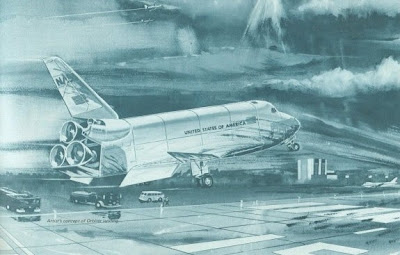
Early Space Shuttle Drawing

My favorite part of the book now is the artist's rendering of the "future Space Shuttle".  In 1976, it had been planned, budgeted, designed, and the first orbital vehicle prototype had just been built!  It would be 7 months before Space Shuttle Enterprise performed her first test flight.

It's stunning to think that I have seen four launches of these beautiful shuttles now, and seen three in museums after retirement. At the time this book was purchased, I had never laid eyes on one.  The first STS mission was still 5 years in the future, and none of us could imagine the 30 years of Shuttles to come!

Kennedy Space Center Book

Another favorite page is the map of Cape Canaveral, listing all the launch pads, and which missions (up to that date, of course) launched from each spot.

According to the tallies in the book, by 1976, there had been 31 manned flights, with 43 participating astronauts -- adding up to 22,500+ cumulative man-hours in space (or on the Moon).  In contrast, as of today, there have now been 211 manned missions, with 310 participating astronauts... and number 312 will head to the ISS in September!

Click on any of the pictures above to see full-size originals of the entire (non-copyrighted) booklet!

Monday, October 29, 2012

RTFM

Share

And now, out in paperback...

Seems the hardbacks are getting harder to come by, but it's also being released on Kindle today. I'm beginning to think people have too much time on their hands. But then, if it inspires space buffs, I'm all for it.

As Stephen Hawking said, it's odd that at the pinnacle of scientific achievement in many fields, fewer and fewer youngsters aim to be scientists. Why is that, exactly? It cannot possibly be a shortage of reading material... I lost track of all the space-related materials released this month to coincide with the Apollo anniversary.

Rocket ship
Do kids still do this? Do we need them to? Laugh if you like, but the boys in that picture probably thought we'd have an entire colony on Mars now. Why don't we? And what will kick start the next wave? Will civilians be routinely launched into orbit? Are private sector billionaires poised to spur interest in new rocket science technologies where once only space agencies ruled?

If we plan to get to Mars by the 2030s or 2040s, and the average age of a spacefaring explorer is about 37 years old, take a look around you at the age range that will be in training when we finally have the technology to make a Mars landing a reality.

Mission Control of the Future Laugh again, but you're looking at the future -- I hope. They're either about to take Driver's Ed class... or downloading Jonas Brothers tunes to their iPods. That's right, the ones with the toe rings and the spiky haircuts who won't pull up their pants... right down to the ones having Disney princess parties and water pistol wars.

They're going to Mars. Around the time I'm finally dipping into my IRA and learning how to knit. Food for thought. And it makes me want to buy every kid alive under the age of 15 a book about space travel... a Buzz Aldrin action figure... tickets to a planetarium... a toy rocket... a week at Space Camp...

Friday, October 19, 2012

The 10 Most Bizarre Space Experiments

Share

My first appearance in a textbook! After numerous turns on the internet, radio and television, I'm truly proud that I've been able to contribute to an educational resource for children. Hopefully it will serve to initiate a fascination with space research for some young minds.


Rubicon Publishing has recently released "The 10 Most Bizarre Space Experiments", a fun and fascinating look into various space projects around the world... and off the world!

TheCanadian company who writes "The 10" series of books contacted me with a request for personal photographs insights into my personal experience with bedrest studies. These programs are used to simulate spaceflight so scientists and doctors can study changes in human bodies in prolonged weightlessness.


It was refreshing to talk about the details of the studies again, since of course it's been quite awhile now since I did extended quarantine with spaceflight protocols. Happily, however, these studies are still going strong, and many new studies are also developed each year for new participants.  Johnson Space Center is still seeking healthy paid volunteers for studies like the one I shared here with Rubicon, and new programs involving the newest space station treadmill.


Ah, memories... but, I was not the star of the tiny tome by any means. A complete list of all the featured stories include:
  1. LEGO on ISS
  2. Six-legged Astronauts
  3. Newts in Space
  4. Cola Wars
  5. Mars500
  6. The Bedrest Experiment
  7. Balloon Jump From Space
  8. Moon Bricks
  9. Space Underwear
  10. Telepathy From Space

One of my favorite simulations, performed as a joint project by the European and Russian space agencies, is the Mars500. I followed all three of their missions for years! My feature ends on page 5, and the Mars500 feature begins on page 6! What an absolute honor to be in the same pages of a book with them. Of course, perhaps they would also consider it an honor to be included with a book of long-term space experiments and yeeeeeeears of comparable NASA studies.


I sure wish I could give a link to where the book can be purchased that would work for everyone! However, the target audience is Canadian educators, so it won't be made widely available.  However, if anyone has connections to any of the experiments and would like a look at the particular pages, please let me know!

Wednesday, August 22, 2012

NASA Exercise Study for Men

Share

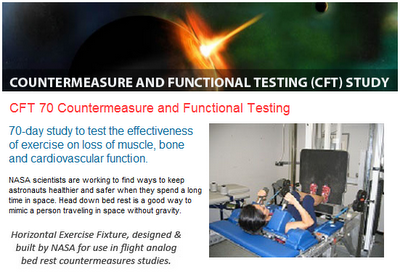
Astronauts exercise on the ISS treadmill to keep their muscles and bones healthy; on the ground, "flight analog" testers use similar equipment so medical scientists can measure cardiovascular fitness. How do they simulate weightlessness? By going vertical! Some of you remember this as the "COLBERT" treadmill that will be used on the space station... named after the goofy fake-TV news host, Stephen Colbert.

Colbert Treadmill
Yesterday, I mentioned the studies website was updated with new programs, and this, the Countermeasure and Functional Testing or simply CFT 70, is the current big kahuna of studies! It is similar to iRATS , though instead of 2-3 weeks, this one will be a longer affair, with more opportunities to test out the new toys!

This is probably the best video I have ever seen in terms of how the treadmill in space works, and how they gear equipment on the ground to simulate weightlessness. The NASA Edge guys featured the original Enhanced Zero-Gravity Locomotion Simulator... the newly built one in Texas is very similar, but with "floating" capability.


Space Treadmill as Featured on NASA Edge

Co-host Blair Allen is a goofball, but highly entertaining, and he volunteered to don the space station harness to try out the treadmill. So, if you are interested in participating in this study, you can watch him undergo all the protocols.

Their show also featured more updated footage on the ISS, Peggy Whitson during training, and a description of what "weightless jogging" feels like around the 5:30 and 6:40 marks. Great stuff!

The new web site design has much more information than the older versions, complete with detailed descriptions, schedules, and photographs of the equipment used in the various trials.

NASA Space Flight Simulation Study
In the past, part of the challenge was not being able to exercise during some of these campaigns, but now exercise and comparison are built in, so they have the potential to be more fun and active, as well as useful to NASA scientists in terms of collected data.

Click on the Application Form to apply, or refer any healthy person, and tell them Pillownaut sent you! I'd love for them to know I'm still doing the Mars Cheerleader thing! ;)

Friday, August 17, 2012

Jon Stewart: American Hero

Share

I would give anything to get Jon Stewart's commentary on the NASA bed rest studies. "Really, you simulate space flight by staying in bed for weeks? Are we allowed to bring blow up dolls?" He could have a field day, because even when he pokes fun at something worthwhile and useful, he finds the irony and the humor in every human journey.

We should declare Jon Stewart a National Historic Landmark. Or at least his hair.

The Daily Show with John Stewart
Stew Beef reacts to the Mars Curiosity Rover Landing...

This has to be my favorite Daily Show video clip ever, ever, ever. And that is truly saying something, considering how often he and Stephen Colbert promote space program initiatives, astronauts, exploration, space station activities and technological progress in general.

Olympic coverage? Sure, we admire America's greatest jocks! But, what about America's greatest NERDS?


I love how he combines the "7 Minutes of Terror" video with a comedy routine, and popcorn-munching anticipation. For some people, that wasn't funny at all. We were biting our nails, knowing what was at stake for the amazing people who worked on this project for a decade or more, and what it meant for the space agency as a whole. But wait... no, looking back now... it is funny. NOW.

Honestly? Even if that rover died today, and didn't move another centimeter, the feat of getting it to the surface was a shining moment in human engineering skill, and everyone who got it there could be lifelong-proud.

Jon Stewart The Daily Show
"When Mission Control got word of the successful landing,
they, in scientific terms... LOST. THEIR. $HIT."

Soon, we'll be all aglow with news of lasers, spectrometers, chemical analysis and what the heck is in those Martian rocks! Knowing those elements will give NASA scientists new understanding of how Mars formed, how wet [and possibly even Earth-like?] it once was, what changed to make it so barren... and whether it could have ever supported life.

Jon Stewart will make that sound hilarious too. Waiting. In the meantime, someone please set him up on a date with Shirley in Propulsion.

Monday, December 26, 2011

Space Commercial of the Year

Share

Dream come true for one special lottery kitty!


Of course, I wish there were more space-themed commercials to choose from, but across the board, I have yet to see anything during the Superbowl that tops this! Enjoy :)

Friday, December 23, 2011

How To Find Treasure From Space

Share

I mentioned yesterday that Geoff Notkin of the Meteorite Men gave me a copy of his book, which now holds the distinction of being the tome in my personal library with quite utterly the longest title ever:

Meteorite Men
But, accurate, certainly. And so full of passion! There is something so compelling about someone who is excited about how they make their living... those amazing people who bound out of bed and cannot wait to do what they do. Seeking bits of an alien world is a unique mission, as evidenced by Geoff's eloquent introduction:

"Meteorites are the most remarkable things on our planet, and they are not even from this planet. They are pieces of extra-terrestrial rock and metal that have fallen onto the surface of the earth. Meteorites are at tangible link with an existence outside of the world we know and are, literally, visitors from outer space… within them are clues to the origin of suns, planets, asteroids, and possibly, even life itself. They are valued by enthusiasts because a space rock is, perhaps, the most intriguing of all collectibles."

If he wanted to light a fire under people to make them want to go hunt meteorite themselves, this book absolutely succeeds!

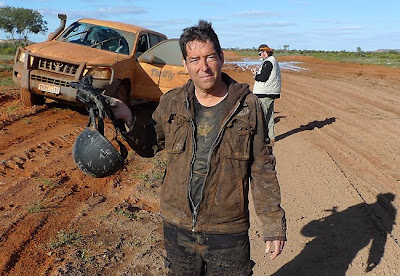
Off Road in Australia
Then I look at pictures like this and realize
I'm quite cozy at home watching on TV, thanks.

Well, even if I never canvas a frozen Russian steppe with a metal detector, thanks to Geoff I can now intelligently articulate regmaglypts, chondrules, ablation, bolide, and strewnfields. Can you tell the difference between a fall and a find? How about the difference between a crater and an impact pit?

About halfway through the book was the intriguing sentence, "Nothing gets Meteorite Men co-host Steve Arnold more charged up that a good fireball chase!" Alrighty then. What's a fireball?

Well you can find that out, and more, in these helpful and educational pages – but don't think it's all fun and games. One must consider, as Notkin highlights from experience, the pitfalls of permits vs. trespassing, local laws for space rock hunting – and let's pretend for a moment that field equipment isn't exactly cheap.

Digging in Kansas
Backhoe rentals. Also not cheap.

Another reality of the meteorite hunting life is all the "meteowrongs" one is apt to dig up in serious pursuits, and Geoff describes a hilarious list of objects he's unearthed over the years, including unexploded bombs and missiles! So my sofa is looking comfier all the time.

But hey, for those of you more apt to frolic in the wild with shovels and snappy multi-pocketed utility vests, remember:

"Most meteorites spent millions of years traveling through the vacuum of space at temperatures approaching absolute zero. When meteorites land on our planet, they are immediately exposed to oxygen and moisture, and the process of terrestrialization begins. Iron starts to oxidize, the decay of radioactive isotopes commences, and delicate fusion crust will begin to corrode. The sooner a fresh fall is delivered into the hands of a researcher, the more valuable it is to science. There is a real urgency to recover new falls and get them to labs as quickly as possible."

Digging in Poland
You haven't lived until you've dug holes in every continent

So are there any catches to living the exciting life of a meteorite man? A few, says Geoff. Seems he has a growing pile of boxes crowding into his life, filled with rocks. The senders want to know if they have found meteorites? But wait, I said, puzzled; the book clearly indicates how to identify meteorites in the laboratory and in the field.

Geoff laughed. He knows. He wrote it. But even with the advised magnet tests, estimations of weight and density, and describing varying means of visual identification based on features, it turns out that he increased rather than lessened the numbers of people sending him rocks in boxes!

Punchline: read his book, or the Meteorite Identification Tips on his Aerolite web page, you won't need to spend money to mail a rock to anyone. You'll have all the information you need to identify true meteorites!

Human nature: People want to send a rock to the guys on TV, so they can tell their friends about it.

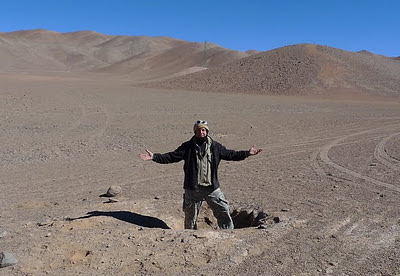
Not Digging in Chile
Someday, I want to look this happy standing inside an Impact Crater

What's next for the Meteorite Men? Well, I'm personally hoping to see an ANTARCTICA ROAD TRIP! Catch Meteorite Men on the Science Channel Monday evenings. If you miss the show at its premiere time, it's also run twice more for you night owls, and can also be found On Demand in many areas that offer DirecTV.

All photographs from © Aerolite Meteorites LLC, gratefully re-used here with permission of the Meteorite Men. In order, they were taken in Australia, Kansas, Poland and Chile.

Wednesday, December 21, 2011

Meteorite Hunter Geoff Notkin

Share

And last but not least for This Week In Pictures, the finale of Akimel A-al Astronomy Night in Phoenix, Arizona. The final speaker of the evening was none other than Geoffrey Notkin of the Meteorite Men!

He let me touch his rock. And this one was heavier than I am! (I think I asked him where he found it, and he told me, but I was so bowled over by all the fun that I promptly forgot. If I find it on his website somewhere, I'll update later. ;)

Geoffrey Notkin
Heather & Geoff

Being oblivious to most things on cable television, I was something of a buzzkill latecomer to the space rocks party, but was quite immediately hooked by their adventures once I tuned into the new episodes!

Geoff tells great stories, works hard to engage people interactively in the science of his calling, and truly brings to life the excitement of being a meteorite hunter -- whether it's fun, rugged, intoxicating, cold, crowded, rewarding, life-threatening... or all of the above:

здравствуйте = Russian = Hello!

Like astronaut Bill Gregory before him, he spoke about his training and knowledge base, then took questions from the children. He also then challenged them to answer questions about things they were learning at their Astronomy Night event, and passed out copies of his book to those who offered up correct responses.


Geoff kept the audience well-engaged, and stayed for hours displaying his meteorite samples, answering questions about his tools of the trade, and signing autographs or posing for photos with everyone who asked.

I also managed to get a signed book, which I've been reading hungrily and will describe tomorrow. For the entire suite of pictures from the evening, see the Astronomy Night album in my Picasa Gallery.

Monday, November 28, 2011

Meteorite Men

Share

Take everything you learned from yesterday's trivia flap, and get ready to have your world ROCKED (literally) by the new season of Meteorite Men! Sounds like a band of science super heroes, doesn't it?

Those who might read regularly know that I have a borderline-loathing for most television. It takes an awful lot to get my attention onto something other than NASA TV. Many of you feel the same way I do, so I thought I'd provide this handy list of reasons to watch Meteorite Men:

Pros: No hoarders, no toddlers, no tiaras, no dancing, no Kardashians.

Cons:
I have not gone on a road trip with these chaps, and I resent it deeply.

Meteorite Men
Geoff & Steve at the Secret Alpha Site in Kansas

Seriously? I've thrice driven through Kansas, and joked to a friend that the state colors were "Red, White & Boring" -- but if I had known there were olivine meteorites to be had, I may have stayed longer. It's truly amazing what you can find when you know how and where to look. Turns out Kansas is America's "Cosmic Bullseye", with more meteorites per square mile than any other state!

This is just one of the many things I have learned watching their adventures; all the James Bondy toys (watch for their industrious amphibious vehicle, the Rockhound) must just tickle the gadget geek contingent, but being more of an academic, I like the part where they meet up with experts from esteemed universities to verify the possible history and authenticity of their extra-terrestrial treasures.


Season three of the popular Science Channel series premieres tonight (11/28/11) at 10pm ET, but of course check your local listings for specifics. Now that there are thousands of channels to choose from, I learned the hard way that satellite company details can often be harder to find than meteorites themselves.

No matter the weather conditions, with or without paved roads, through swamps and deserts, intrepid explorers and world-prominent meteorite hunters Geoff Notkin & Steve Arnold pursue some of the rarest ancient objects on Earth, compliments of the cosmos.

Tonight's first episode will see them visiting to secure a sample from the Morasko Crater Field of Poland, and also pay a visit to the amazing SOFIA, the Boeing jet serving as NASA's Stratospheric Observatory for Airborne Astronomy.


The season will feature eight episodes total, taking the Meteorite Men through a few US states, across remote areas of Russia, up through northern Sweden to the Arctic Circle and into Whitecourt Crater in Canada. Brave, they are! Heck, I've only been as far north as Edmonton...and that was more than snowy enough.

If you're an off-the-grid dweeb like me who lacks cable television, you can watch their YouTube channel clips or also go onto Amazon MM, where episodes are $1.99 apiece. Worth every rock.

Monday, June 27, 2011

The Sun's Heartbeat

Share

Book review time! I don't do many of these because I read SO many books, it's rare that anything hypnotizes me, but this one is a true gem than any space enthusiast must add to their collection. The full title is The Sun's Heartbeat And Other Stories From the Life of the Star That Powers Our Planet by Bob Berman –- whose name you will doubtless recognize from Discover magazine. Yes, that Bob Berman.

As in his columns or speeches, he is humorous and delightfully un-condescending in his sharing of astronomical knowledge (and I mean that in both the literal and adjectival senses!), making this a fluid read. In fact, the fluidity is addictive. I'd planned to read the book next week and review it in July prior to its 7/13 release, but wound up finishing it after just two sittings, quite unable to put it down.

The Sun's Heartbeat"At it's most elemental, the Sun is the sole source of our life and energy... Everything about the sun is either amazing or useful. Beyond the peculiar history of its discoveries by a motley collection of geniuses, it directly or indirectly affects our lives, our health, our emotions, and even our dollars."
~ Bob Berman


As interesting as any biography of a person who lived a long and interesting life, this book unfolds the life of our Sun, and the millennias-long melodrama of our quest to understand this amazing entity, as discovered through the eyes of an esteemed cast of characters: Galileo, Kepler, Halley, Schwabe, Herschel, Pauli, Kirchhoff & Bunsen. Wait... Kirchhoff & Bunsen? Yeah, and you don't know the most stunning discoveries about the Sun until you know their work (proving once again how scientific Zeitgeist often rewards entirely the wrong people).

What makes the sun shine? Recorded history shows we tried to figure that out for about 25 thousand generations. Those of us alive today have known the truest answer for just one human lifetime: the fusing together of hydrogen nuclei, and fusing its helium into heavier elements.

NASA 3D EYES ON THE SUN Archives
From Babylonian scientists recording sun spots 3 thousand years ago to current climate change debates, through ancient religions and alchemy to modern sciences such as heliophysics and helioseismology, Bob Berman brings alive the Sun's gifts to planet Earth: how we divine the Sun's properties through water, weather and tree rings; the sun's role in the evolution of life forms in terms of how fast mutations occur, as evidenced by fossil records; and, even how petty fights between dueling scientists often led to advancements in the knowledge of our solar god.

Subtitles of the book could easily include Sunscreen 101, the Vitamin D chronicles, Aurora-Chasing, How a Solar Eclipse Can Change Your Life, and Hey, Twenty Trillion Neutrinos Are Slamming Through Your Head Every Second! Really.

Columnist Bob Berman
Berman's new writing gig

Berman lays out the heliophysics in detail; not the dry stuff of textbook mechanics, but rather the dynamic story of superstitions versus experiments, and finally, modern scientific method and measurement. From believing the sun was a deity to understanding the very foundations of what made our solar system possible, he makes the Sun precisely what it is: a STAR!

And he does so with quips and quirky prose that will make you read the lines twice to make sure you are actually reading a science book instead of a Dilbert strip: "Neutrons don't help us and don't hurt us: they're like coleslaw," and "Sagittarius resembles an archer the way I resemble Brad Pitt" are among the LOL moments. And he actually used the words KAPLOOIE and SHAZAM. Awesome. My favorite, to the chagrin of astronauts everywhere, had to be: "Once you venture outside Earth's protective field, your HMO would be wise to stop covering you."

Indeed. So far, this is the geek read of the year. Go find it. :)

Friday, May 6, 2011

Light This Candle

Share

Yesterday’s post didn't even scratch the surface in terms of all the great tales in Alan Shepard's biography: how he viewed himself and his world, how he was viewed by others, and the complex emotional dynamics of the early Space Race.

The amazing author of Light This Candle: The Life and Times of Alan Shepard generously offered an autographed copy of his book for a blog prize, and even made time in his schedule for an interview, so I could satisfy some of the burning questions I had after reading his book.

For example... good grief, are test pilots completely CRAZY?

Neal Thompson Blog
Also check out Neal's blog, where he invites any
and all to "stalk" him on Facebook and Twitter!

Test-pilot personalities seem such a paradoxical mix of precision and flamboyance. Alan Shepard claimed to hate the press, but clearly adored the spotlight. Your book was published 5 years after his death from Leukemia. Do you think he would have liked it? Or liked the attention from being the subject of a biography?

Neal Thompson:
I'm pretty sure Shepard would have seriously disliked the idea of my book, and probably the book itself, too. And I think one reason no book had been written when he was alive was because he refused to cooperate with any potential biographers, and his friends did the same. Many of the people I contacted early on would say something like, "Al wouldn't have wanted me to talk about this." But I think in time some of those sources realized his life story was an important one that deserved to be told. It is true, though, that he hated the press but didn't mind the celebrity status he achieved.

I think he liked managing the spotlight, and keeping reporters away from certain aspects of his story. The deal with Life magazine helped in that regard, and helped assure that, while he was alive, no one got close enough to tell the real story.

I was blown away by the amount of people you interviewed from every phase of Shepard's life. Most impressive was your in-depth research of WWII, his role in introducing jets to the naval fleet as propeller squadrons were retired, and his crossover into NASA at a time when our culture was in Sputnik-turmoil . Did you have a healthy interest in any of these historical eras before this book?

Neal Thompson: At the time of Shepard's death, I was covering the military (primarily the US Naval Academy and the NSA), so I already had an interest in military stories and, in general, stories about men living big lives. So when Shepard died, and I realized, to my surprise, that no one had yet told his full story, I knew I wanted to dig deep and really get to know who Shepard was.

This was tricky in the beginning, since man of his friends were reluctant to talk about him. But little by little I got through to people, and doors started opening. I also felt it was important to explore some of the lesser known aspects of his impressive life and career, such as his days as a carrier pilot. So much has been written about the space race, so I chose to find a fresh approach that showed not only what he did with NASA, but how and why he got to the point where he was chosen among the first 7 astronauts. To learn about the full breadth of his life, I felt that I had to talk to everybody.

Light This Candle, The Life and Times of Alan ShepardGordon Cooper called Shepard the "most complex" of the first astronauts, but NASA white-washed the "image" of the Mercury Seven, so we rarely see their multi-faceted humanity. However, his foibles brought him alive on the page for me, I admired how you didn't shun being truthful. While he was fascinating, brave and intelligent – he was also often arrogant, dismissive, and his adultery was no secret. Did you worry at all about revealing the "evil twin" of an American hero?

Neal Thompson: One reason I was drawn to Shepard's story was because his life is so rich with complexity and paradox. He was raised in a religious and disciplined family, but became a renowned rule-breaker, occasional hellion and undeclared agnostic. He was a good father and devoted husband, but not necessarily faithful. He was a top Navy pilot, but constantly battled against the Navy's rules, to the point of almost being court martialed. He was ruthlessly competitive but could also be generous, kind and extremely loyal. In short, he was fascinatingly complex. He was a human being, with exceptional qualities but also flaws. Learning about all facets of his personality made him seem more real to me, and I hope I achieved my goal of showing the man behind the white-washed NASA image of the man.

You absolutely did. He claimed the "Right Stuff" book and film were fiction, and disliked both. I for one am surprised that a separate film has never been made about him… but now that the 50th-year milestone has passed, perhaps someone will greenlight one. Do you think one ever will make his life story into a movie, and if it was made now, who do you picture playing Alan Shepard?

Neal Thompson: In recent Op-Eds that I wrote in advance of the 50th anniversary of Freedom 7, I describe how Shepard represented the iconic, bad-ass test pilot, how he dressed well and drank martinis and smoked cigars, how he was the epitome of Mad Men-era style and cool – he was basically Don Draper in a spacesuit. So, as for playing him on the big screen, how about Jon Hamm of Mad Men? I would love to see a Shepard-focused film some day, especially one that explores his mid-60s fight back from Meniere's Disease to eventually reach the moon.


Oh wow, yeah, how about John Hamm of Mad Men to play Alan Shepard! Check him out!

Wednesday, May 4, 2011

Alan Shepard Book Giveaway

Share

Over the past week, I've had the distinct intellectual pleasure of reading Light This Candle: The Life and Times of Alan Shepard, a captivating tome from Crown Publishing, courtesy of author Neal Thompson.

Let me just say, that while I love reading anything about astronauts and all things space, this in particular was a fun, fluidly conversational read – though still densely packed with remarkable stories and skillfully researched information about a very complex, often evocative, and always mysterious man who captivated the world in May of 1961!

Light This Candle, The Life and Times of Alan ShepardThose of us who were unfashionably late to the space race (*cough* Not born yet *cough*cough) eagerly absorb tales from the "names" who excite us – Jim Lovell, John Glenn, Gene Cernan, etc. and many were interviewed personally for this book. Still others were quoted from their own famed auto-biographies, to paint a fuller picture of the man who made some of them money, made more of them jealous, and made all of them work harder!

From early school pranks to golfing on the moon, he was certainly never boring – never even still for five minutes at a time, for that matter. Reminiscences of the remaining Mercury Seven and other Moonwalkers, as well as the foreword by Chris Kraft, paint the era in which Shepard thrived and reached the pinnacle of achievement for a cocky test pilot. Call it the Right Stuff, call it the Best of the Best, the clichés are many and varied. But once you delve into the many facets of the man inside the silver suit, he is anything but clichéd.

May 2011 Alan Shepard 50th Anniversary Stamp

Did everyone get a chance to go play on the Space Cadets app yesterday? I'm sure you've noticed that alongside the serious scientists and astronauts, there are some light-hearted science fiction stars as well… from Captain Kirk to Captain Mal... to Yoda. And kudos to anyone who plays with the quote generator long enough to find the lone Looney Tune. ;)

Alan also appears many times, with both funny and ponderous quotes, and you'll have a chance at winning a free SIGNED copy of Neal Thompson's "Light This Candle" if you go find him!


Go to the Space Cadets page and click the LIKE button… and you're entered in the contest! Generate a quote and post it to your wall, that's worth another entry. Everyone who helped test the new app is automatically entered, and all the wonderfully supportive readers who joined when I announced this yesterday.

I went to my admin alerts page today, and saw 50 new fans, right out of the gate… way to go, space geeks! I always hear people complain there is no "intelligent" material on Facebook, so here's your chance to join a page dedicated to the brainy, the pioneering, the true and literal rocket scientists.

Also, anyone who joins my Pillownaut Twitter feed in May is automatically entered (or entered again). On Friday, May 20th, I'll choose randomly from the alerts, and send the winner a brand new, free copy of Light This Candle: The Life and Times of Alan Shepard, personally autographed by researched and author Neal Thompson … because it's worth it!