Showing posts with label NASA Goddard. Show all posts

Friday, January 4, 2013

Fast Eddie & The Robots

Share

Wouldn't that be an awesome name for a punk band?? Some of you may remember Fast Eddie from my article in 2010 about his awesome work with spacesuit glove testing and Hubble mania! Ed has held some amazing positions with NASA over many moons, but may have one of the most important jobs of his career now, in terms of Earth's technological future.

Heather & Ed
Me & Ed with ROSIE

See that big block behind our heads in the Satellite Servicing Capabilities Office (SSCO) at NASA Goddard? THAT is the star of the Robotic Refueling Mission (RRM) now being tested on orbit by the space station crew and robots.

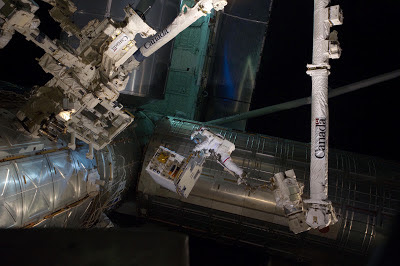
Humorously named after the cartoon Jetsons robot, the block is ROSIE, or the Robotic Operating Simulator for Integration and Evaluation. She and all her delightful tools and gizmos were the very last American Space Shuttle payload by Atlantis STS-135 in July 2011.  ROSIE was installed into the ELC-4, with the intent for Dextre to demonstrate refueling experiments throughout 2012 and 2013.
Satellite Servicing Capabilities Office
Astronaut Ron Garan delivering ROSIE to the ISS
for joint experiments between NASA & CSA

This is one of the those NASA Projects where I do the research, learn about the work, meet the people involved, and then realize certain things at NASA truly do need budget doubling.

An incredible amount of things in our modern lives depend on satellites. (But I wonder how many people appreciate them until their smartphone or TV aren't working?!) Drawing upon 20 years of experience servicing the Hubble, the SSCO initiated the development of RRM to demonstrate the feasibility and practicality of robotically refueling and servicing satellites on-orbit. Exploring ways to do this without "catching" them or simply adding to the dead, floating space debris junkyard, is worth our time, trouble and future investments!

Robotic Refueling Mission
Artistic representation of Dextre
performing a robotic refueling task on RRM

Someday, it will allow NASA and commercial entities to launch larger and more complex satellites, because they can travel without heavy fuel, then meet with a separate fuel source in orbit, much the same way a car pulls off the highway when it needs a gasoline station.

Dextre will work on ROSIE's multiple activity boards,check-listing through tests on protective thermal blankets, caps, valves, simulated fuel, and other components that need to be pushed back, cut through, unscrewed and transferred.  Each component and activity board represents and individual refueling or servicing task, and each RRM is designed to efficiently complete a wide range of targeted activities.

SSCO RRM
Ed removing the Wire Cutter Tool from
one of the RRM Activity Boards

Wire sheaths? Nozzles? No problem. Robots got this. The tool collections primary functions are to cut and manipulate wires, unscrew caps, open and close valves and transfer fluid. Tools also have integral cameras for ground operator vision and include specialized features tailored to complete each task.

Technology and techniques are all being verified on orbit as we speak, and you can follow the action at the Satellite Servicing Office's Facebook page.

Satellite Servicing Capabilities Office (SSCO)
SSCO Office and Weightless Testing "Sky"

Curious how refueling a satellite in space can impact your day-to-day activities on Earth?  Check this awesome ROBOTIC REFUELING video by CTV, who crammed a stunning amount of awesome information and NASA coolness into 3 minutes.

To see the entire gallery of pictures from Ed's tour of the Satellite Servicing Capabilities Office at NASA Goddard Space Flight Center in Greenbelt, Maryland, click this link or any of the pictures above. Thanks for your time, Fast Eddie!

Wednesday, January 2, 2013

NASA Goddard

Share

Another year, another NASA center!  I have long wanted to see the NASA Goddard Space Flight Center in Greenbelt, Maryland... home of Heliophysics, the Hubble Space Telescope, Explorer Program, Lunar Reconnaissance Orbiter (LRO) and many other amazing NASA projects.

Heather at NASA Goddard

One of the 10 major NASA field centers, GSFC is named for Dr. Robert Goddard (1882–1945), father of modern rocket propulsion in America. Luckily, I was able to make a quick visit while in town working the social media thang at NASA HQ.

This incredible think tank and design/manufacturing center is the largest combined organization of scientists and engineers (over 10,000!) dedicated to increasing knowledge of the Earth, her Solar System, and our entire known Universe, using observations from space.

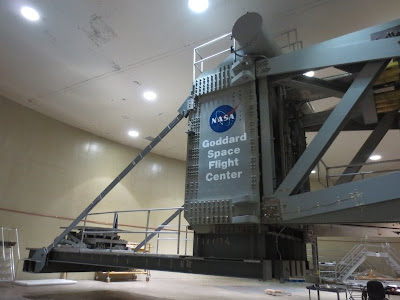
Plus, it is home to one of the largest centrifuges in the world. Here it is. Well, part of it. It's too darned huge to fit in one shot. So cool.

Centrifuge at Goddard

It is no exaggeration to say that most of what you know, and certainly all the pictures you've seen, of the celestial objects in the known currently-photographable cosmos are due to NASA Goddard!

In fact, the brains at the Goddard center are also largely responsible for everything you know about climate change, arctic ice, storm systems, solar eruptions, coronal mass ejections, interstellar clouds, geodesy, ocean ecology... and for crying out loud, they even accidentally found dinosaur footprints on their campus.
Ed Rezac

One huge highlight was meeting up with my buddy Ed, who showed me all kinds of fun robots in the Satellite Servicing Capabilities Office (SSCO). Details will follow, as his team is definitely worth their own blog post.

I also finally got to see, up close and personal, the James Webb Space Telescope, in all mirroresque glory, and surrounded by exciting optical components! The JWST is now being assembled in the same clean room where Hubble was assembled. A truly historic spot.  Other clean rooms housed the Global Precipitation Measurement Satellite (very big) and the Magnetospheric Multiscale Satellites (even bigger).

Heather with James Webb Space Telescope

Like Hubble, you cannot fathom the sheer size of that sucker until you're staring right at it! Around every corner is something even more exciting, and my only failure in visiting this amazing NASA center was not spending enough time.  Wish I'd had an opportunity to visit the LRO and SDO teams, but I'll have to catch them on the next round.

To see the entire picture gallery, click on any of the photographs above, or click here to visit the Pillownaut Picasa album collection.

Tuesday, August 3, 2010

Call Sign: Rezac

Share

I'm always excited when I convince someone to overcome natural camera-shyness, because frankly, I'd do a "NASA Employee Spotlight" once a week if I could get away with it. Most folks are too modest, and longtime NASAman Ed Rezac is no different, but he was kind enough to share stories and photos!

Starting in 1976, Ed supported Space Shuttle era Extravehicular Mobility Unit (EMU) development at ILC Dover and astronaut hardware development at ILC Space Systems in Houston. Then up into the 1980s, he was a Payload Integration Engineer at JSC & KSC, supporting NASA Life Science Space Lab payload development.

Feel like a slacker yet? I was getting ready for my senior prom around the time he became a Space Station Utilization Engineer at Grumman Aerospace, and had just earned my first college degree when he moved to the Center for Space & Advanced Technology at NASA Headquarters to manage the subcontract in support of Microgravity and Life Sciences in the early 90s.

Hubble Space Telescope Mockup
Standing in the High Fidelity Mechanical Simulator (HFMS, a full size mock-up of the Hubble Space Telescope's aft shroud) in Building 29 at the Goddard Space Flight center in Greenbelt, Maryland

For the last decade, he's been at Lockheed Martin as an EVA Systems Engineer, working with engineers, scientists and NASA astronauts to plan, train for, and execute servicing missions to maintain the Hubble Space Telescope.

I could spend about 18 blog posts pestering him with questions about any number of tasks he performed at any of these jobs, but for the sake of him actually being able to escape my evil clutches and get back to work, I'll just share a few episodes in line with my blog themes of simulations and ground testing.

Hence, my favorite photo sets:

NASA - Ed Rezac
Ed again, with what he lovingly calls his "Ron Burgundy moustache."
Sweet Lincoln's mullet! (click to embiggen)

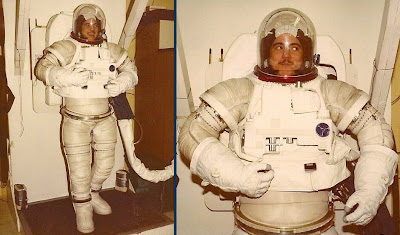
Above is a shot of Ed in 1980, as a suited tester. Definitely click to see the larger version, and see all the details of this EMU.

You were probably sitting in a theatre somewhere, watching Caddyshack. Then maybe you went home and played your Atari 2600 or the new Andy Gibb album. Yeah, Ed was conducting actual certification runs of the pre-flight testing of astronaut Bob Crippen's gloves that were flown on STS-1 in April 1981!

When I emailed Ed to ask if I could use these wonderful pictures on my blog, he replied:
"I suspect that what you may find more interesting than the activities of 30 years ago are the more recent hardware design, procedure development, and crew activities conducted in preparation for the Hubble Space Telescope (HST) Servicing Mission. I was the HST Project's EVA Lead for two of the tasks completed during the last Hubble servicing; changing out the three Rate Sensing Units (RSUs) that contain the gyros that keep the telescope steady during viewing operations, and repair of the Advanced Camera for Surveys (ACS) science instrument."

"Both tasks required design, development and testing of hardware; development of both nominal and contingency procedures; and instruction, training and on-orbit choreography development for the astronaut crew and ground personnel. I worked with the astronaut instructors at JSC to train the astronauts using 1-G simulators, VR, the Neutral Buoyancy Laboratory, and put in many hours "on the loops" at Mission Control for pre-mission simulations as well as actual flight console support."

Mike Good, John Grunsfeld, Ed Rezac, Mike Massimino, Andrew Feustel
L to R: Mike Good, John Grunsfeld, Ed, Mike Massimino & Drew Feustel.
The STS-125 spacewalkers in front of the mock-up HST aft shroud following a training session in Houston, TX.

I was going to do a "write-up" on all that, but it actually works better in Ed's own words, and all the amazing photographs truly speak for themselves. Click on any to move to a page where you can see the whole photo sets, Hubble mockups, astronauts and all!

Thanks so much for giving folks a view into your world, Ed... we love having looks behind the scenes at the real people who keep the space program running!