Friday, September 13, 2013

FREE Firefly T-shirts From GeekChicTees

Share

9/21
CONTEST HAS CONCLUDED AND WINNERS HAVE BEEN CONTACTED.

THANKS TO ALL THE AWESOME BROWNCOATS WHO PARTICIPATED!

Browncoats! Do you know what the Alliance hates? Dedicated freedom fighters, creativity, and most of all: FREE STUFF! Next Friday, September 20th, is the anniversary of the premiere of Firefly. More than a decade later, I still live to wave the Serenity Valley flag.


You've all seen the great GEEKCHIC TEES Firefly products on Captain Mal's Wisdom or Facebook Firefly, probably thanks to the them partnering with us for a contest to give away a free shirt this past May.

We had SO much fun, and met SO many new awesome FLANS, we decided to do it again.  Now, GeekChic Tees will be giving away TWO free T-shirts to two lucky Browncoats!  The contest will run for one week, today through next Friday (September 13th - 20th).

At the end, we let the cat pick two names at random (SRSLY!), and the winners, upon sending clothing size and address confidentially, get to pick their favorite products from the GeekChic Tees catalogue!

Geek Chic Tees

To enter the contest for the free T-shirt, simply tweet one of the following, so Mr. GeekChic and I can see it in our feeds:

Browncoats! Win FREE Firefly TShirt from @geekchic_tees at @Pillownaut blog http://bit.ly/13Ubic4 SHINY #YouCantTakeTheSkyFromMe #FIREFLY

#Firefly Win a Free FIREFLY shirt http://tinyurl.com/kdc3ykj from @geekchic_tees at @Pillownaut blog. Browncoats Unite! #Shiny #Serenity

Win FREE Firefly TShirt at @Pillownaut blog http://bit.ly/13Ubic4 @geekchic_tees Spread the word, Browncoats! #CantStopTheSignal #FIREFLY

#FIREFLY Win a Free Firefly shirt http://tinyurl.com/kdc3ykj from @geekchic_tees! Browncoats Unite! #Shiny #BigDamnHeroes cc @pillownaut


Or, make up one of your own tweets, but be sure to include, AT MINIMUM: the link to the contest, both Twitter handles, the hashtag #FIREFLY and any other Browncoat saying or quote... but please, not too much gorram cussing in Chinese!

If you are not on Twitter, share this page to Facebook, Tumblr, Pinterest, and/or Google+ and then email Pillownaut to say you have done so: h r a 2 3 6 2 - at - yahoo dot com.

Enter as many times as you like, on as many platforms as you like. We'll go check them out! Every share and tweet counts as an entry.  It also counts as an entry if you follow either of us on Twitter for shiny NASA and Firefly updates in the future.

DEADLINE FOR ENTRIES: Midnight, September 19th!
Winner will be announced on the morning of September 20, 2013.


Saturday, September 7, 2013

Count Meteors for the LADEE Mission!

Share

LADEE, the Lunar Atmosphere and Dust Environment Explorer is a robotic lunar orbiter that will fly into the moon's atmosphere to sample its composition and structure and look for dust lofted into the lunar sky.  Determine the size, charge, and spatial distribution of electro-statically transported dust grains? She's on it!

LADEE Mission Patch

During LADEE's time over the surface-boundary exosphere (an atmosphere that is so thin and tenuous that molecules don't collide with each other), her UV Spectrometer will determine the global density, composition, and spatial variability of the fragile lunar atmosphere before it is perturbed by future human activity.

It may also shed light on the atmospheric species 20-150 kilometers above the lunar surface. Are these species at orbital altitudes there by virtue of solar wind? Released from lunar soil? Can we discover the cycles and sources of these species? LADEE may tell us!

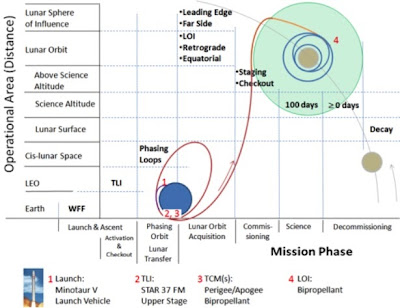
LADEE Mission Phases

I think the most exciting portion of the mission will be the optical communications experiments. While in orbit, it will demonstrate the first 2-way high-rate long-range laser communications.  The Lunar Laser Communications Demonstration (LLCD) will test how spacecraft may be able to use lasers to send movies, high-resolution photographs and even 3D images to ground controllers, someday

LADEE launched yesterday evening from NASA Wallops Flight Facility in Virginia, though over 8,000 west-coasters also watched the launch event at an epic party at NASA Ames Research Center

And now now that LADEE is flying, NASA needs your help!

Meteor Counter for iPad and iPhone

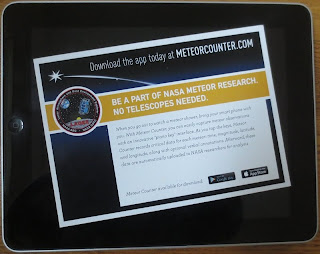
During the LADEE Mission, NASA would like to have as many people as possible submitting meteor counts so scientists can compare that data to what LADEE's instruments record. And of course, there's an app for that.

Download the NASA Meteor Counter app, which allows observers to use their iPhones, iPads, or Androids to record meteor count observations, and send the data directly to NASA.

When you watch a meteor shower, just take your smart phone with you! (As if you leave it home anyway, right?)  Capture meteors with the "piano key" interface. As you tap the keys, Meteor Counter records critical data for each meteor: time, magnitude, latitude and longitude, along with optional verbal annotations.  These data are uploaded to researches at NASA for analysis.

Meteor Counter

Anothe great way to get involved is with your 8 to 14-inch aperture telescope to detect meteoroid impacts, as monitored by the NASA Meteoroid Environment Office, and the Lunar Impact Monitoring Program. In both entities, lunar scientists seek to determine the rate of meteoroid impacts on the Moon, as they are an important source for the lunar exosphere and dust.

The LADEE mission is a also a participant in the International Observe the Moon Night, and the Student Spacecraft Tracking and Monitoring effort, so visit LADEE Mission Opportunities page to pick a project!

Wednesday, September 4, 2013

Lunar Atmosphere Dust Environment Explorer

Share

Is everyone prepared for the historic launch of NASA's Lunar Atmosphere and Dust Environment Explorer this week? This will be the first of TEN launches in September! Busy rocket season.


This historic robotic mission to the moon will mark the very first lunar blast-off from a place that is not-Cape-Canaveral. It will also clear up many of the Moon Mysteries we humans have wondered about since the Apollo program.

NASA Wallops Flight Facility in Virginia is very excited to host the launch of LADEE (pronounced Laa-dee, as opposed to "lady") on a USAF Minotaur V. NASA Ames is holding an event at their parade grounds, and 8,000 people have purchased tickets! NASA TV will also carry pre-launch activities, so find a place to watch: 

NASA LADEE Lunar Launch
Friday, September 6th
NASA TV Coverage Begins 6:30pm PT / 9:30pm ET
LAUNCH WINDOW 11:27-11:31pm ET

Click to embiggen Launch Visibility map

Designed and built at NASA Ames, the Lunar Atmosphere and Dust Environment Explorer (LADEE) is a robotic mission that will orbit the moon to gather detailed information about the composition, density and variability of the thin (but glowing!) lunar atmosphere.

LADEE will  study conditions near the surface and environmental influences on lunar dust, and also test new laser communications technology that could potentially bring broadband speeds to planetary space missions!


The LADEE 3-phase animation, by Dana Berry at NASA Ames, first shows the Lunar Dust Experiment (LDEX) instrument, which operates by detecting ions generated when dust particles impact at high speeds. Data will be used to calculate the mass, density and electrical charge of lunar dust.  Phase 2 depicts orbital flight path variations, and phase 3 shows light from the sun scattering through the lunar atmosphere.

Why are such explorations important?

Interestingly, our Moon may be the most common type of atmosphere in the solar system -- perhaps in most solar systems. Known as a "surface boundary exosphere," a very similar type surrounds Mercury, the moons of our gas giants Jupiter and Saturn, all the largest asteroids observed, and even minor celestial bodies beyond the orbit of Neptune. 

Given that we have an SBE so close, we really ought to be exploring it!  In the future, the data may help probes land on Jovian moons!

Follow the NASA LADEE action on Twitter, and of course, I will be live-tweet all the action from the Pillownaut Twitter account, too.

Wednesday, August 28, 2013

Apollo Moon Tree

Share

Armed with my handy space maps, I am always on the lookout for Apollo Moon Trees, wherever I go.  Virginia was no exception, and I found the tallest one I've seen yet!

Apollo 14 Command Module pilot Stuart Roosa, who remained in lunar orbit while his cohorts Alan Shepard and Ed Mitchell frolicked about Fra Mauro, took hundreds of redwood, sycamore, pine, fir and sweetgum tree seeds aboard the Kitty Hawk capsule in 1971, at the request of Forest Service employees. Upon return to Earth, the seeds were distributed to various communities, resulting in the "Moon Trees".

Apollo Drive
Can you think of a better place to plant a Moon Tree?

Most Moon Trees were planted as experimental controls, alongside normal seeds, though many decades later there is no visible difference. The majority were distributed as seedlings, and planted in 1976 for bicentennial celebrations, though the List of Moon Trees records plantings from as early as 1973 and as late as 1984.

A few traveled to foreign nations, and still others found their way to universities, NASA centers, national parks and monuments -- including the White House.  To date, only one was ever deliberately removed – a New Orleans pine that was damaged during Hurricane Katrina.

My recent find was a beautiful sycamore at Booker Elementary School on Apollo Drive in Hampton, Virginia.

Hampton, VA Moon Tree

This particular tree is very special, and different from the others in that it was the result of a poetry contest held among the schoolchildren.

In 1976, then-6th grader Marjorie White (who is 52 now) wrote the winning poem called "A Tree Lives", which Booker has kept on their main office wall for many years, alongside a gold NASA plaque from when the tree was dedicated during the Bicentennial, and once again at the 30th anniversary in 2006.

The Winning Poem!
"A Tree Lives" by Marjorie White
(Click to see original in larger type!)

Despite knowing Roosa had hundreds of seeds, only 90 are listed officially by NASA – and a mere 44 have been photographed by the Waymarkers Moon Tree Group.  Sadly, they were not tracked efficiently. Like the Goodwill Moon Rocks, the 1970s handlers were casual about what would one day become a part of world heritage.

Pulling togehter many resources over the years, I have catalogued directions and coordinates to 83 Apollo Moon Trees, which can be found (along with outdoor scaled Solar Systems) on my Pillownaut Nature Walks Map.

If you know the location of any seeds, or where they were planted, curators at the National Space Science Data Center would love to hear from you. Email NASA if you find one!