Wednesday, February 3, 2010

Liftoff

Share

Yep, shuttle launch in four days! But today, my title refers to a different kind of liftoff... that of our space program itself. It's not an overstatement to say that Huntsville, Alabama – known as "Rocket City" – is the true home of the American space program – the site where our first launch vehicles were designed and tested, before NASA or any of its space centers were founded.

After World War II, Dr. Wernher Von Braun and his "rocket team" surrendered to Allied forces and moved from Germany to work for the United States Army, eventually assigned to Redstone Arsenal in Huntsville. There the teams expanded to include hundreds of American scientists and engineers, who played a key role in the success of early milestones.

Historic Redstone Test Stand
Me at the 75-foot-tall Redstone Test Stand
Added to the National Register of Historical Places in 1976.

On January 31, 1958, the team used a modified Redstone rocket called a Jupiter-C to launch Explorer I, America's first orbiting satellite. Two years later, Von Braun became director of NASA’s George C. Marshall Space Flight Center -- named in honor of the Army Chief of Staff during WWII, Secretary of State, and Nobel Prize Winner for the reconstructive Marshall Plan.

The "Rocket Teams" were already developing the famous Mercury-Redstone Rockets, basically the same modified military missiles, but their warheads were replaced with crew capsules and escape towers. The first ones were built at Redstone Arsenal, but based upon their designs, the Chrysler Corporation (seriously) was awarded the contract to build production models, the third of which propelled Alan Shepard into space on May 6, 1961.

Redstone Rocket Test Site
O sure, hey...let’s test-fire a rocket
and sit like four feet away.

When my pal Craig drove me by this test stand at Redstone Arsenal, I was shocked to see how close the blockhouse (used for observations and for receiving telemetric data during tests) were to the actual firing site! They were basically only steel tanks covered by dirt mounds, with metal doors and observation windows...

You could jog from the rocket base to where the scientists were sitting in about 6 seconds! Hope you guys kept your goggles on.

The Redstone Test Stand is the oldest static firing facility at Marshall, and the very first in the US to accommodate an entire launch vehicle for static tests (previous test stands had accommodated only engines). The stand was also used to develop "human-rated" launch procedures, propellant fuel procedures, launch ignition procedures and acceptable criteria for launch pneumatics and thrust measurement.

Original cost to build in 1953? $25,000. Isn’t that about what a Prius costs now?

Seriously, every space or rocketry enthusiast should feel the magic and majesty of this small, abandoned site in northern Alabama. Despite how small and ancient it looks to modern eyes, it is the reverent stepping-stone of all stepping-stones to what our space program would eventually become.

Monday, February 1, 2010

Question Mark 2010

Share

I'll probably regret later that I commented on this today, since it's still sinking in. I wonder... will I look back on this day, many years from now, and say "They did the sensible thing." Or, will history remember this move as the first in a resigned downward spiral?

The FY2011 Budget overview for NASA was published, along with statements from Charlie Bolden and Buzz Aldrin. I tuned into SpaceVidCast.com's Q&A session held by the Office of Science & Technology Policy, whereby OSTP Chief of Staff Jim Kohlenberger and NASA Deputy Administrator Lori Garver did reply to the press with a fair amount of detail -- but danced around direct questions, armed with honorific buzzwords, because of course that would be a natural reaction.


I’m not a reporter, so again, I won't rehash particulars, but none of the leaked suspicions of the past week were proven counterfactual. Norman Augustine summed it up best, though he probably had no idea he was doing so:

"While many of us who believe strongly in human space flight hoped that further funding would have been possible, this is obviously a demanding period from a budgetary standpoint. The President’s proposed program seems to match means to ends, and should therefore be executable."

In other words, Constellation was too much burrito supreme for our tiny taco economy right now. Kennedy, Johnson, Ames, Marshall, Michoud, Langley and Glenn were all mentioned – but no one had the guts to utter the word “layoff,” preferring to emphasize redirection or refocus. All the people working on Constellation… how will they be re-assigned? That question was given only a vague response, with the strategic mention of “robotic missions.”

Kohlenberger further emphasized that "because we’ve spent $9 billion on a program that cannot be executed doesn't mean we should spend billions more and potentially still be unable to execute."

Well, yeah, we can all see that point. Buzz is finally on board, so can I try to be? They argue that Constellation forced budget cuts to other NASA programs, which may now thrive again: climate change, ISS extension, telescopes, increasingly “green” aviation, and science-based education programs, etc. I found myself thinking, well, those are positive steps… those shouldn't fall by the wayside. No one is naïve about how difficult it is to control spending and still spur growth in a recession, and many members of Congress (in both parties) have already made it plain they want these spending outlines adjusted or scrapped, so we’ve hardly heard the last word on the matter.

The Future of Human Space Exploration
Then I wonder, am I just doing what they’re doing? Rationalizing? Well, of course I am. It’s human nature to try to make the best of news you didn’t want to hear. We certainly could make a success of bypassing the moon for continued work in low-Earth-orbit, and destinations such as asteroids, the Lagrangian points, Mars and its moons, etc… but it’s my honest feeling that these missions will prove far more dangerous without first testing long-duration human existence on a working lunar base.

Bolden wrote: "The new effort will enable our nation to develop more innovative technologies, foster new industries, strengthen international partnerships, and increase our understanding of the earth, our solar system, and the universe beyond. Our endeavors in space can inspire our imaginations and kindle our collective spirit of discovery and adventure."

Really? If this is so keenly inspiring and adventurous, why didn't Obama say it himself during the State of the Union? When the big guy says it on prime time, it’s a win. When lesser bureaucrats hold a Monday afternoon tea, it’s an acquiescent sigh called "Plan B."

They sounded pretty, but I know a band-aid on a bullet wound when I see one.

I truly hoped international "collaboration" would be the keyword of the 21st century, but Americans seem to be proving we cannot get onboard en masse with anything that isn’t rife with "competition."

Sunday, January 31, 2010

Golden Gate

Share

Must take a break from the gloom, and share this; forgive my random foray into photography. My California friends will love it... and understand why this sort of thing always makes me just a tad homesick.

Astronaut Sōichi Noguchi shared this wonderful pic of the Golden Gate Bridge from space, isn't it breath-taking?

Golden Gate Bridge From Space
For many years now, the GGB has been named the most photographed man-made structure on Earth. Honestly, I've never really understood why the orange bridge over the Golden Gate Strait captivates the way it does, but there is just something about it! San Francisco natives and non-natives alike can't seem to put their cameras down.

Thought for the day:
Our planet has existed for billions of years, but only in the last half-century have any of its inhabitants developed the technologies to see our natural biosphere and our creations from above in such serene and amazing ways. Low Earth Orbit photography is unique to the populations living today, and if you took a time machine back to any other era to show these photos to people... they wouldn't believe your descriptions or visual evidence.

In fact, you'd probably be burned at the stake.

Friday, January 29, 2010

Four Moments Of Silence

Share

A sad, sad week for the space program -- in more ways than one. Of course, three major NASA tragedies all occurred in different years but in the same week, and it’s important to remember the contributions of the astronauts who risked their lives for our efforts in space exploration:

January 27, 1967... Apollo 1 lost
January 28, 1986... Challenger STS-51L lost

February 1, 2003... Columbia STS-107 lost

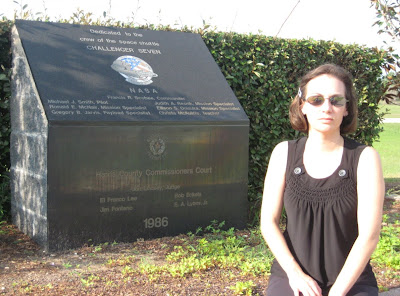
Challenger Memorial Park, Houston
(
Click to see full gallery)

We had all hoped for a more positive announcement in the President's first State of the Union address, and were disappointed to have no bold or visionary announcement for the space program.

Behind the scenes, and despite already spending billions on these goals, it seems Constellation has been crippled, Ares outright cancelled, and all the plans outlined by the Bush Administration dashed... another casualty of our current recession.

Possible loss of jobs, loss of stature as world leaders, and our inability to encourage new generations of youngsters to be passionate about science and astronomy... well, it’s a fearsome picture that bodes not well for our national future.

I won't delve into gruesome detail, because the news is all over the internet now in various space forums who are far more adept at "reporting" than I am. In between gritting my teeth at how maddeningly vague our leaders have been about how the chips will finally fall, I’ve forced myself to read between the lines: The life of the ISS has been extended, money will be forthcoming for LEO scientific experiments and other crucial projects such as the new Webb Telescope, but the way in which all the articles cite sources who "don’t wish to be named" or who "aren’t authorized to speak officially" is downright cowardly.

In my mind, I had a flash of Tom Hanks, playing Jim Lovell in Apollo 13: "We just lost the moon."

No lunar base, no clear path to Mars. A looming gap in launch and crew vehicles. No more giant leaps for mankind in the foreseeable future.

They tried to soften the blow by saying our hopes should rest with their plans to "encourage private industry" to collaborate with NASA in future endeavours... but for many of us, that’s just not good enough. Sorry to interrupt the fun and end the week on such a downer, but I guess if it didn't rain once in awhile, we'd never appreciate the sunshine.