Friday, January 1, 2021

Star Wars Gonna Star War

 2020: the year all SciFi events were wiped off our calendar. Our R2-D2 is currently beneath a dust cover, unable to attend the Galactic Outpost, SW Celebration, or even small Comic Cons. 2021 is no  huge improvement, but we have high hopes that we might get the droid out of the house by... autumn (?)


I try not to ramble about Star Trek or Star Wars too much on my social media, because many of my dedicated readers come here for NASA updates, but until the Mars Perseverance Rover lands in February, the only true highlight of the New Year is the ongoing splash in the Star Wars Galaxy.


In our bored isolation, we clung to Disney+ and spent months re-watching all the films, delving deeper into Clone Wars lore, and hunting down Easter eggs in Star Wars Rebels. Since we’d seen all these properties before, we were really just filling time between new episodes of The Mandalorian. 

Can I just say, Grogu healed us in ways we could neither describe nor define. It went beyond the whole “death by cuteness” memes of Instagram, Twitter emoji-ography, or cooing in the watch parties. Overall, I think the key to “Baby Yoda” was the appeal of innocence: he was helpless, but a fearsome firestarter. He was sneaky in charming, goofy ways, but saved the day with masterful heroics in desperate moments.  *No obvious spoilers* to the mind-blowing finale that we’ve now viewed three times, but we weren’t going to rest for a whole ‘nother year before we knew he was in good hand. Pun intended.


True to form, the voice of Grogu (Sound Engineer Dave Acord) broke our hearts. It was often said in the 1980s that half the audience watches Star Wars for the explosions, but the other half watches for tragedy. But, before leaving us hanging, producers kept the dearest portions of innocence intact among the players. Din Djarin initially saw himself reflected in this tiny, abandoned, endangered foundling – and it may have been the only thing in his adult life to convert his customary stoicism into emotional investment. His tangle with the Dark Saber of Clan Vizsla seemed like an optional storyline, but has now clearly set up Season 3. We now all have a year to worry that Grogu will be absent, unless they craft ways for the duo to cross paths again.


It didn’t escape my attention that in the quick, explodey flashbacks of Djarin as a child, he and his parents both dressed in scarlet robes. Might they, like Lyra Erso and Chirrut Îmwe in Rogue One,  been connected somehow to the Whills? Had they lived on planet Jedha? I didn’t want to overthink the inferences, but couldn’t help wondering if the Mandalorian would eventually join Djarin and Grogu’s paths by concluding they were “destined” to find one another, by virtue of connections to Force guardians, like the Brotherhood of the Beatific Countenance.


Crafters of Star Wars stories, in particular Lucas-worshippers and combinatorial storytellers like Jon Favreau, do not utilize details in an incidental manner. There’s always a can of worms waiting to be placed on a fishhook somewhere. 

I still cannot believe my friends at Lucasfilm kept these secrets for yeeeeears at a time – but above all, Star Wars creators are dedicated to shock value. Part of the joy of watching Grogu’s story unfold was that it packed the same punch that Yoda did in The Empire Strikes Back (1980), where amid a decade of macho bullet-laden movies, we all had to wrap our brains around the most powerful magical samurai in the cosmos being a little green hermit who just wanted peace and quiet. Forty years later, his origins are still a mystery. But is it a mystery we even want solved? 

I’m torn. I’d rather know how Sabine lost the Darksaber and why Bo-Katan of Clan Kryze was so keen to find it. I’d also perhaps rather see Din Djarin land on Mandalore with the Fett, and stir up the shenanigans we know are sure to follow in that austere, fractured culture. I suspect they will lose a fair amount of viewers from the show if they simply pick up where SW Rebels left off, and don’t find some way to incorporate Grogu into the tale.


One thing is certain: this tiny character LANDED, like few others did in the most recent film trilogy. Getting Star Wars fandom to agree on any single point is nearly impossible these days, and Disney would be missing a serious opportunity if they did not design a new trilogy around this infant Force wielder who faced down a Moff and traveled the Outer Rim before his first day of school.

Are there more Little Green Men on a faraway home world somewhere, or is only one of these Jedi born every millennia or so? Will we ever get a name for the species of Yoda, Yaddle, and Grogu? Given that The Child was born the same year as Anakin, perhaps he was the fabled creature who would bring balance to The Force, and not the Skywalker clan.  The story could take any number of turns in the wider story timeline (click to embiggen):

I can’t imagine a world where the idea of a Grogu trilogy isn’t already generating scripts or at least meetings in slick Los Angeles conference rooms, high in the sky where the people who make the big decisions find ways to have Star Wars ask all the big questions about good and evil, light and dark, and… are we each products of destiny or free will? 

In the meantime, 2021 will bring us fully twelve new Star Wars shows to fill our quarantine hours. Which one are you most excited about? 

I’ll start. “The Bad Batch” !!

See other reviews of films, television shows, and books.

Thursday, December 17, 2020

Space Science Trilogy - The Formist Series

Exciting News! And just in time for Christmas. I used to do a full recommendation of sciency type gifts, including the galactic chocolates, cosmological music selections, and of course my favorite NERD product of all time... knee Spocks!


Har har. I'll show myself out... but not before I let everyone know about the newest book release by Matthew Williams of Castrum Press. If you are interested in accurate hard science in your #SciFi reading selections, I cannot recommend this trilogy enough. 

The author, whom you may follow on Twitter at @StoryByWill, is a science teacher who conducted absolutely bonkers amounts of research into our planets and satellites (those most likely to support life once we have a serious leap forward in propulsion technology). 

I reviewed the first and second books, The Cronian Incident and The Jovian Manifesto, which both received high stars on Amazon and Goodreads. I'm flattered to say I was contacted by the author, whereupon we had some delightful conversations about his very accurate depictions of space science throughout our Solar System. I got a sneak preview of his newest novel, and conclusion of the series, The Frost Line Fracture.


Of particular interest is the theme of pioneering -- a favorite among exploration enthusiasts -- and hypotheses of what sorts of cultures would arise on our inner planets versus the outer worlds.

From bio-implants to solar system stations to the particular engineering environments in each system, this is a well-developed story with believable settings and characters. The author has a firm grasp of exobiology and extremophiles that will please scientists who enjoy 'realism' in their reading, but enough possible future tech that will also please the space-opera crowd. 

Don't be afraid of methanogenic hydrocarbons -- the hard science is never overwhelming, but neither does Williams assume is audience is dumb by over-explaining anything. A nice balance is struck, here. The novel assumes you know the basics of aerospace, but even if you don't, you'll follow the heroes because you want to, as his reluctance transforms into purpose. 

The standout in terms of detail is the uniquely, culturally distinct factions, which could only be created with competent research on each environment, and projecting the imagination into the framework of what it would truly take to colonize places like Mercury, Titan, or Callisto. 

Join the Interplanetary Accord! Or bless the astronomer in your life with one book or all three. 

Merry Christmas everyone!

And may 2021 suck just a little bit less...

Tuesday, September 15, 2020

The Little Boy in the Library


Ronald McNair was African-American. For this reason, he was asked to leave a segregated library. He later became a NASA astronaut and the very same library is now named after him.

HONK IF YOU WANT THIS TO BE DONALD GLOVER'S NEXT MOVIE.

Space Force, or The Force in space??

McNair's richly complex and accomplished life deserves a biopic more than most, and I’m not just saying that because I’m bored with the actor they got to play Neil Armstrong. Overall, I could easily stand on top of a mountain and shout MOAR SPACE TRAVELER MOVIES until I get lava-larynx.

Having charted the missions & birth place and birth date of every astronaut who ever flew a mission, I've known the basics of Ronald McNair's career for years: he was the first to play a saxophone in space on STS-41-B (1984), he was the first astronaut of the Bahá'í Faith to fly a mission, and he was in charge of chemical experiments and Cinema 360 filming about the Space Shuttle. He was also a Trekkie, and I feel a kinship with all fellow Trekkies, of course. I even visited his center at the Aeronautics & Astronautics Department at the Massachusetts Institute of Technology, where he earned his PhD in Physics.

Ronald McNair Building MIT Boston


However, it wasn’t until I researched libraries for Nerdglorious Trivia that I learned of his civil rights resistance at the once-segregated Lake City Public Library in South Carolina. In 1959, around the time he was in fourth grade, McNair attempted to gather science-based materials, whereupon a Caucasian woman told him "This library is not for coloreds," and called the local police.

I'll repeat that. A librarian called the police. On a 9-year-old boy. For trying to check out SCIENCE BOOKS. 

Long before Permit Patty and Barbecue Becky, Library Lisa was on the job! Unfortunately, officers could have easily sided with her in this era, and lawfully removed Ronald from the public space, because signing of the Civil Rights Act of 1964 was still half a decade away. His mother, Pearl, was also summoned; both she and the officers encouraged the librarian to issue Ronald a library card as she did for the white children. Pearl McNair assured the librarian that her son would take good care of the books, and the librarian reluctantly let the elementary-schooler borrow the ones about flight that he had chosen.

Ronald's Big Mission - Children's Book

Decades later, after his untimely death in the Space Shuttle Challenger disaster, the library was dedicated to his memory. In addition, a children's book called "Ron's Big Mission" offers a fictionalized account of the library encounter.

Other things named in his honor? McNair Crater on Earth’s Moon, his hometown public memorial, a chapel, 2 streets, 4 University buildings, 2 parks, 20 schools, 152 scholarships, a theatre, a Masonic Lodge, and a public playground.

Can't seem to find the actual name of that librarian.

Ronald McNair playing saxophone in space
Ronald Erwin McNair (October 21, 1950 – January 28, 1986)
(click for video of life + mission photographs)


Wednesday, June 17, 2020

Ancient Moon Shadows

Is everyone ready for the Annular Solar Eclipse this Sunday, June 21st?  Charted a viewing spot? Got your glasses? Tracked the path of totality and calculated obscuration?

Now imagine that if you didn't fully prepare and estimate those facts accurately, you could be beheaded. Not a typo. Beheaded. Because history is wild. 

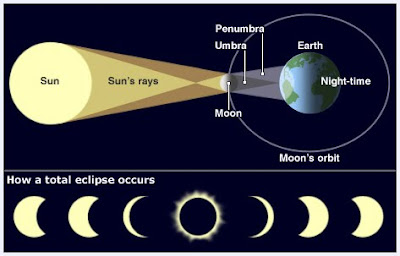
On October 22, 2136 BC, astronomers in China noted what is now the oldest surviving record of a total solar eclipse, which occurs when the moon passes between the Earth and the sun, causing the moon's shadow to fall upon Earth and block the sun from view.

In ancient China, astronomy was a government-mandated pursuit, and state astronomers had quite sophisticated observatories for their time. Good thing too, for observing solar and lunar eclipses, as well as tracking planetary orbits, were divination tools for predicting the fate of the Emperor.

If an Emperor could predict a solar eclipse, such was a good omen for his health; accuracy was helpful in validating that he was the ordained link between heaven and his subjects on Earth, endorsing his divine right to rule. Imprecise predictions could be seen as evil omens, or even result in a new ruler, whereby rivals for power might use the eclipse as a sign that they could overthrow one who had lost the blessing of the gods. Careful records were made of all solar eclipses. (Lunar eclipses were only haphazardly noted, being so common as to merit lesser import.)

Solar Eclipse
As early as 2650 BC, a star-gazer named Li Shu wrote about celestial bodies, in particular noting that the sun, earth, and moon moved in harmonious ways. Technology in ensuing years revolved around trying to forecast when certain events might occur so as to keep their political successions and societies more stable.

The fascinating field of "Archaeoastronomy" shed light on the Oracle Bones of the Shang Dynasty (1600 – 1050 BC), unearthed in Anyang, Henan Province. Hailed as the bones of dragons (though actually turtles or oxen), they represent some of the earliest Chinese writings. One such gem tells us that the failure to correctly predict the timing of a total solar eclipse resulted in beheadings:
"Here lie the bodies of Ho and Hi,
Whose fate, though sad, is risible;
Being slain because they could not spy
Th' eclipse which was invisible."

Surely these weren't the only two state astronomers to lose their heads, given how erratic solar eclipses can be in any specific geographic location. With so much at stake, precision was well sought after. By 720 BC, some Chou Dynasty astronomers recognized eclipses as "naturally" occurring phenomena, and not heavenly commentary on who held any particular throne. Still, diligent record-keeping continued up through the ages.

Oracle Bone
By the turn of the millennium, the Chinese had a firm grasp of what actually caused eclipses, and by 206 AD, they were predicting cycles by analyzing lunar orbits. Their records show that between 600 and 1300 AD, their solar eclipse timing predictions were often accurate to within about 20 minutes!

To see how it's done in the modern day, see the NASA Eclipse Website.

Also be sure to join me on Twitter tomorrow for my #TriviaThursday series, with everything you need to know about #Eclipse dynamics and safe viewing this weekend!


Monday, June 1, 2020

The Space Anniversary I'm Glad We Don't Celebrate

"Putting a man in space is a stunt. Man can do no more than an instrument, in fact, he can do less. There are far more serious things to do than indulge in stunts. As yet, the American people do not understand the distinctions and we in this country are prone to rush at any new thing. I do not discard completely the value of demonstrating to the world our skills, nor do I under-value the effects on morale of the spectacular. But the present hullabaloo on the propaganda aspects of the space program leaves me entirely cool." 

  Vannevar Bush Chairman of the Board Governors of the Massachusetts Institute of Technology < Well, what a relief it wasn't up to you, Vann man! The above excerpt is from a statement to the Congressional Committee on Science & Astronautics, made in June of 1960. And it's a 60th anniversary I'm pretty happy we don't celebrate. 

Vannevar Bush

Is it just me, or does he look like Gandalf?

 Of course, we're all very happy that Vannevar Bush (1890-1974) helped to end World War Two, made possible the position of "Science Advisor to the President" and founded the National Science Foundation... but after reading some of his materials (this is the sort of light reading with which I fill my free time), I'm equally happy that he was neither heeded nor funded by the federal government at this point in his career. This is one of those funny things, where I was reading biographical and technical information on a historical scientist, not intending to find any references to space or human exploration. 

While I knew Vannevar Bush had been on some aeronautics councils after WWII, I'd never known he worked long enough to speak to Congress about the space program. So shocked to find this excerpt... but I suppose the content was inevitable at the time. Not everyone was on board! 

Vannevar Bush Vannevar Bush represented the ideals and thought-paradigms of the previous generation -- one that wasn't ready to move forward, out of their protective stance made necessary by war. While he was happy to keep pace with and reward emerging scientific research, he represented a faction of our government who was not willing to seek new frontiers in the stars... and I cannot help but wonder if our current science advisers suffer from the same pessimistic blindness. 

 Do they also believe astronauts are merely stuntmen? No one walks around these days saying, "Wow, he sure hit the nail on the head 50 years ago. We should have spent all that money on something else and just been content with the practical applications of science instead of inspiring the world." 

And... in another 50 years?


Monday, May 11, 2020

Pluto & Friends


Research time! So it started bothering me that I'm fuzzy on the differences between Dwarf Planets, Trans-Neptunian Objects, Plutoids, Plutinos, Scattered Disc Objects (SDO), Kuiper Belt Objects (KBO) and Oort Cloud bodies.

I've seen these terms bandied about, but not even the schmoes who coined them can decide what's what. Occasionally, the International Astronomical Union tries to set definitions in stone, but no one ever agrees... so it's like a high-IQ version of Congress without all the fancy neckties and sex scandals.

I initially planned this post as a companion to the Pluto Trivia I'm preparing for a Twitters series. I encourage those interested to examine the linked definitions, and try not to start any fights. I settled for familiarizing myself with the most prominently debated objects, here listed smallest to largest:

1) Ceres
Classification = Former planet, Dwarf Planet, "largest asteroid"??
Approximate Diameter = 950 km
Ceres is the smallest identified "dwarf planet" in the Solar System and the only one in the asteroid belt between Mars and Jupiter, accounting for about a third of the belt's overall mass. Discovered in 1801, it was classified as the 8th planet for half a century. The surface of Ceres is a mixture of water, ice, and various minerals, with the possibility of sub-surface liquid oceans. NASA's Dawn space probe, launched in 2007, will reach and explore Ceres in 2015. Ceres was the Roman goddess of growing plants, harvest-time, and maternal love.

Trans-Neptunian Objects
2) Quaoar
Classification = Dwarf Planet, TNO (plutoid)
Approximate Diameter = 1260 ± 190 km
Quaoar is a binary system orbiting the Sun in the Kuiper belt, and the very first TNO to be measured directly from pictures taken by the Hubble Space Telescope! It orbits 3.7 billion miles from the Sun with an orbital period of 287 years. Quaoar is named for the creator god of the Tongva, the native peoples from what is now Los Angeles. It has one satellite, Weywot, which may be a collisional ice fragment, though details about its orbit are unknown. The sky god Weywot was the son of Quaoar in Tongva lore.

3) 2007 OR10
Classification = Dwarf Planet "candidate," TNO (plutoid), SDO
Approximate Diameter = 875–1400km
2007 OR10 is currently the largest known Solar System object without an official name, though its discovery team nicknamed it Snow White, as it would have to be very bright to be detected by their survey. 2007 OR10 is on an orbit similar to that of Eris, circling the Sun every 552 years.

4) Orcus
Classification = Dwarf Planet "candidate," Plutino, TNO (plutoid), KBO
Approximate Dimensions = 946.3 +74.1−72.3km
Because their mutual resonance with Neptune constrains Orcus and Pluto to remain on opposite sides of the Sun in otherwise similar motions, Orcus is oft described as the "anti-Pluto." Orcus was a Roman underworld god and punisher of broken oaths, likely adapted from the Greek demon Horkos, the personification of Oaths and son of Eris. Using observations with the Hubble, astronomers detected a satellite, as yet unnamed and circling every 9 days. Scientists suspect that like the Pluto-Charon system, Orcus and its moon are likely tidally locked.

5) Sedna
Classification = Dwarf Planet "candidate," TNO (plutoid), SDO, new DDO?
Approximate Diameter = 1600 – 1800km
Sedna's precise orbital period is unknown, but calculated at between 10-12 thousand years. At the time of its discovery, it was the largest object found since Pluto in 1930, and also the furthest from the Sun. (Eris would prove further, though Sedna's elliptical orbit will overtake it around 2114). Observations from NASA's Spitzer Space Telescope indicate it is nearly as red as Mars. In Inuit mythology, Sedna is goddess of marine animals, who rules the underworld (Adlivun), where souls prepare for travel to the Land of the Moon (Quidlivun).

Trans-Neptunian Objects
6) Haumea
Classification = Dwarf Planet, TNO(plutoid)
Calculated ellipsoid shape = 1,960×1,518×996 km
Haumea is a dwarf planet in the Kuiper belt which orbits the sun every 283 years. Calculations from its light curve suggest elongated ellipsoid shape, with its greatest axis twice as long as its shortest axis. Other indicators show unusually rapid rotation and a surface of crystalline ice. In Polynesian lore, Haumea is the Hawaiian goddess of fertility. Known moons are named after two of her daughters, Hi’iaka, patron goddess of the Orchid Isle, and Namaka, a water spirit.

7) Makemake
Classification = Dwarf Planet, TNO (plutoid), KBO
Approximate Diameter = 1800km
Makemake's discovery team used the codename Easterbunny for the object, because of its discovery shortly after Easter. In accordance with rules for Kuiper Belt Objects, it was named for a creator deity: Makemake was the creator of humanity and god of fertility in the folklore of the Rapanui, natives of Easter Island. Its low average temperature, about −243.2 °C, means its surface is covered with methane, ethane, and possibly nitrogen ices. Makemake orbits the sun every 310 years.

8) Pluto
Classification = Former planet, Dwarf Planet, TNO(plutoid)
Approximate Diameter = 2,390 km
Pluto, the most controversial due to its demotion from planet status, is about one-fifth the mass of Earth's moon. Like other members of the Kuiper Belt, Pluto is composed primarily of rock and ice. It has an eccentric orbit that causes it to periodically to come closer to the Sun than Neptune. Pluto was the Roman God of the underworld, derived from the Greek Ploutōn, another name for Hades. Pluto orbits the sun every 248 years, and has three moons: Charon (the ferryman who carried deceased souls across the River Acheron in Hades), Hydra (the multi-headed serpent who guarded Acheron) and Nix, (after "Nyx," the Greek goddess of darkness and night).

9) Eris
Classification = Dwarf Planet, TNO (plutoid), SDO
Approximate Diameter = 2,500 km
Eris is about 27% more massive than Pluto, making it the largest known "dwarf planet" in the Solar System, and the ninth-largest body known to orbit the Sun. Eris has an orbital period of 557 years. Discoverers originally called the object Xena, but the official name became Eris, after the Greek goddess of strife. There is one Eridian moon, Dysnomia, the demon of "lawlessness"... a humorous slant toward the first informal name, as portrayed by Lucy Lawless.

And for an absolutely brain-bending list of all the known TNOs, click here. I want all of these to be represented by chocolate!

Wednesday, April 22, 2020

Joyful Earth Day


I'm tickled pink and thinking green today on our big blue marble! I pledged my little garden and acts of blog advocacy on the Earth Day Network for the Billion Acts of Green campaign, and I hope everyone else is doing their part too!

The "Acts of Green" counter is up over 6.5 million! Good job, Earthlings! Let's work to keep our amazingly diverse planet safe, habitable for all creatures, wisely sustainable and as beautiful as it was before we pesky hairless apes invented gasoline and garbage.

Earth Day 2011
Yours. Mine. Ours.

Of course, for many workers in clean energy, green aviation, solar power research, ethanol development, wind turbine manufacturing, and a growing plethora of efforts to be respectful to our lush landscapes, every day is Earth Day!

Special shout out to the awesome folks who are experimenting with Sustainability Base Green Buildings, (I remember being hired to photograph this back in 2012 when it was still called the Ames Ultragreen!) for what we hope shapes the future of office building construction and maintenance.

VPE - PHL
Look Ma, no plastics!"

Following up on trivia series about the studies of planetary habitability of Earth, the Solar System, and exoplanets, and the now-public press release from the Visible Paleo-Earth project?

Data sets from the present day Earth and all the way back to 750 million years ago are available, and they are spectacular! Using a collection of satellite-based observations, scientists and artistic "visualizers" from NASA Goddard Space Flight Center stitched together observations of the land surface, oceans, sea ice, and clouds into a seamless, true-color mosaic of every square kilometer of Earth.
The PHL also has a great collection YouTube Channel, which includes various animations of their work:


My favorite is the compilation of rectangular maps, morphed together to show changes on Earth from 750mya onward; it's amazing to see what tectonics wrought over the many millennia, until finally, at the end the formations become the "recognizable map" of continents that we all know today. Wonderful job!

Wednesday, March 18, 2020

Système Solaire

A planet by any other name... Have you ever had a burning desire to know the names of all the planets in the Welsh language? I, for one, was afire with curiosity. Wonder no further: 

 English / Cymraeg 
Mercury
= Mercher
Venus
= Gwener
Earth
= Daear
Mars
= Mawrth
Jupiter
= Iau
Saturn
= Sadwrn
Uranus
= Wranws
Neptune
= Neifion
Pluto
= Plwton 

And now you know where J.R.R. Tolkien got his inspiration for the territories around Hobbiton. 

Nine Planets by Bill Arnett Renaissance techie Bill Arnett runs a delightful web site called NINE PLANETS, and for awhile he inserted a graffiti-esque "8" to observe the demotion of Pluto. More recently, he added the subtitle "We still love you, Pluto!" and all his information about the original nine remains intact. 

One of his most fascinating and well-researched appendices, in my opinion, is the Planetary Linguistics. 

I'm partial to the tongue of the Cymry as it is one part of my personal heritage, but this appendix lists popular, transitional, and dead languages -- from Sumerian to Latin to Olde English to Icelandic to Farsi to French. He also demonstrated how some of these terms evolved into the months of the year, and days of the week... Saturni... Saturn's Day... Saturday. 

 I had a splendid time going through all of these, and also googling some of the less obvious words that weren't related to Latin roots, only to find that many were separate names of deities, specific to the cultures in question. The best days are when I learn something new! I also love how he added the fictional Klingon jargon toward the end. Again, Pluto has not been removed (though it seems people aren't in any tearing hurry to add Eris, Haumea or Makemake. Maybe soon!) 

 And for those of you uninterested in the random etymology of floating rocks 0.00000102529 or more light-years away, well... sorry. I do this sort of thing when I get bored. I was in Wales this time last year, and I'm feeling that hiraeth. If it makes you feel any better, the rest of the week will be spent watching SpaceX news...!

Monday, March 2, 2020

GEO LEO Death by Acronym


This will likely be the single most depressing addition to my SPACE TRIVIA series, but it's important to know. If you easily lose your Zen to not-happy space news, skip me and go read The Bad Astronomer today instead. Awesome blog.
But, here are some bite-sized facts about space junk. At this time, pieces of orbital debris in Low Earth Orbit (LEO) and Geosynchronous Orbit (GSO) number in the tens of millions.

That's right, tens of millions. Nearly 20,000 of these are larger than 10cm. Particles between 1-10cm are estimated at about half a million. The rest are less than 1cm.

Orbital Debris in Low Earth Orbit
LEO

Orbital Debris is defined as a human-made object in orbit around the Earth which no longer serves a useful purpose, such as launch vehicle upper stages, spent payload carriers, derelict spacecraft, pieces resulting from explosions or collisions, and even tiny paint flecks released by impacts.

Most orbital debris reside within 2,000 km of the Earth's surface, or are in LEO.

How do we estimate the numbers and placements? Ground-based radars can detect objects as small as 3mm, and space-based detection systems can detect things as far as 40,000km out.

The US Space Surveillance Network tracks all orbital debris larger than 10cm. An average of one catalogued piece of debris falls back to Earth each day, and this has been the case for the past four decades.

Orbital Debris in Geosynchronous Orbit
GSO

In LEO and below, orbital debris circles at around 7-8 kilometers per second, or up to 18,000mph.

As a result, the International Space Station (ISS) is the most heavily shielded spacecraft ever flown. Nodes holding human crews and pressure tanks on the structure are able to withstand impact of debris as large as 1cm. The ISS can also maneuver to avoid tracked objects.

The higher the altitude, the longer the debris will remain in orbit. Debris left below 600km fall back to Earth within a few years, though precious little survives the super-heated re-entry through Earth's atmosphere. Things higher than 800km take decades to return. Above 1,000km or more? Those may circle for a century or more.

Geosynchronous Orbit as seen from Polar View
GSO Polar View

Most telecommunications and meteorological satellites operate at the 36,000km altitude in geostationary orbit, where the problem or orbital debris is less severe. Which is not to say... harmless.

If you participated in the UARS hype, and have nothing better to be indignant about this week, you can read all about how NASA handles Orbital Debris Re-Entry. Or if you want to be part of all future re-entry hype, you can sign up for NASA's "Orbital Debris Quarterly" newsletter.

Wednesday, February 12, 2020

Thy Chariot Does Not Await

Here we go again! The chariot story is circulating anew on the Twitterz. In not one but two strings, well-meaning authors are attempting to persuade us that the earliest styles of vehicles pulled behind beasts of burden ultimately set the standard from ancient times up through the space program. 

So say these champions of consequential causality, the span of two horses side-by-side (about five feet) was the original measure of uniformity. Roman roads were thus created to accommodate wheeled carriers of this width, which then spread across Asia, Europe, and the Americas. When roads became railroads, all the tools and surveys were standardized to continue engineering such widths. 

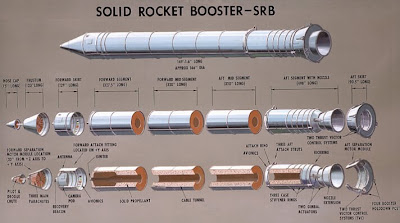
When the Space Shuttle was being developed, its Solid Rocket Boosters (SRBs) had to travel by train from their manufacturer to the launch pad. No matter how large or powerful NASA may have wanted them, they had to fit on flat train cars, and through train tunnels. And so the size of modern rocket boosters were determined by ancient Roman horse-drawn chariots.

Such a simple choice in ancient times, and yet, it had a huge impact on the world. Or did it? Sometimes, we just innocently enjoy believing stuff because it sounds cool. (But, you know, don't.)

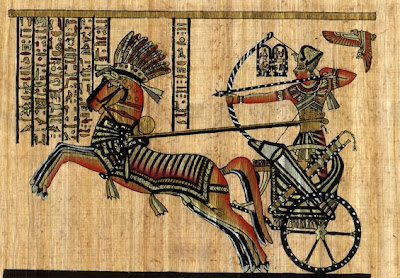
 Egyptian Chariot

One of many different designs of chariot
 

Our brains are primed to enjoy the neat, circular narrative. We love a satisfying story, and as evidenced by how far these tweet-strings travel -- often circulated thousands of times, they are almost impossible to counteract. Case in point, my polite explanation received only a fraction of the retweets. Even for the most patient of teachers, the effort is always an uphill battle.  

This urban legend has circulated every decade since the Space Shuttle program began in the late 1970s. 

The first thing to note is that Romans did not invent chariots. Second, the earliest roads over all kinds of terrain were simply human footpaths. The ground wasn't waiting around to say "hey, I'm a road now!" until chariots were invented (though certainly wheels did indeed carve ruts more effectively).

The third claim is objectively not true. Distances between railroads tracks (known as "gauge") have varied widely over the last two centuries, with three standards in the United States alone. The standard gauge used today is based on engineering practicalities, not ancient Italian equine technology.

 
Chances are, you will wear a white gown at your wedding. Roman brides did too. We still use plenty of things invented by the early Roman Republic and the later Roman Empire: candles, scissors, postage, showers, umbrellas, heating systems, street lights, rampant economic inflation, and so on.  

So, to say that ancient standards are still alive in the modern world isn’t all that exciting. Humans are well-known for sticking with certain things that work, and equally notorious for sticking with certain things that don’t. 

Archaeological evidence suggests the existence of chariots in far more ancient cultures: Chinese, Sumerian, Greek, Persian, etc. The Romans were late-comers, though they fancied-up chariot production with trigas (pulled behind three horses) and quidrigas (pulled behind four horses). So, while we can credit their empire with widespread road systems, they weren't overly attached to the simple metric of dual-equine-derrieres. 

 Methods and means of transportation have, throughout history, been designed different ways to carry different things and accommodate many different vehicles. Some have been dictated by creation costs, others by limitations of nature. From gravel paths to 14-lane freeways, a single lane often accomodates a car as small as a Mini-Cooper, or an 18-wheel rig.

Solid Rocket Boosters
Commonality of construction
is no more bizarre here than the idea that all current automobiles have steering wheels – regardless of brand, model, size, number of doors, or color. The Romans would have called such specification: "desideratum" – colloquially, that which is essential is desired. 

At the height of the railway era, over a hundred US companies manufactured three different gauges of track, showing a decided lack of standardization. The Chariot-to-Shuttle tale also assumes that any tunnel would only accommodate a single set of tracks, or only clear the train's mass with no room to spare. Also notice the mysterious mountain tunnel in question is never mentioned by name –- but between where the rocket boosters are built (Utah) and where they are ignited (Florida), there are actually 50+ tunnels.

Skepticism is the new black

We could muse at length over the patterns and rhythms of urban legends, but rest assured NASA takes travel into account when designing hardware specifications, but to my knowledge, NASA has never been crippled by the slightly-less-than-five-foot span of railroad tracks. No fewer than 20 companies contributed to the many parts of solid rocket boosters, so even if transport was the main event, much of the hardware is already delivered in segments, and "Some Assembly Required" is already a given on the launch pads of Cape [Kennedy] Canaveral. 


Monday, January 20, 2020

Quips & Quotes V


"When I was growing up it was really cool to be a scientist or engineer. We need to make science cool again." ~ Sally Ride

"When you advance frontiers, heroes are made." ~ Neil deGrasse Tyson


"It matters to me. People don't get in line to get autographs of the land rover." ~ Congressman Frank Wolf, in response to NASA Administrator Charles Bolden's statement that it "didn't matter" if America or China got a manned mission to the moon.

"All civilizations become either spacefaring or extinct." ~ Carl Sagan

Moon Beer
"In the beginning the Universe was created. This has made a lot of people very angry and been widely regarded as a bad move." ~ Author Douglas Adams

"Astronomy compels the soul to look upwards and leads us from this world to another." ~ Plato

"Our two greatest problems are gravity and paperwork. We can lick gravity, but sometimes the paperwork is overwhelming." ~ Werner von Braun

"It's human nature to stretch, to go, to see, to understand. Exploration is not a choice really: it's an imperative." ~ Astronaut Michael Collins

Astronaut
"We are just an advanced breed of monkeys on a minor planet of a very average star. But we can understand the universe. That makes us something very special." ~ Stephen Hawking

"Every so often, I like to stick my head out the window, look up, and smile for a satellite picture." ~ Comedian Steven Wright

"The Mars research has advanced my life in no capacity. How has it helped your life? Looks like Arizona, tastes like chicken. Billions of dollars. I think we should just blow it up and sniff it as it drifts past." ~ Actor Charlie Sheen

Tuesday, January 7, 2020

Galileo Figaro Magnifico


On January 7, 1610, Italian astronomer Galileo di Vincenzo Bonaiuti de' Galilei discovered Jupiter's satellites Callisto, Io and Europa. He was on a roll with his new-fangled telescopio, as only a week later on January 13th, he also spied Ganymede, later confirmed to be the largest moon in our Solar System.
These four Jovian moons, initially titled "Medician stars", are now referred to as "the Galilean satellites", and Galileo's observations of their orbits would be instrumental in over-turning the belief [cough*wishful-thinking*cough*cough] that ALL objects in the universe revolved around Earth, including our Sun.

Galileo
Galileo, Figaro, Magnifico, oh oh oh...

This particular Copernican concept was a hard-sell during the time of the Roman Inquisition. Various clerics – up to and including the Pope – denounced him as sacrilegious, censored his books, attempted to bar him from teaching or publishing, and ordered him to undergo a trial before the Holy Office of Rome.

At his sentencing in June of 1633, ten Cardinals of the Holy Roman Church, as commissioned by the Apostolic See as 'Inquisitors-General against heretical depravity in Christendom', read the following statement in court:

"We pronounce, sentence, and declare that you, Galileo, because of the things deduced in the trial and confessed by you, have rendered yourself according to this Holy Office vehemently suspected of heresy, namely of having held and believed a false doctrine: that the sun is the center of the world and does not move from east to west, and the earth moves and is not the center of the world, and that one may hold and defend as probable an opinion after it has been declared and defined contrary to Holy Scripture."

Galileo was placed under house arrest until his death at age 77 in 1642.

Galileo Space Craft JPL
Me with the Galileo craft model at NASA's Jet Propulsion Laboratory

A few centuries later, the joke was on them, since Galileo got a NASA spacecraft named after him to study those very moons; and to date, we have no spacecraft named after anyone in the Inquisition. So there.

Jupiter has 63 confirmed satellites, and one floating trouble-maker being argued over by chaps who are much smarter than I, so I'll not venture an opinion. Time will tell if #64 nails the audition, but in the meantime, the Voyager, Hubble, and Galileo craft offered interesting portraits of the fantastic four:

Solar System
Ganymede is larger in diameter than Mercury, with ice and silicate crust covering underground ocean in some areas. Abundant craters and mountains surrounded by lava flow indicate ancient origin.

The next largest, Callisto, is considered a likely spot for a human base when we reach Jupiter, as study indicates the presence of water ice, ocean, carbon dioxide and possible organics.

Io is the most geologically active object in the Solar System with over 400 volcanoes, many higher than Earth’s Everest. Lava flows often invade the frosty sulfur dioxide surface, creating yellow, red, green and black compounds, creating a "pizza planet" exterior.

Europa, smallest but perhaps best-known, is about the size of Earth's moon and has an oxygen atmosphere. Its bright, smooth [well, un-cratered] crust led to the hypotheses that it is quite young, and may also have oceans beneath its surface.

Tuesday, November 12, 2019

Lunar Ponderings


A stunning anniversary just passed: 50 years since Apollo 11. We have 6 more Apollo lunar anniversaries to go, (7 overall in this program if one counts the non-lunar Apollo-Soyuz Test Project). For years, I've tracked statistics of Apollo missions and astronauts as they aged. And each time I have to update my records, the solemnity of the loss halts all activity in my brain.

On December 19, 1972, upon the splashdown return of Apollo 17, there were 12 men on planet Earth who knew what it was like to walk on the surface of our Moon. This fact remained true for true for 18 years and 7 months.


Then, in August 1991, James Irwin (Apollo 15) died of a heart attack at age 61.

In 1998, Alan Shepard (Apollo 14) died of leukemia at age 74.

In 1999, Pete Conrad (Apollo 12) was killed in a motorcycle crash at age 69.

In 2012, Neil Armstrong (Apollo 11) died of heart failure at age 82.

In 2016, Ed Mitchell (Apollo 14) died in his sleep at age 85.

In 2017, Gene Cernan (Apollo 10 and 17) died of long-term illness at age 82 and Dick Gordon (Apollo 12) died of cancer at age 88.

In 2018, John Young (Apollo 10 and 16) died of pneumonia at age 978, and Alan Bean (Apollo 12) died of sudden illness at age 86.

Today, as we approach more 50th anniversaries of lunar landings, there are just 4 men left who remember traveling to and working on the Moon.

  • Buzz Aldrin turns 90 years old in January 2020.
  • David Scott is 87. 
  • Jack Schmitt and Charles Duke are both 84.
Among the other Apollo (orbiting or CSM pilot) astronauts, all are now octogenerians, with youngest Ken Mattingly reaching the age of 84.

Even if the youngest of them make it in to their 90s or to 100, will they see another Moon mission? Will they watch astronauts who are American or Chinese? Male or female?  Will it be just as inspiring to the world?

L to R: Charlie Duke (Apollo 16), Buzz Aldrin (11), Walter Cunningham (7), Alfred Worden (15), Rusty Schweickart (9), [Harrison] Jack Schmitt (17), Michael Collins (11), and Fred Haise (13).
PHOTO CREDIT: Felix Kunze/The Explorers Club

Some think we could pull off a Moon mission by 2024, though with how administrations roll (I've seriously been watching various plans and cancellations across my entire lifespan now), it will be more like 2027.
  • At that point, Buzz Aldrin will be 97. 
  • David Scott will be 94. 
  • Jack Schmitt and Charles Duke will be 91. 
  • Every living Apollo astronaut will be a nonagenarian. 
I wonder, will they make it? Statistically, the deaths in this tiny club are accelerating, and we can expect to lose a few more before we see a return to the lunar surface, given that even the best technological developments never seem to last past early stages. Anything could suffer cancellation again, in favor of Mars, Asteroids, or on the altar of war, economic depression, or unforseen disaster.

So, when we return to the Moon, if we return to the Moon, will anyone alive personally remember what it was like to visit the Moon?

Something to ponder.

Sunday, September 1, 2019

On The Moon in 1902

Thanks to the joy that is YouTube, I've been watching the very first science fiction film ever created in 1902. In fact, it was released TODAY, 117 years ago!  

Le Voyage dans la Lune or A Trip to the Moon was a produced and directed by Georges Méliès, and loosely based on stories in Jules Verne and H.G. Wells novels ("Earth to the Moon" and "First Men in the Moon" respectively). 

 The budget? 10,000 Francs or about $1800, which wasn't chump-change at the turn of the 20th century! (That would now be in the range of $50,000 dollars.) The silent film, originally narrated in French with a running time of 14 minutes, was extremely popular upon release, and is now public domain because its copyright expired after 100 years. 

Le Voyage dans la Lune The leader of an astronomical society proposes a trip to the moon, whereby most astronomers say the trip cannot be accomplished, but six agree to try. A hilarious scene building a "spacecraft" ensues, inexplicably showing men banging hammers onto what looks like a giant metal bullet! A pack of dancing girls push the bullet into a cannon, then "break the fourth wall" by waving to the audience! Makes me wonder if NASA ever considered hiring cheerleaders. 

The moon is characterized as a large face, and the space craft crashes into his eye – but then the view switches to a flat terrain. The astronomers fling open the hatch, disembark in their street clothes... and I guess "realism" in sci-fi mattered as much then as it does now – since they had no pesky problems with the atmosphere being breathable nitrogen and oxygen... too funny! 

 The astronomers watch Earth rise over the horizon, another understandable error of the time -- since to a person viewing Earth from the tidally-locked lunar surface, one side of the Moon always faces toward Earth and any such "rise" would only move slowly in a horizontal direction, taking many days to complete.  

You can tell I'm a barrel of laughs in movie theatres.


After the astronomers set up camp to sleep, a comet passes, and they are watched by human-faced stars in the shape of the Big Dipper. Saturn makes an interesting surprise appearance, but don't get me started on the snow flakes, the gigantic mushroom or the jumpy little Selenite acrobats exploding into smithereens. (???) 

Eventually, they are taken to a palace, where they kill the Moon King (we really can't be trusted to play well with others) and rush back to their big bullet. After toppling off a moon cliff and landing in Earth's ocean (I thought the jellyfish were nice touches), they are towed ashore where they are greeted by a parade. Hmm... wonder what Neil & Buzz thought of this masterpiece? ;) 


Tuesday, August 6, 2019

Moving To Planet Mercury


For any international readers, you may have noticed American social media buzz yesterday about a curious little holiday we call "Thanksgiving", which we pretend is about Pilgrims and Natives preparing meals together at the dawn of our colonial period. It's kinda not, but as with most holidays, we like myths more than we like historical facts.

This excuse to over-eat  is held each year on the third Thursday of November. Then, on the third FRIDAY of each November, we celebrate an even more curious custom known as... Wishing We Could Move To Planet Mercury.


Your Weight On Other Worlds
There is a great contraption at the San Francisco Exploratorium, where you can step on a large scale and see what you weigh on all the planets. I've been on it, and it's quite a fun experience. They also have their calculator on a web page, so you can see Your Weight On Other Worlds.

(I think it goes without saying, there will never be a book fad known as "The Jupiter Diet".)

Why the discrepancies? In simple terms, gravity is the force of attraction between objects. Gravitational pull is what makes the Earth orbit the sun, or the moon orbit the Earth. Suns, moons and planets are all surrounded by fields of gravity. These fields will be different, depending on things like planet size, mass, speed, its location in any solar system, and any other objects around it in space.

If Earth's force of gravity is measured at 1.00, force on other planets would be:

List of Planets and their Gravitational Forces
We'll include Pluto for the purists. And so I don't have to listen to any arguments.

More complex components of gravity come into play, but in general: the larger the object, the greater the gravity. However, the further away you travel from an object, the less you are affected by its gravitational field. Jupiter is the largest planet in our solar system, so it has the strongest field (except for our Sun, which is over 27+!). You cannot stand on Jupiter, because it's mostly gas. However, if it had a surface, the force holding your body on the planet would be much greater. This increases your weight, even though your mass remains the same.

At any rate, multiply your weight by any of these numbers, and you will see what you weigh on that planet.  Oh goody, math homework!


Monday, June 17, 2019

Scale of the Universe


THIS. IS. AWESOME.

Truly one of the most amazing pieces of visual art I have ever encountered in my life, and if you do nothing else on the internet today in your spare browsing time, visit this site to see The Scale of the Universe!

The Scale of the Universe
Cary and Michael Huang of HTWINS.NET released "The Scale of the Universe" in 2010, but recently updated their interactive visualization to include handy clickable descriptions... in twenty different languages!

The Scale of the Universe 2
Using objects varying in size from elementary particles up through the enormity of the entire universe, the scrolling "tunnels" help viewers grasp relative sizes in relation to creatures, known architecture, states and continents and finally planets and galaxies.

The Scale of the Universe
Ever wanted to know the difference between a Charm Quark or a Top Quark? Want to see the Cat's Eye Nebula? The Oort Cloud? Distance to the Hubble Deep Field?

Just click on the icons as you travel between Planck Lengths and Gigaparsecs.

The Scale of the Universe 2
Use the scroll bar along the bottom of the screen to move in and out of size comparisons, or simply flick the wheel of the mouse... if there is, in fact, a wheel on your mouse.

Don't go play The Scale of the Universe until you have some time on your hands, because you may get stuck there for hours!

Wednesday, May 15, 2019

Pillownaut Muse


After my follow-up DEXA Bone Scan last winter, and the nice article NASA's Human Research Program published about me and other past pillownauts in preparation for the new simulation protocols, I didn't expect much more to happen. It's been many years since my studies, and my blog is now only rarely updated.

I pondered perhaps "over-hauling" this site to be a #SciComm hub -- but honestly, I think there are so many great existing Science Communication sites, and I will work to amplify those. I figured I'd had my 15 minutes of fame, and decided to leave my old blog "as-is" as a historical record of how I lived through the unique experiences of Space Flight Simulations projects at NASA.

But. Every time I think I'll never hear about it again, another author or press outlet comes knocking. Last time it was Charles Wohlforth, and you should definitely still read his great book, "Beyond Earth: Our Path To a New Home in the Planet." My father was very impressed they devoted more space to me than to Neil Armstrong, so we may have to put that on my tombstone.

Along came Minute Number 16...

http://pillownaut.com/muse/muse.html


Muse Magazine asked to feature my studies and chose the same title, just spelled a bit differently! In "Beyawned Earth," writer Jen Mason compiled many of my past blog excerpts, a few older press turns, and many of my personal photographs from quarantine into an exceptional article designed to teach students about space flight and how it affects the "biological packages" that travel in spacecrafts.

Reading the finished product, I was definitely the happiest I've ever been with an interview. I've had TV and radio stations ask me exhaustingly inappropriate questions; sometimes even reputable outlets go for the sensationalist spin by giving the study clever little [incorrect] nicknames or dwelling on incidental details, like how we manage to shower during simulations, or that we cannot have sugar or caffeine or salt in quarantine. Sure, those things are challenging, but not life-threatening. They pale in the quest for good data.

http://pillownaut.com/muse/muse.html


However, MUSE Magazine hired a skilled and serious writer who truly nailed the science. After literally a decade of interviews in varied formats, and even being featured on the NASA website itself, this was really the first full-length article that revolved around MY OWN WORDS REGARDING MY OWN EXPERIENCES. This is the closest article to what I would have written myself. Maybe someday, some outlet will invite me to do so. Hope springs eternal.

I was gratified that this particular entity put the science in detailed and accurate terms, because it's directed at students and young adults potentially getting started in scholastic concentrations, and beginning to think about choosing majors.

Issue came out in March, and I was thrilled to receive copies by May, after I returned from my 6-week trek in Europe. You can order back issues of Muse Magazine yourself, or subscribe your teens, at Cricket Media.

My entire list of articles has been updated to include the last 2 years.