Wednesday, August 31, 2011

Why Astronauts Cannot Whistle In Space

Share

I'm surprised Congress hasn't moved their operations to low earth orbit, since there can (quite literally) be no whistleblowers in space!

IO9 recently reported on Why Astronauts Can't Whistle in Space, claiming that the fact was "discovered" by Dan Barry in 1999… but that's rather like saying Cristoforo Colombo "discovered" America when there were already human inhabitants on the continent. Another case of HE WASN'T EVEN CLOSE TO BEING FIRST.

Of course, trying anything in the vacuum of space would result in swift death, so it comes down to: can you whistle in the space station? Yes. Can you whistle while inside of a space suit? No. In the Apollo era, many of the moonwalkers found they could not whistle inside the Lunar Module or in their space suits. The short answer then and now? Air pressure.

Space whistling
Not so fast, pal!

For humans to create whistle sounds, they must suck or blow a controlled airstream through the lips, teeth, and tongue in such a shaped, narrow way that creates turbulence, which must in turn vibrate fast enough to produce audible tones. This is fairly simple to accomplish in the 14+ psi (pounds per square inch) of breathable air close to the Earth's crust.

By contrast, space suits re-circulate air with only about 4 psi of pressure – not nearly enough to create that necessary labial turbulence. Not enough air molecules? Not enough vibration? No whistle.

Astronaut whistle
Why Female Astronauts Don't Miss Whistling

Astronaut trainers have for years told astronauts once they are in their suits, deliberate or absent-minded attempts to whistle while they work, but space-walkers feel the need to put it to the test, as evidenced by similar interviews of astronauts Jeff Hoffman, Jim Reilly, Mike Fossum and Ron Garan, among others.

So, time and time again we prove we cannot whistle in space. Hey, there's no such thing as a "good hair day" in space either, but why should we care? Coifs? Whistling while we work? Does it matter? Probably not.

It's just a reminder of how different life can be away from Earth's atmosphere. Likewise, all bets are off when we leave the gravitational field, leave the magnetic field, and/or leave the biosphere of Earth behind. We did not evolve in the vacuum of space, and it will thus forever be a foreign environment, full of surprises great and small.


Tuesday, August 30, 2011

Fragile Oasis

Share

"As we got further, Earth diminished in size. Finally, it shrank to the
size of a marble, the most beautiful you can imagine. That warm,
living object looked so fragile, so delicate, that if you touched it
with a finger it would crumble. Seeing this has to change a man."
~ James B. Irwin, Apollo 15

You've been to the Fragile Oasis web site, haven't you? Everyone knows when an astronaut starts embracing social media, right? Well, that's what I thought. Sometimes, I don't bother commenting on or writing about things that seem "obvious" to me… like everyone in the space community knows about certain things that simply don't need mentioning.

However, I just had an online conversation with some Spacetweeps yesterday who hadn't yet visited Fragile Oasis, begun by astronaut Ron Garan in June 2010, and I was shocked. Shocked, I tell you… shocked! ;)

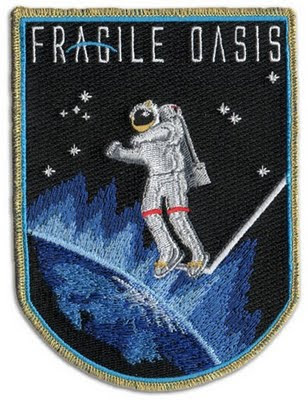
Fragile Oasis mission patch
Some astronauts have blogged while on assignment, and still others have joined Twitter or Facebook, but few have been as dedicated or prolific in their writing as Ron Garan, who shares his thoughts on training in Russia's "Star City", quarantine, flight traditions, living and working in the ISS, and how one comes to think of our amazing world when they get to see it from 250 miles up each day.

The Bloggernauts section features an archive of posts from Ron over the past year, as well as posts from fellow astronauts Don Pettit, Doug Wheelock and Nicole Stott; guests posts are a frequent treat, most notable from Russian Cosmonaut Dmitri Kondratyev, singer/songwriter John Ondrasik, and Cirque du Soleil founder Guy Laliberte (Canada's first private space traveler).

You can also see some great materials about Fragile Oasis on Twitter and Vimeo, where their roving reporters go to events and ask people what they think about our planet Earth. And yes, I'm in there chattering ;)

Astronaut Ron Garan
Astronauts are the lucky few who get to rise far above the Earth and see our planet in space in a way no other humans can, and this tends to have a dramatic emotional effect on their psyches. They see the oneness and beauty of everything without national borders, without close-ups – and they are able to do so as a result of scientific progress that MUST continue forward.

"The stark contrast between the beauty of our planet and
unfortunate
realities of life for many inhabitants reaffirmed
the belief I share
with so many. Each and every one of us has
the responsibility to leave it a little
better than we found it."
~ Ron Garan, STS-124 & Soyuz TMA21


Fragile Oasis
Fragile Oasis started as a blog, but has now grown to include a community of shared projects, and an interactive map of where all the members are seeing their Earthcare projects through to completion, including green business initiatives, energy-efficient engineering, famine relief, disaster preparedness, widespread literacy & education concerns, and clean water efforts.

It all started from an orbital perspective, once we'd be wise to share. Come check it out, and vote for projects to follow where you live! Thanks, Ron!

Thursday, August 25, 2011

Space Race 2012

Share

In honor of the 50th anniversary of Seattle's Space Needle (1962-2012), click here to enter the sweepstakes being held by Space Needle LLC. Over the next few months, the following prizes will be awarded:

September Winner: Celestron NexStar 8SE Telescope

October Winner: Breitling Aeromarine Colt Quartz watch

November Winner: SuperCade Upright Classic Arcade Machine

December Winner: Seattle & Space Needle Adventure Vacation

Finally, a thousand entries will be chosen in December, and as of 2012, one final winner will receive a seat aboard G-Force One for a Zero Gravity experience.

Space Needle Contest
The fine print? Ah yes, there's always fine print beyond the "no purchase necessary", LOL! Of course,

Here's the kicker: The "Trip to Space" (a slight misnomer since it's really more of a "Trip Through Parabolas") will be awarded to the winner of a skill-based competition that is separate from the ongoing Sweepstakes. The competition is governed by its own rules and restrictions, separate from the monthly giveaways.

One thousand potential winners will be selected randomly from all the entries received between August and December. Then, since they are calling it the "Competition Contestant Prize Drawing", one assumes we will all compete against one another. They don't say what sort of competition they are cooking up, but I entered anyway, on faith that I'll have a bash at whatever it turns out to be.

ZeroG
You can click to their rules page to see all the other fine print and the retail value of the various prizes. Once a participant has been selected as the potential prize winner of any prize in the Sweepstakes, he or she becomes ineligible to win any other Sweepstakes prizes.

Overall odds of winning the monthly prizes or the grand prize at the end will depend on the number of eligible entries over the next four months. Participants need not and may not be present at a drawing to win… so, one assumes they will be contacted by email.

Wednesday, August 24, 2011

US Leadership in Space

Share

When I have writer's block (like now) and have trouble getting posts started (like this week), I tend to go minutiae-hunting, and just wait for some sort of passionate inspiration to hit me. I always wonder if people can tell? There are many space issues and projects over which I am naturally passionate… but, actively seeking things to write about can often result in stumbling over things that peeve me.

Like this:

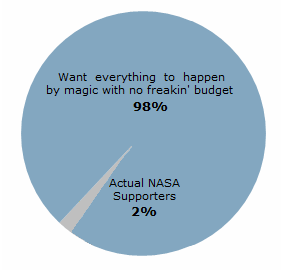
Seems the Pew Research Center of Washington DC, whose catchy motto is "Numbers, Facts and Trends Shaping Your World", released the dubious statistic that 58% of Americans see US leadership in space as essential.

Pew Research
Really? I'm certainly not seeing this professed "majority" of support. And I don't think this is entirely an education problem… maybe it's just a lip service problem.

The Pew Research Center @pewresearch professes to be a nonpartisan "fact tank" that provides information on worldwide attitudes and trends by conducting public opinion polling and social science research. They (it?) claim(s) to not take any position on policy for any particular issue, however...

Honestly, if you asked the proper question about this issue, I'm pretty sure the pie chart would look more like this:

Pew Research
Still, the article on the Pew Research web site about the Space Shuttle Program is definitely worth reading. Looking back, a majority (55%) say it has been a good investment for the country, and that it is crucial for America to be the world leader in space exploration. While this is lower than it was when the shuttle program began in 1981, six in ten people (or more, across certain demographics), said the program was a good investment in terms of:
  • Helping to encourage interest in science and technology
  • Leading to scientific advances that benefit all people
  • Contributing to national pride and patriotism

Ed Stein Space Cartoon
A couple of my readers and a few of my friends have pointed out my recent posts have rather a sarcastic bite. True. It's part post-shuttle-launch-anti-climactic-letdown, part fear of what's to come for manned spaceflight. If anything.

In the re-worded words of flight director Wayne Hale, HOPE ISN'T A PLAN. Write to your senators and congresspersons!