Thursday, December 9, 2010

New Space Era X

Share

And today, the blogosphere is awash with excitement about the little capsule that could! Congratulations to everyone at SpaceX for the successful launch of the Falcon 9 rocket, and the successful orbits and recovery of the Dragon spacecraft. The latter will now undergo a deep forensics examination, and many have already predicted that it will wind up in the Smithsonian.


Videos of the events and comments by NASA administrator Charles Bolden are available on the YouTube Channel for NASA TV. Nothing burned up! All three chutes opened! The capsule splashed down on it's exact target! Wow.

Of course, within moments, CNN featured Time Magazine asking, "Is NASA Irrelevant?" LOL, one suspects they have been saving that one for any hint of a commercial space flight success! I was gratified to see many people defend NASA in the comments section of this extremely inaccurate and poorly researched article, utterly unworthy of Time in its misleading rhetoric. SpaceX is a commercial partner of NASA, and this was all part of a NASA program, founded to develop commercial launch systems.
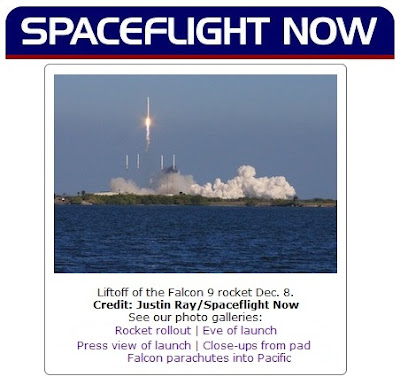
SpaceFlight Now Mission Status Center
I won't rehash all the details here, because NASA TV is re-running it incessantly as we speak; and write-ups appear on every space site today, from Discover to Spaceflight Now! Though speaking of SpaceFlight Now, I think they had the best real-time coverage and photograph galleries, so I'm happy to re-direct people to their Mission Status Center for an overview.

SpaceX CEO Elon Musk seemed downright dazed and uncharacteristically ineloquent at the post-mission press conference, but who can blame him? He thanked NASA at length, insisting they could not have done what they did without this particular public sector + private sector partnership, because all of their work is based on decades of NASA's core technologies.


Some other Elon Musk quotable quotes:

"It's hard to be articulate with a blown mind."

"People think the difference between cargo and crew required enormous amount of magical pixie dust, but this is not the case. If there had been people sitting in Dragon today, they would have had a nice ride."

"Will it quiet our detractors? If there are people who are going to cast aspersions on what was done today, I pity them. It wouldn't make any sense; they'd be fighting on the wrong side of yesterday's war."

The Dragon capsule carried a few thousand patches, SpaceX employee badges, and various other small keepsakes from the designers, but sometime today they will also mention a "secret payload" that was aboard their first flight. Musk was mum on the details, but assured his audience that "if you like Monty Python, you'll love the secret payload."

A can of spam? Albatross?! Can't wait.

SpaceX is the first non-government entity in history to orbit a spacecraft and recover it back on Earth. Very few people outside the space geek crowd truly understands what occurred today, and it may not be fully understood for some time – but if you watched and understand the gravity of this event, you are part of a minority who understands that a new space age has just dawned.

Wednesday, December 8, 2010

Flying Dragon

Share

We of the Geek waited nervously at T-minus 13 minutes for what seemed like an eternity of comfortingly technical chatter this morning, hoping to see the SpaceX launch. Friendly talking heads startled us every now and then with status updates.

Falcon 9 is the second test flight of the Falcon launch vehicles (Falcon 1 achieved orbit on its fourth attempt in September of 2008), and the first test flight of a Dragon capsule, which we hope will be able to reach the International Space Station, with a crew of up-to-7 people, and/or various cargo. What's all the fuss about, you ask? You don't see the NASA logo anywhere, so what is this hardware taking up space at a Cape launch complex?

Falcon 9
This event marks the first time a commercial company is attempting to launch, orbit a crew-capable spacecraft, and "re-enter" that spacecraft from orbit.

At T-Minus 2:48, the major hitch of the day was a false telemetry reading on the ordinance interrupter, which is a part of the flight termination system. John Insprucker of the Falcon 9 team said they corrected the database on the ground computers, and declared everything was safe. Around 10:30am, chatter began again in earnest, with numerous people in mission control shouting GO!

If you aren't into the anticipation of launches, there is nothing I can say to convert you until you try it. I understand most people wouldn't sit around for hours staring at a launch pad -– because more often than not, you wind up deflated and disappointed because of an abrupt abort.

However, on the days when large launch windows allow time resets, additional tries… and then everything works out, the rush is magnificent!

15 Seconds After Liftoff
The launch was awesome!! Amazing to think that this was a private company that pulled this off!

Says SpaceX CEO Elon Musk, “This will be the first new American, human-capable spacecraft to travel to orbit and back since the Space Shuttle took flight three decades ago. The success of the NASA COTS program shows that it is possible to return to the fast pace of progress that took place during the Apollo era, but using only a tiny fraction of the resources.”

COTS is the Commercial Orbital Transportation Services, a program begun in 2006 to attempt the construction of crafts able to reach the ISS, and it would appear SpaceX is well on its way. So exciting!

Dragon Spacecraft
The big questions surround the Dragon capsule now: Can it achieve orbit? Can it be operated remotely during orbit? Can its heat shield withstand re-entry and descent? Can it be recovered properly upon splashdown?

The flight coverage tanked around the +11:00 mark, but continued details about orbit, splashdown and recovery will be announced on their SpaceXer Twitter feed, Space X Facebook page and of course, the SpaceX main website.

Monday, December 6, 2010

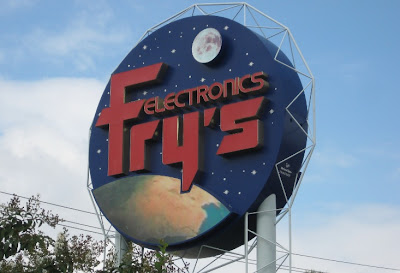
Fry's Space Station

Share

Today, I'm uncharacteristically featuring a "tourist attraction" of sorts near the NASA Johnson Space Center… though I wonder how many of visitors to Houston find this gem?

Technically, it's a retail store masquerading as a nerd mecca, and I'm not promoting anything it sells in particular, but it's worth a visit. The exterior is made to look like the International Space Station, and the interior features a giant scale replica of the ISS -- not accurate down to each specific piece, but darned close, down to the mechanical CanadArms!

Fry's Electronics in Webster (Southeast of Houston)
The South Houston Store: ISS Theme

Fry's Electronics, Inc. was founded in Silicon Valley to supply hi-tech professionals, and now has 34 stores in nine states, ranging from 50,000 to 180,000 square feet! Each store carries its own unique theme, so they are really fun parks in a sense. Stores across the USA have Aztec, Egyptian, Roman, Mayan, Tahitian and Wild West themes… also, would you believe Atlantis and Alice in Wonderland? Of course, the Anaheim store is worth a mention here, since their theme is the NASA flight deck of Space Shuttle Endeavor, complete with launches on huge TV screens (shown on the weekends).

The store nearest Space Center Houston depicts the history of space exploration in murals and artifacts, along with the "true-to-life-sized" floating habitat. No small feat, since the ISS is now roughly equal to the length of a football field!

Fry's ISS Replica
Click to see the entire gallery...

The above photo is a view of the Russian Orbital Segment of the International Space Station, as seen from the Software section of the store. Full-scale mockups (from left to right) of the Soyuz capsule, the Zvezda ("Star") module, and the Zarya ("Dawn") module can be seen, beneath the actual-sized solar arrays.

I walked all around the store, photographing the space-themed paintings and structures, and uploaded all the results to the Houston gallery in my Picasa Albums… where you can also see the various spacecrafts, tethered space-walkers, the Japanese Kibo module, the American Unity (node 1), the Destiny Lab and all the various truss segments... some of which have been "tunneled out" to accommodate products or seating areas.

Such a novelty! I should have taken video. If anyone visits the space themed Burbank or Anaheim stores, I'd love to see your photos, too... email me!

Thursday, December 2, 2010

Ten Questions For Science

Share
Science
The Royal Society of London for the Improvement of Natural Knowledge was founded by King Charles II in 1660. In 2010, Britain's renowned “Royal Society”, as it is now abbreviated, celebrates 350 years of practical scientific inquiry and experimentation. Today, they act as scientific advisors to the United Nations; and their committees and policy centers finance over 700 research fellowships, and also awards annual medals accompanied by prize money intended to fuel research.

One of the milestones of the anniversary was the academy's leading thinkers compiling 10 Questions That Science Must Answer… and a very interesting set of questions it was. What are the issues of our age that need be solved or pondered by the Big Brains?

The Royal Society

I have to say, some of these surprised me in terms of simplicity, since a fair number of arguments are well-worn in their fields, but perhaps enjoyed only contested conclusions. Others will bear out in time, certainly... but still others are rather depressing question marks.

The ten questions were:

1. Kathy Sykes (Bristol University Professor of Sciences): What is consciousness?

2. Dame Joan Bakewell (BBC Journalist): What happened before the big bang?

3. Mark Miodownik (King's College Physicist): Will science and engineering give us back our individuality?

4. Tracy Chevalier (Novelist): How are we going to cope with the world's burgeoning population?

5. Marcus du Sautoy (Oxford University): Is there a pattern to prime numbers?

6. Brian Cox (LHC Physicist): Can we make scientific thinking all pervasive?

7. John Sulston (Royal Society Chair): How do we ensure that humanity survives and flourishes?

8. Andrew Motion (Poet Laureate): Can someone explain adequately the meaning of infinite space?

9. Lionel Shriver (Novelist): Will I be able to record my brain like I can record a program on television?

10. Piers Sellers (Astronaut): Can humanity get to the stars?

I was gratified to see they included one of the eminent European Astronauts in their published list (three-time Shuttle veteran), who asked what I considered to be the most pressing question… but I realize I'm quite biased. One other of their chosen essayists also mentioned space as a necessity:

Ten Questions For Science
Various European news outlets have reprinted these with detailed paragraphs of the asked questions, and hefty biographies of the ASCIIs (hat tip to whomever gets that joke). It's definitely a time investment to read the entire article, but well worth it.

Except for #8, as one suspects that Mr. Motion wasn't taking this endeavour altogether too seriously. Amusing, but he might have picked a less solemn forum to discuss his theories about his cat.