Monday, August 30, 2010

Space Animals Timeline

Share

During my research this month, from both books and the NASA archives, I compiled an exhaustive list of all mentions of animals on space missions. I turned up more than anticipated, and far more than bargained for in terms of note-taking. Wow.

Of course, we are all most familiar with missions upon which humans were sent, but technically, these are also simply "biological packages" on board, and the goals are the same: keep the biological entity alive, and see how it reacts. Quite literally THOUSANDS of living creatures have been launched into space, and only a scant few hundred of those were human.

Life Sciences Studies
Some of the most interesting, and oddly, the least popularly known, were the three Biosatellites, carrying fruit flies, parasitic wasps, flour beetles and frog eggs, along with bacteria, amoebae, plants and fungi. Talk about upstaged by Apollo, but no one begrudges that! Their stories are quite interesting however, and I encourage everyone to go learn about:
The Orbiting Frog Otolith of 1970 and NASA Ames' Genesat of 2006 are also considered "biosatellites" –- though they were part of different programs. Each assessed the effects of space flight on living organisms, and all but BioSat 1 were successfully recovered at the end of their missions.

While I found many records of international collaboration, they were scattered and I could really only attempt a comprehensive view at the American space program's animals –- or at least the closest estimation. I haven't got access to a lot of the material from other countries, and/or they do not post informational history on their public servers.

But click and take a looksee... this list will blow your mind... =)

Sunday, August 29, 2010

Space Animals Trivia

Share

If you've been reading along this month, you should know most of the missions to which these facts refer!

In September 1968, the Soviet Union launched two horsfield tortoises, wine flies and meal worms in the Zond 5 space craft, which completed a circumlunar voyage (i.e. traveled around the Moon) and came safely back to Earth – making these the first living things to survive "deep space".

Russian Tortoise
Only the Apollo 13 crew flew further

During the 1950s and 1960s, the Russians launched missions that included passenger slots for at least 57 dogs. The number of animals that actually reached space is smaller, as several dogs went more than once. No monkeys or apes ever traveled into space more than once.

Russian spacedog Strelka's puppy, Pushinka, was presented to John and Jacqueline Kennedy as a gift in 1961. White house staff had her X-rayed to check for any devices before turning her over to the children to play with. Many of her descendants are alive today.

Widely newsworthy Enos the Chimp tested the Mercury craft for safety and stability in an orbit around the Earth, then John Glenn flew his orbit around the Earth. Glenn was invited to meet President Kennedy after his historic flight. Also present was an obviously unimpressed Caroline Kennedy, then aged 5, who looked up at John Glenn and demanded, "Where's the monkey?"

John Glenn never saw it coming
"Dad, tell the nice space man I'd rather meet the monkey."
(Well, technically, little miss... it was an ape.)

A biological payload record was set on April 17, 1998, when over two thousand creatures joined the seven-member crew of the Shuttle Columbia (STS-90) for a sixteen-day mission of intensive neurological testing (NEUROLAB).

On July 12, 2006, Bigelow Aerospace launched their Genesis I inflatable space module, containing experiments to be observed on camera. Mexican jumping beans (i.e. - seeds containing live moth larvae) and hissing cockroaches were aboard, making it the first private flight to launch animals into space. On June 28, 2007, Bigelow launched Genesis II, which also carried roaches, as well as harvester ants and scorpions.

Trivia Q of the day:
Anyone catch the Beagle tie-in to Archer (Scott Bakula) in the newest Star Trek flick? Go watch it again, pay particular attention to Engineer Scotty's lines when he is introduced ;)

Friday, August 27, 2010

All In The Family

Share

In Russia, if had there been no space dogs, there would have been no orbiting Yuri. Meanwhile in America... no monkeys or apes? No Shepard or Glenn. It's that simple.

Many people are surprised to find that "space monkeys" preceded the official establishment of our space program by over a decade. In 1948, NASA didn’t exist yet, but launching macaques (Rhesus monkeys) past Earth's atmosphere with V2 rockets did. Cynomolgus and Squirrel Monkeys followed in the 1950s-60s. Each attempt measured vital signs of the monkeys in different positions, in order to examine biological effects of space travel, though few had happy endings.

Like the dogs, this is another one of those posts where I won't go too in-depth… there are entirely too many monkeys for a narrative, and there are already many pages out on the web that detail their stories. I'd be just another re-hashing spot. So, I'll stick with the Greatest Hits and simply pepper the post with links to further study for those who are interested in delving deeper.

Able and Miss Baker
Able and Miss Baker at 1959 Press Conference.
Click to see their LIFE MAGAZINE cover

1940s: In June 1949, American macaque Albert II became the first monkey to officially reach "space" when his rocket reached 134 km (83 miles) -- past the now-internationally recognized Kármán line of 100 km (62 miles).

1950s: In May 1959, the big stars in the news were Able and Miss Baker, the first two monkeys (rhesus and squirrel, respectively) to return safely to Earth, having actually survived space flight at an altitude of 579km (360 miles). In December of the same year, SAM the rhesus monkey was the next Mercury subject to capture headlines, though his flight only reached 53 miles.

Ham
Primates, unlike many other animals, can be trained to look as
if they are actually enjoying all this space-training nonsense!

Early 1960s: In January 1961, HAM the chimpanzee was the first ape in space, having been chosen as the best trainee among 40 potential astro-chimps. He was the first to be trained to operate levers inside the space craft, a crucial step that demonstrated the ability to perform tasks in weightlessness.

Just over 3 months later, Alan Shepard went into space, and he was none too happy about sharing the spotlight with an ape!

In November of that same year, Enos the chimpanzee because the first ape to orbit Earth, followed closely by John Glenn, who handled the situation a bit more deftly by poking fun at both himself and the primate who "beat him to the punch and probably flew the craft better."

Late 1960s: France launched two pig-tailed macaque named Martine and Pierette on Vestas rocket in March of 1967. The US launched the macaque, Bonny, in 1969.

1970s: No monkey business.
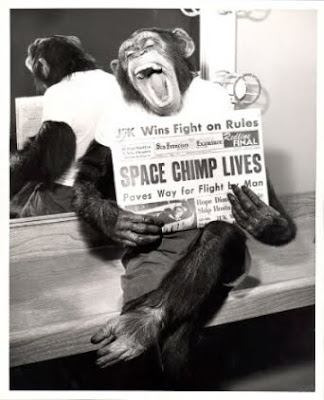
Space Chimp Lives
1980s: The first Soviet monkeys to fly were placed aboard Kosmos-1514 in 1983, nearly 22 years after they had already flown humans Throughout the 80s and 90s, Russia sent 12 Rhesus monkeys into space on various other BION missions -- two of whom, Zhakonya and Zabiyaka, hold the "monkey endurance" record at 14 days in space -- and NASA included two on STS-51-B inside SpaceLab 3.

See the NASA archives for details of all the monkey’s and chimp’s stories. Don't miss the single most interesting (IMHO) document scanned into the archives, describing the Results of the Project Mercury Ballistic and Orbital Chimpanzee Flights, including craft specifications, task consoles, restraint systems, bio-instrumentation, flight plans, flight results, and medical monitoring.

Wednesday, August 25, 2010

Muttniks

Share

"Work with animals is a source of suffering to us. We treat them like babies who cannot speak. The more time passes, the more I'm sorry about it. We shouldn't have done it. We did not learn enough from the mission to justify the death of the dog." - Oleg Gazenko, Russian Scientist and Laika's Trainer

The National Space Centre of the United Kingdom (Leicester, England) recently put a Russian Canine Pressure suit on display, one of the very few that has survived the era between 1950 – 1960 when the Soviets put dozens of dogs into space.

Vostok Program Canine Pressure Suit

The only other suit on display belonged to Laika the dog, and can be seen in Moscow's Memorial Museum of Cosmonautics.

I've written about Laika before, her 1957 journey in Sputnik 2 (nicknamed Muttnik), and her stone memorial; however, I'm oddly reluctant to get too deeply into the stories of the Russian space dogs, or the lesser-known pair of Chinese space dogs (Xiao Bao and Shan Shan), launched in 1966. First, because there are just too many, and second -– I have an inexplicably dreadful emotional reaction to studying their records. I don't seem to get these feelings when reading about other space animals.

Many folks might think it's because these animals are "pets" – but so are cats, and the stories about cats don't bring tears to my eyes. I've never owned a dog in my entire life. They require dedicated care that I don't have time to adequately offer, and I would not want such a trusting, exuberantly-loving type of animal to feel neglected. So perhaps that's the reason I find dog experimentation hard to stomach: my mental image of a dog's personality.

Belka Strelka
Belka and Strelka

I am in no way attempting to vilify Roskosmos, either. One of their greatest accomplishments was the first recovery of animals from orbit in 1960, the dogs Belka and Strelka, proving crafts could "de-orbit" and bring biological packages home alive to Earth. That was a monumental step forward, and no organization would have allowed a human to try before other living creatures succeeded.

During the Vokshod program later in 1966, the Russians also broke a duration record, putting the dogs Veterok and Ugolyok in orbit for 22 days. This was the longest space flight by any creatures, and would not be surpassed until three humans went aboard Skylab 2 in 1974.

Sergei Korolev (founder of the Soviet space program) loved dogs and preferred his scientists work with them instead of primates, who he thought too excitable and prone to illness. Only females were trained, both for reasons of temperament and because the waste disposal systems were designed to fit female canine bodies.

Sergey Korolev
NASA Archives: Sergei Korolev with
an RD-1 rocket survivor (1954)

All space dogs trained by the Russian program are listed in order on the Wiki, complete with their names and flights. There are tons more resources if you Google around a bit, but this is a nice overview to get a quick impression of scale. The contribution of canines was enormous, and could not possibly be over-stated. To go in depth and truly appreciate what dogs taught us about how living creatures react to space, and really for any student of space exploration history, I recommend Space Dogs: Pioneers of Space Travel by Chris Dubbs.

Theirs is a riveting tale, but please know beforehand that along with some very heart-warming and heroic stories, some of these amazing animals suffered horrific accidents, and I had to put the book aside more than once. But, one cannot truly understand how man reached into space without understanding that we put our alleged "best friends" to the test first.