Monday, January 14, 2013

How Many Houses Would Fit Into The Death Star?

Share

So there's this realty company named Movoto, and they somehow grew a sense of humor, despite being a realty company.  You think of realtors as pretty  peeved in this recession, right?  Not these folks.

Death Star

Not only are they funny, they are space enthusiasts! On the Movato blog, they profess an admiration for SpaceX, and say they have been inspired by commercial space initiatives to think up interesting ways to relate to space!  Hey, don't most of us do this all day?  Or at least, we wish we could.

On this same blog is an amusing info graphic about how many average homes could fit into the DeathStar, and I'm digging whomever they go to complete their artwork.  In terms of working environment, this place must be a hoot. Clink on the link or the picture to see the answer. :)

Launch Your House Into Space

It gets better. Want to know how much money it would take to launch your entire house into space? I tried it. It would take $678 million to put my dwelling up into the black. 

To put that number into perspective, that's just slightly over the nominal gross domestic product (GDP) of Ecuador. 

They don't happen to mention whether you will just be orbiting around Earth in your floating house or if you theoretically get to travel somewhere interesting. Pity, as I was expecting the follow-up graphic to be the mileage to Europa!

Earth's Moon

The space fun doesn't stop there. Last but not least, just how large would a house have to be in order for it to be visible on the moon??

No joke, just a little larger than the city of Houston.  I'm betting we wouldn't lack for construction volunteers on the project, however...when do we leave?  Check out Movoto's site -- but make sure it's when you have some time to kill.

Friday, January 11, 2013

Space Show Live!

Share

What a treat! I'll admit, I was a bit anxious at being "live" for a 90-minute radio show where anyone could call in an ask questions, but I had nothing to fear.

It was such a pleasure to be on The Space Show with Dr. David Livingston, and he kindly flattered me about being a "unique" guest, despite my lacking quite the impressive credentials of astronauts or commercial space CEOS! But I just enjoyed the good company and tried to do the best I could.

NASA bedrest studies
In bed for science!

Such a walk down memory lane! The show brought back so many memories. I participated in three NASA Spaceflight Simulations in 2008, 2009 and 2010; since then, I have tried to promote the programs as accurately as possible, making available my own medical materials and testing experiences. Sometimes it was both fun and funny, other times gritty and painful -- but at all times an amazing experience with NASA scientists who work hard to develop counter-measures to micro-gravity side-effects, so that astronauts can stay healthier in space.

The show certainly didn't seem like 90 minutes. When I first heard about the length, I didn't think I'd have anything to talk about for that long.  But, being naturally over-opinionated, and concentrating on people's questions by phone or email, I felt the time slip away quickly.

NASA bed rest study
Learning to walk again after being in bed for science!

Although a fair bit of time has passed since my studies, and new studies are being continually developed, many details came back to me easily when someone asked about a particular protocol, screening criteria, the NASA ward environment, or possible medical applications of the research.

Dr. Livingston is also a gracious host, and allowed me to speak freely, when the average CNN anchor would have cut me off.  Of course, with the well-educated, science-oriented audience of The Space Show, we were all largely "preaching to the choir" about hoping to reach Mars, the future of rocket propulsion possibilities, and usefulness of space technologies here on Earth.  These are all things we love to talk about amongst ourselves endlessly!  Someday, they will hopefully be realities.

The Space Show

If you'd like to listen to the show, please see The Space Show archives, where my interview and Q&A session is listed on January 8th.  Dr. Livingston has already invited me back for another show in February, hopefully to speak jointly with the NASA astronaut who started the simulations in the late 1950s, so stay tuned for news about that! Should be fun!

Friday, January 4, 2013

Fast Eddie & The Robots

Share

Wouldn't that be an awesome name for a punk band?? Some of you may remember Fast Eddie from my article in 2010 about his awesome work with spacesuit glove testing and Hubble mania! Ed has held some amazing positions with NASA over many moons, but may have one of the most important jobs of his career now, in terms of Earth's technological future.

Heather & Ed
Me & Ed with ROSIE

See that big block behind our heads in the Satellite Servicing Capabilities Office (SSCO) at NASA Goddard? THAT is the star of the Robotic Refueling Mission (RRM) now being tested on orbit by the space station crew and robots.

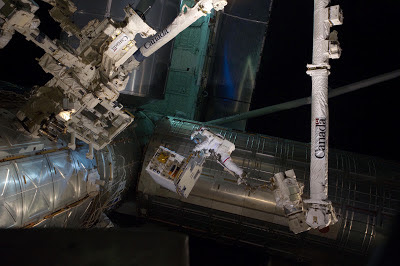
Humorously named after the cartoon Jetsons robot, the block is ROSIE, or the Robotic Operating Simulator for Integration and Evaluation. She and all her delightful tools and gizmos were the very last American Space Shuttle payload by Atlantis STS-135 in July 2011.  ROSIE was installed into the ELC-4, with the intent for Dextre to demonstrate refueling experiments throughout 2012 and 2013.

Satellite Servicing Capabilities Office
Astronaut Ron Garan delivering ROSIE to the ISS
for joint experiments between NASA & CSA

This is one of the those NASA Projects where I do the research, learn about the work, meet the people involved, and then realize certain things at NASA truly do need budget doubling.

An incredible amount of things in our modern lives depend on satellites. (But I wonder how many people appreciate them until their smartphone or TV aren't working?!) Drawing upon 20 years of experience servicing the Hubble, the SSCO initiated the development of RRM to demonstrate the feasibility and practicality of robotically refueling and servicing satellites on-orbit. Exploring ways to do this without "catching" them or simply adding to the dead, floating space debris junkyard, is worth our time, trouble and future investments!

Robotic Refueling Mission
Artistic representation of Dextre
performing a robotic refueling task on RRM

Someday, it will allow NASA and commercial entities to launch larger and more complex satellites, because they can travel without heavy fuel, then meet with a separate fuel source in orbit, much the same way a car pulls off the highway when it needs a gasoline station.

Dextre will work on ROSIE's multiple activity boards,check-listing through tests on protective thermal blankets, caps, valves, simulated fuel, and other components that need to be pushed back, cut through, unscrewed and transferred.  Each component and activity board represents and individual refueling or servicing task, and each RRM is designed to efficiently complete a wide range of targeted activities.

SSCO RRM
Ed removing the Wire Cutter Tool from
one of the RRM Activity Boards

Wire sheaths? Nozzles? No problem. Robots got this. The tool collections primary functions are to cut and manipulate wires, unscrew caps, open and close valves and transfer fluid. Tools also have integral cameras for ground operator vision and include specialized features tailored to complete each task.

Technology and techniques are all being verified on orbit as we speak, and you can follow the action at the Satellite Servicing Office's Facebook page.

Satellite Servicing Capabilities Office (SSCO)
SSCO Office and Weightless Testing "Sky"

Curious how refueling a satellite in space can impact your day-to-day activities on Earth?  Check this awesome ROBOTIC REFUELING video by CTV, who crammed a stunning amount of awesome information and NASA coolness into 3 minutes.

To see the entire gallery of pictures from Ed's tour of the Satellite Servicing Capabilities Office at NASA Goddard Space Flight Center in Greenbelt, Maryland, click this link or any of the pictures above. Thanks for your time, Fast Eddie!

Wednesday, January 2, 2013

NASA Goddard

Share

Another year, another NASA center!  I have long wanted to see the NASA Goddard Space Flight Center in Greenbelt, Maryland... home of Heliophysics, the Hubble Space Telescope, Explorer Program, Lunar Reconnaissance Orbiter (LRO) and many other amazing NASA projects.

Heather at NASA Goddard

One of the 10 major NASA field centers, GSFC is named for Dr. Robert Goddard (1882–1945), father of modern rocket propulsion in America. Luckily, I was able to make a quick visit while in town working the social media thang at NASA HQ.

This incredible think tank and design/manufacturing center is the largest combined organization of scientists and engineers (over 10,000!) dedicated to increasing knowledge of the Earth, her Solar System, and our entire known Universe, using observations from space.

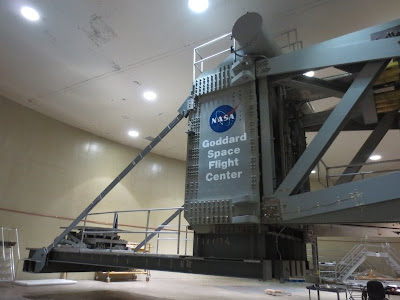
Plus, it is home to one of the largest centrifuges in the world. Here it is. Well, part of it. It's too darned huge to fit in one shot. So cool.

Centrifuge at Goddard

It is no exaggeration to say that most of what you know, and certainly all the pictures you've seen, of the celestial objects in the known currently-photographable cosmos are due to NASA Goddard!

In fact, the brains at the Goddard center are also largely responsible for everything you know about climate change, arctic ice, storm systems, solar eruptions, coronal mass ejections, interstellar clouds, geodesy, ocean ecology... and for crying out loud, they even accidentally found dinosaur footprints on their campus.
Ed Rezac

One huge highlight was meeting up with my buddy Ed, who showed me all kinds of fun robots in the Satellite Servicing Capabilities Office (SSCO). Details will follow, as his team is definitely worth their own blog post.

I also finally got to see, up close and personal, the James Webb Space Telescope, in all mirroresque glory, and surrounded by exciting optical components! The JWST is now being assembled in the same clean room where Hubble was assembled. A truly historic spot.  Other clean rooms housed the Global Precipitation Measurement Satellite (very big) and the Magnetospheric Multiscale Satellites (even bigger).

Heather with James Webb Space Telescope

Like Hubble, you cannot fathom the sheer size of that sucker until you're staring right at it! Around every corner is something even more exciting, and my only failure in visiting this amazing NASA center was not spending enough time.  Wish I'd had an opportunity to visit the LRO and SDO teams, but I'll have to catch them on the next round.

To see the entire picture gallery, click on any of the photographs above, or click here to visit the Pillownaut Picasa album collection.