Wednesday, May 9, 2012

Mojave Air & Space Port

Share

Gateway to space! That's what the sign says when you enter Mojave, California. And why not? Good a place as any for the Mojave Air & Space Port -- also sometimes known as the "Civilian Aerospace Test Center". Following the social events at NASA Dryden this past week, a few of us stragglers had a mini #SpaceGirlTweetup on our way home!

We wound up realizing we should do this more often.

Annie Wynn and Camilla SDO
Mojave Air & Space Port

MHV, formerly a WWII Marine air station, is now the up-n-comin' Space Oasis! Or at least, that is what we're all hoping as space start-ups congregate to test vehicles and develop new technologies. It is the first facility to be licensed in the United States for horizontal launches of reusable spacecraft, being certified as a spaceport by the Federal Aviation Administration in 2004.

Later that same year, the first private spacecraft, named SpaceShipOne, was launched by Virgin Galactic. SpaceShipTwo, which will host tourist trips to the "62-mile-high" club, is currently being developed. Other space port inhabitants include Stratolaunch, Interorbital System, Orbital Sciences, Masten Space Systems, XCOR Aerospace, Masten Space Systems, and Firestar Technologies.

Rotary Rocket
The ROTON - Rotary Rocket

The port has a long history of military service, test programs and world records; perhaps not as importantly, but still rather novel: it has been a filming site for 18 television shows and 16 movies, including the Hey Let's See Keanu Reeves Blow Up a Huge Plane scene in Speed (1994).

Since 1981, the site has also housed the civilian National Test Pilot School (NTPS), and since 1994, the affiliated National Flight Test Institute.

Test Pilot School
Sign me up!

For tourists interested in visiting, one of the very new features of the port is "Legacy Park", a lovely mirage covered with lawns and wild flowers -- quite the odd site in the desert!

Created on behalf of all the Mojave workers who have contributed to the site, the lovely park houses memorials to fallen test pilots, a composite of the SpaceShipOne craft, the flown ROTOR rocket and a mockup of the Rutan Model 76 Voyager -- the first aircraft to fly around the world without stopping or refueling.

Voyager Restaurant
Julie, Heather, Camilla, Jane & Annie

Another fun "don't miss" item is the aviation-themed diner with many dishes named after aircrafts and pilots! Voyager Restaurant overlooks the runways, where we ate lunch while watching planes taking off and landing.

Besides being right on top of the flightline, your dining experience includes great food, local aeronautics newspapers and periodicals, Tower Radio at each table, and free wifi. Okay, it was no NASA Social, but not a bad show!

Sunday, May 6, 2012

Dryden NASA Social

Share

Tweetups turned into Socials, and Dryden Research Center's first official gathering was a rousing success! What a ride!

Dr. Hugh L. Dryden would probably have been amazed at the frenzy created by these events, given his reputation for calm countenance... hmm, I wonder if he would have joined us on Facebook?

F/A-18 Fighter Aircraft
OMG! Chicken in the Cockpit!

I got to sit in the cockpit of an FA-18 Super Hornet twin-engine carrier-based multi-role fighter aircraft! And I really just want everyone in the world to know it. Thank you.

We saw, either up close or in slides & videos, many retired and active aircraft, so I kept the link to the Dryden Historical Aircraft Photograph Collection handy throughout the day in order to identify everything. It's a bit surreal to visit a largely isolated place where millions of dollars worth of flying machines are just sitting around everywhere! And even more surreal is that, by the end of the day, you've gotten entirely too used to it.

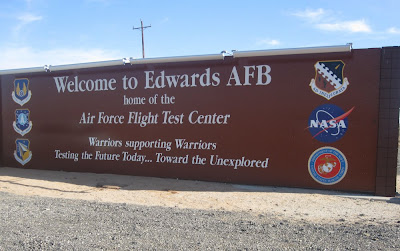
Edwards AFB
Mojave desert in California

Edwards Air Force Base is just east of the middle of nowhere, but SO well worth the trip to see a place not many people are allowed to visit. There were speeches, there were songs, there were many hours of walking and tweeting and ... wow, there was even a flight-suit fashion show.

We were treated to SONIC BOOMS, and a test pilot named Jim Less (his aviator callsign is "Clue", LOL!) performed a fast, roaring flyby in an F/A-18 just for our waiting cameras!

Afterward, we roamed from hangar to hangar to see currently used aircraft, new designs in the making by General Atomics, Northrup Grumman, McDonnell Douglas, and Boeing, plus many historical artifacts back to the Apollo era.

Test Pilot Helmet
Test Pilot Helmet!

We were allowed to sample flight food (tubes similar to those used on space missions), try on various helmets, board the CTV, mingle with research and test pilots, and of course meet many other aeronautics enthusiasts from all over the US!

After hours, we headed to the local test pilot hangout in Boron, CA for dinner and ... okay, singing & sombreros after a little tequila time ;)

Apollo LLRV
Lunar Landing Research Vehicle (LLRV)

Click on any picture to go to the full gallery, or click this link to see the NASA Dryden album in my Pillownaut Picasa site, which also includes last year's trip to the Dryden Aircraft Operations Facility in Palmdale to see SOFIA!

Thursday, May 3, 2012

NASA Tweetup #5

Share

New Tweetup on Friday, May 4! Now called the NASA Social! Back in MY DAY they were called Tweetups, anyway. Just kidding, don't want to sound like a geezer 50 years before I should.

Anyway, it's ROAD TRIP time again, and this time I'll be headed to Monterey, where I'm excited to show Camilla the Apollo Moon Tree in Friendly Plaza, and then on to the NASA Dryden Flight Research Center (DFRC) on Edwards Air Force Base in California.

NASA Dryden Flight Research Center
Seems pretty big on the ground, but if you check out all of Edwards AFB on Google Maps, you'll see it's only a very tiny portion of the base! And pretty far inside the boundaries, so you'll never trip over it.

Sadly, Dryden is one of the very view NASA sites that is not open to the public, partly due to the classified nature of some aeronautical research, and partly due to budget concerns on the base. One used to be able to reserve pre-arranged tours at Dryden with specific dates, but those small allowances were also cancelled as of December 2011.

NASA Dryden logo
So, if you are interested in the first "A" of the NASA acronym, follow me Friday on Blogspot, Twitter, Facebook and Picasa this week for all things Dryden! Most of the Tweetups I've been to thus far have been about Space, but the agency's Aeronautics research and manufacturing branches are also crucial to the whole!

I'm already on the road, now -- and eagerly anticipating Star Wars Day (anyone think that was a coincidence?) at Dryden, perhaps seeing experimental aircraft, perhaps getting to meet real live test pilots, and... would an Autonomous Airborne Refueling Demonstration be too much to ask?

A girl can dream.

Dryden Fleet
Last summer, it was my honor and pleasure to visit the Dryden Aircraft Operations Facility to see SOFIA, the Stratospheric Observatory for Infrared Astronomy. That was rather a short and sweet affair off the base. This time, however, the crowd of 75 social media (mongers? maulers?) ... okay, let's call us "enthusiasts", will be able to spend the entire day seeing the aircraft fleet!

All participants have been told we can photograph static aircraft, though no word yet on what we will see or be able to record in flight. Stay tuned for more updates! On twitter, you can also follow hashtags #DrydenSocial and #NASASocial, or follow the @NASADryden feed.

For my and Team Camilla's updates, you can follow @Pillownaut, @Camilla_SDO and @jotolluch!

Tuesday, May 1, 2012

Space Registry!

Share

Sadly, this is not a way for people to get married in orbit while amassing cool presents from various NASA Gift Shops. (It should be, but it's not. And, someone should get on that.)

Sure is a fun toy for nerds, though. Awesome place to kill major amounts of curiosity time! Been trapped here for hours.

The U.S. Space Objects Registry tracks all objects ever launched into outer space by the United States (and they are preparing to add items for Russia and China). On the top right of the page, you can click Browse Registry to begin with America’s first satellite (Explorer I in 1958) and continue on through every piece of hardware we ever shot into the sky!

US Space Objects Registry
Of course, it's much more fun and intriguing to play with the drop-down menus, which are quite enlightening. I found more decayed objects than I would have thought, but also more recovered objects than I imagined in our launch history. A lot of stuff is still floating out there, but quite a lot has been guided back to our planet's surface.

Selenocentric: As seen or estimated from the center of the moon; with the moon central.

Heliocentric
: Referred to or measured from the sun's center (or appearing as if seen from it).

GSO: Geosynchronous, as opposed to Geostationery, orbit.

Areocentric: In orbit around the planet Mars (or "Ares").

US Space Registry Search Results
Once inside the results, you can click on the International Designator to find more details, such as:

US Space Registry Search Details
You can also search by functions, such as which crafts are engaged in research, atmospheric conditions, communications, exploration, space flight techniques, and so on. Hours of fun for the geek set.

If you are truly hardcore (and have a few clicks to spare), go instead to the searchable Index at the United Nations Registration of Objects Launched into Outer Space. There you will find everything ever launched from Earth by 48 different nations.