Monday, September 20, 2010

Pillownaut Space Map

Share

New project! I am in the process of creating a SPACE MAP, and the first markers show all the field and research centers for the National Aeronautical and Space Administration. Of course, everyone is familiar with "Johnson" and "Kennedy", but there are well over a dozen facilities across 13 states that operate launches, oversee mission control, design crafts and technologies, manufacture components, conduct equipment and biological testing, plan payloads, and pioneer research across many scientific disciplines.

Wow, I sure wish I had thought of this before the summer vacation season this year, but, better late that never for us enthusiastic road-trippers!


Click on the map to go to the main Space Map page at Pillownaut.com, or click over to the main engine on Google Maps. In both of these spots, you'll see a larger screen where you can zoom in, zoom out, and examine precise locations.

Also, click on each marker for descriptions of each NASA center, including who it is named after, the year it was founded, and their main function(s) in the space agency.

In the future, I'll add space museums in the United States, and locations of all spacecrafts on display around the country. After that, perhaps I'll start adding world agencies, or even make the map an "open source" project where people can add sites to share. What do you think, should I add the NASA clinics and study facilities on the map too?

The first batch includes:
George C. Marshall Space Flight Center
Hugh L. Dryden Flight Research Center
Independent Verification & Validation Facility
Jet Propulsion Laboratory
John C. Stennis Space Center
John F. Kennedy Space Center
John H. Glenn Research Center
John H. Glenn Center Plum Brook Station
Joseph S. Ames Research Center
Langley Research Center
Lyndon B. Johnson Space Center
Michoud Assembly Facility
NASA Headquarters
Robert H. Goddard Institute for Space Studies
Robert H. Goddard Space Flight Center
Vandenberg Air Force Base
Wallops Flight Facility
White Sands Test Facility

Happy Mapping!

Saturday, September 18, 2010

The Winner!

On August 30th, I published a complete timeline of all animals put into space between 1946 and 2010. It detailed all the species and how they traveled, from the first fruit flies up to the most recent humans, with every dog, cat, rat and monkey in between!

The Space Animals Timeline HTML page connected to that blog post was pretty exhaustive... if you press "Print Preview", it comes out to 12 full pages! At the very bottom of page 12, I posed a trivia question... a pretty easy one, I thought... but mostly I just wanted to see if anyone would actually read that far, LOL!


The answer was inside the timeline, of course: In April of 1998, STS-90, a mission of Space Shuttle Columbia, set a biological payload milestone, when over 2,000 creatures resided aboard the orbiter for 16 days. Seven humans operated NEUROLAB, where they studied space adaptation syndrome, vestibular function, adaptation of central nervous systems and the ability to sense location in the absence of gravity. On board animal containment facilities held 18 pregnant mice, 1514 crickets, 135 snails, 233 fish and 152 rats.

This past Thursday, Rebekah Maral of Port Washington, Wisconsin emailed me with a perfect response... what a reader! She provided her address and will soon be the proud owner of a limited edition NASA employee T-shirt... good job, Rebekah, look for it in the mail!

Friday, September 17, 2010

Space Laundry

Share

New Challenge! The General Services Administration (GSA) launched the Challenge.gov website, where cash prizes are awarded to participants who offer novel solutions or innovations in technology, defense, education, health, safety and various environmental concerns. The platform was developed in response to President Barack Obama's Strategy for American Innovation, calling for agencies to promote innovation through prizes and challenges.

Advocates of the approach say challenges generate ideas with relatively small investments, and of course, one of the benefits of the "prize-giving" model is that they only go to the people who demonstrate results (not for potentially lengthy or costly government research that may yield little more than red tape).

Challenge.Gov
One interesting $25,000 challenge that just ended (awaiting the winning name!) was the call for a "Microgravity Laundry System." As with most other basic housekeeping chores in space, dealing with the astronauts' dirty laundry can be a real... pardon the repetition... CHALLENGE.

NASA says you can:
1. Wear the same clothes for months (happens all the time on the ISS).
2. Load onto a trash craft to burn up in the atmosphere (also frequent).

3. Make planters for seed experiments (less frequent, and a bit creepy).

4. Feed it to bacteria. Seriously.


The laundry issue is listed on Challenge.gov's NASA section, along with awards for solutions in green aviation, sample robots and night rovers, nano-satellites, power-beaming(???), and they also just added the "choose the last Shuttle Missions' music" that I mentioned last month.

NASA on Challenge.Gov
Of course, there is no guarantee that such challenges will draw mass support or truly result in high-tech successes, but who's to say major cash incentives will hurt anybody?? We're an optimistic lot when it comes to technology, and we love it when hitherto untapped talent lurches forward à la Doc Brown and his ilk! Their instructional catch phrase is, "You are the secret ingredient!"

Other areas on the site detail everything from recipes for school lunches to resume-video production to digital forensic techniques, to name just a few of the current 50. You can also keep up with supporters and new challenges on their twitter feed: @ChallengeGov.

Thursday, September 16, 2010

Mars Mission Milestone

Share

The Mars500 experiment is cruising along nicely! On September 10th, French Astronomer and Graphic Designer Steve Légère presented a beautiful commemorative collage to the crew; many of us following the Mars500 closely added our names to the poster to congratulate all the Marsonauts on their 100th day. We were very gratified when the guys "inside" twittered their thanks for our support.

The ESA and Roskosmos were very happy yesterday, because the team officially reached Day #105 – matching the previous crew's duration. But me, I'm excited about TODAY! Day #106 makes the longest simulation ever completed by a Mars analog team. Now they just have to repeat this duration five more times...

Mars500 Reaches 100 Days
Great job, Steve!

Live voice communications ceased on July 26th, leaving the men with a "time lag" for all audio and text transmissions. To make the simulation as real as possible, their com delays will always reflect where they are in space, on the way to Mars. Crew and mission controllers send messages to each other, but must now wait for replies, meaning no "real-time" communications – not even with family – and in any disaster scenarios, the crew must make crucial decisions for themselves. Simulated crises will test how they respond to emergency situations.

Commander Alexey Sitev
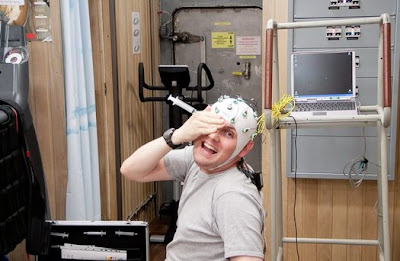
Needle humor. Getting punchy in there, guys?

Italian-Colombian Marsonaut Diego Urbina, worked in Operations at the European Astronaut Centre's Neutral Bouyancy Facility in Cologne, Germany before joining the Mars500 project, and when asked why he applied for the program, he replied, "Because this study... in isolation and reaction is not useful only for Mars, but also for life on Earth."

Unfortunately, 33 very isolated miners in Chile are discovering these phenomena right now, and under much tougher, less-controlled surroundings. While in isolation, you can become closely bonded to those around you, but it can also be a recipe for trouble and clique-behavior under stress, overwork or extreme environmental conditions. Studies and disasters, both voluntary and involuntary, teach us a great deal about human behavior.

Mission Researcher Wang Yue
Scratch that last question. We have our answer.

Very special thanks to the kind chaps on the Mars500 media team for granting permission to use some of their pictures on my blog for this Day #106 update! Большое спасибо!

Click here for my past posts on the Mars500, or here to join their Twitter feed or Facebook page. They also have an awesome YouTube Channel with a tour of the completed Mars ship facility.