Tuesday, March 10, 2009

The Mars 500

I signed up to spend 90 days in bed for "space flight simulation." A lot of folks called me crazy. I never actually argued with that, so I figure I still have wiggle room to point out people who are even crazier :)

But hey, we're all in this together, just trying to get to Mars, right? The European and Russian space agencies are collaborating on mock mars missions, and I posted a detailed article about these projects at HULIQ Science.
Mars 500

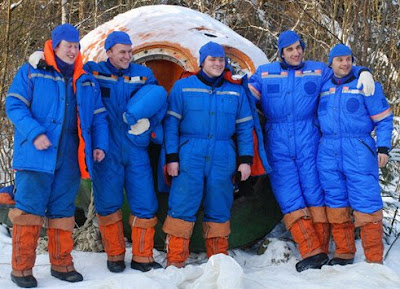
The Mars 500 Crew during survival training.

The first 105-day simulation starts this month. The second, scheduled for later this year, will isolate crew members for 520 days (possibly up to 600, which is still under consideration by Roskosmos) -- the time needed to travel to Mars, stay for a month, and travel back to Earth.

Though still concerned with health and human factors above all, these studies will focus less on microgravity and more on actual survival -- including psychological effects of isolation and self-sufficiency aboard a spacecraft on a long mission.

Moscow's official Mars 500 website has some interesting descriptions, and it's a great step forward for both agencies in confronting the time, equipment and support needed to reach Mars, as well as the dynamics of human interaction under long-term isolation. In addition, the official site of the Russian Control Centre of Space Flights has this marvelous model:

Mars Modules


Module 1: The Mars Lander (6.3m × 6.17m) will be used during the 30-day “Mars orbiting” phase. It has three bunks, two workstations, a data collection system, video communications, ventilation, water supply and fire alarm systems.

Module 2: The Technical Module (3.2m × 11.9m) will house equipment for medical examinations and telemedical, laboratory and diagnostic investigations. All experiments will be conducted here.

Module 3: The Living Quarters (3.6m × 20m) has a kitchen, living room, and main control room. Six individual crew compartments (2.8m²) will have a bed, a desk, chair and small shelves.

Module 4: The Storage Module (3.9m × 24m) features food refrigeration, clothing and crockery cupboards, sauna & gym, plus a “regenerative” life-support system and greenhouse farm. Other partitions house necessary tools for running the study (communications consoles, ventilation, water supply, electrical panels, recycling, safety monitoring, emergency equipment)

Module 5: The Surface of Mars... Oh just imagine the playtime here!

Mars PollMSNBC ran a poll ... with about 41% yea and 53% nay, but I'm thinking the numbers would have been very different if they'd had this diagram on hand, noting the glaring lack of bathing facilities. Says the Russian scientist heading the project, it's just a little hot steam and towels.

That's right, no hot showers for 18 months. 1250 square feet of space with an ISS workload. Could you?

Monday, March 9, 2009

Aspiring Astronaut

Okay this is my favorite part of this whole gig... I had a lovely surprise this week, from 5-year-old Katie in Missouri, a big NASA fan and growing space enthusiast.


Katie watches my posted videos with her mother, Elizabeth, who has been following the blog since last year's newscasts from UTMB. Both enjoy space topics and science museums, and I sincerely hoped to keep her interest healthy... because patches shouldn't cost nine dollars. ANYWHERE. Sorry. In joke. But you can see the whole story on the sweet post Elizabeth put on her Six Golden Coins blog...

Space Station MIR
A few days later, they mailed some artwork to me. Isn't this beautiful... great job, Katie! Keep dreaming of the stars!

Thursday, March 5, 2009

Naming New Node

So NASA asked the public to name the next node to be connected to the International Space Station, a module housing life support systems that will also serve as a control tower for the giant robotic arm -- complete with an elaborate six-windowed observation deck.

ISS Module Node 3
Node 1 is Unity, Node 2 is Harmony, and NASA’s first suggestions for Node 3 were Earthrise, Legacy, Serenity or Venture. You have until March 20th to vote or submit your own idea.

Write-ins include: Synergy, Vision, Tranquility, Vista, Horizon, Hope, Eternity, Peace, Trinity, and – predictably – Enterprise. What? No Shatnerville?? Vote and see scores at NameNode3.

The winning title will be revealed on April 28, and Node 3 is scheduled to launch in December 2009, thereafter attached to the ISS by Space Shuttle Endeavor.


Poindexters?!?! He's amusing, but I'm not feeling particularly compelled to vote his ticket. Well, okay that's not entirely true. I may write letters to Forté and Tazo, encouraging them to consider the peaceful tea names :)

Monday, March 2, 2009

Mars March

Based upon the Greek god Ares, “Mars” was the Roman god of war. This survived into Olde English as Martius, then Middle English Marche. The month of March for many cultures was the original beginning of the calendar year, and the time for resumption of war.

Iron oxidation in the soil makes the Martian surface appear red, and it was associated with war because the planet’s color reminded ancient astronomers of blood. Today Mars is still often nicknamed "the Red Planet."

Mars has two irregular moons, named for the sons of Ares: Phobos is about 17 miles in diameter, and Deimos about 9 miles. In Greek, their names mean "Fear and Dread" (or in some translations, "Fear and Panic").

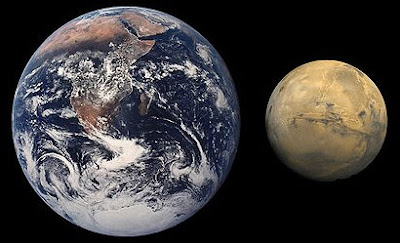
This fourth planet from the Sun is about half the size of Earth, has white polar ice caps and its atmosphere is made up primarily of carbon dioxide.

Mars
Rotation time is nearly the same as Earth, but Mars takes 687 Earth days to complete an orbit around the sun.

An object weighing 100 pounds on Earth would weigh just 38 pounds on Mars.

Arizona’s Grand Canyon would easily fit into a side-crevasse of Valles Marineris, the largest canyon in the solar system. This "Mariner Valley" is 125 miles wide in various places, up to 5 miles deep, and nearly 2,500 miles long. That’s the about distance from California to New York.

Statistically, UFO sightings are at their greatest number during those times when Mars is closest to Earth.