Wednesday, June 1, 2011

The Compression Suit Study

Share

Hot news out of the HTSF! In layman's terms, the Compression Suit Study refers to a new program at UTMB which will use an Alternate Compression Garment (ACG). Fancy way of saying "tight stuff like a space suit interior that squeezes me" – but from a medical point of view.

This one is good news for many of you who have emailed me over the years saying you "would totally sign up for a study if they weren’t so long, because I cannot get three months off work."

Can you get one month off work? Or more seriously, if you are healthy and out of work, this isn’t a bad way to hoof it and avoid taking handouts. So, screening for healthy folks who can hack the head-down tilt has begun! This study will be 34 days total, and aims to research the effectiveness of compression garments on regulating blood pressure after a short stint of head-down bed rest.

Jobst Compression Garments
Spacesuit Sim & Schedule

In the first 13 days, subjects will consume a special diet, but you are free to roam the NASA facility at the Flight Analog Research Unit (FARU) in between baseline tests. Then comes 14 days of bedrest to simulate spaceflight effects... and this phase also includes testing. Finally, there are 7 days of follow-up testing and recovery, though for such a short head-down stint, most healthy folks would bounce right back.

In that week long "recovery" period, you may be chosen to wear a compression garment, and your reactions will be compared to folks who haven't worn the same fitted suit. Will it affect re-adaptation to normal gravity? Your level of orthostatic intolerance will be tested to see!

I’ve actually worn these Jobst garments, when I participated in NASA's Lunar study. Some folks find them a bit tight, but I loved them because I am always, always cold –- and when I wore these it kept my toes warm. After awhile however, you forget you even have them on.

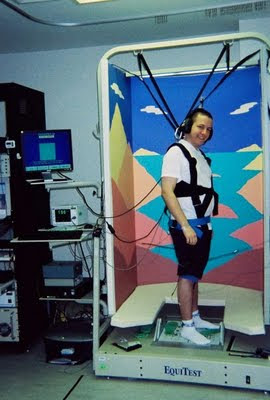
Neuro-Posturography
Looks like you're going zip-lining, but
really it’s to test your sense of balance

This comes on the heels of the news of iRATS 14 being completed, so the feasibility stage of that campaign was successful. That was the short test. Now the long test begins, which is iRATS 70. Yes 70 days! This one is flat instead of head down, and uses the eZLS vertical treadmill, detailed in yesterday’s post… and also featured prominently on NASA Edge, thank you Blair!

So, as we welcome summer in June, there will be lots of activity in the NASA ward – hoping to see two studies in full swing simultaneously! As ever, healthy non-smokers between the ages of 25-55 are needed, particularly females. Tell a friend if you know someone who wants to go play astronaut! :)

Mars500 Bedrest Study
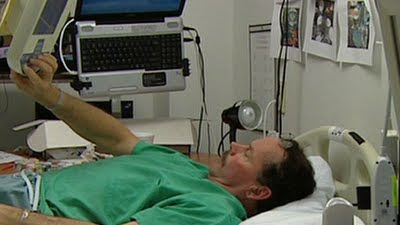
Hey, it's Diego Urbina of the Mars500 simulation during bedrest experiment to simulate spaceflight! See... all the cool kids are doing it.

Monday, May 30, 2011

Who knew lying down was such hard work?

Share

While I'm never enamored of how news can tend to trivialize the research experience and all it entails in terms of space flight simulation, I almost always get over it long enough to enjoy any press for the NASA medical studies! The most recent film broke new ground!

For all the new readers who joined me in 2010-11, I started this whole social media bit by accident after doing two bedrest studies myself, one in head-down tilt micro-gravity, and one in up-tilt lunar gravity. I documented my experiences of playing fake Astro-NOT, while scientists tested their various contraptions, or examined my bones and muscles for changes.

Gary Conway of Seattle
Now, however, a new component has been added to the current studies. Participants in iRATS and other upcoming campaigns get to use the eZLS or enhanced Zero-Gravity Locomotion Simulator, a wall-mounted treadmill that simulates space exercise. Of course, astronauts exercise for many hours per day while in space, but it's still a challenge to maintain bone density and muscle tone in weightlessness. Gadgets such as these on Earth help fine tune new possibilities for the space station.

This television broadcast on the ABC nightly news featured the head project scientist Ronita Cromwell, whom I've interviewed before about these amazing studies; our old friend and physical trainer Brent; some ISS footage of exercise machines versus those used on Earth –- all in all, a great range of what the projects are all about.


WFAA Dallas Channel 8 Story by David Schecter
Featuring Gary Conway (Seattle) and Michael Asaf (Houston)

But... "Mad Science treadmill"?? Well, I've heard worse descriptions. Realism is more beneficial to folks who hope to apply for a chance to be part of these programs, designed to result in, as they said, "Healthier astronauts through rigorous scientific research." Well said.

But was it truly a "mentally and physically grueling" study? Not really. I took those same horizontal showers for two months myself, and they were not that difficult. Humans are highly adaptable creatures; you deal with it, you practice, you become adept, and it becomes routine. Every day isn't a rainbow, but neither is every task so grinding that you cannot function happily; like most things in life, the truth is somewhere in between.

Michael Asaf of Houston
I've seen people make remarks about side effects that aren't true either; when the article accompanying this film was released online, someone commented that "you wouldn't even be able to walk afterward." Not so. Walking was stiff and achy for awhile, but healing is a rather swift affair. With regular exercise, I was back up to running daily miles in less than a month!

If you asked either of these chaps after their study stints... they'd very likely say the same. In fact, Gary and Michael, feel free to weigh in around August or so to back me up, LOL!

Saturday, May 28, 2011

Twitter From Mars

Share

It just wouldn't be a MARS UPDATE week without checking in with Roskosmos and seeing what the Mars500 chaps are up to! Aside from cabin fever, that is.

Cabin Fever on Mars
Very. Serious. Scientists.

After leaving their Marswalk activities behind in March, our intrepid explorers began the long journey back to planet Earth -- continually monitoring the health and psychological stamina of the crew.

One particularly interesting simulation-about-isolation took place in April, where they conducted a complete communications blackout for the space ship. Due to severe disruptions by solar storms (something that could definitely happen on a real Mars voyage!), the crew had no news, no email, no audio or videograms from anyone in the outside world... not even from Mission Control!

In some cases, such total isolation can be damaging, and at the very least, nerve wracking... as evidenced by their later tweet: "What if we came back online [after the storm] and there was no one outside?"

However, this type of training is designed to ensure such autonomy is motivating -- bringing the crew together in times of challenge or uncertainty, and hoping we found the right mix of people who can work as a team in any environment.


They took time in their schedule to celebrate Yuri Gagarin on the 50th anniversary of human spaceflight, continually remembering him as source of inspiration in helping the world to understand that the benefits of our exploration outweigh the dangers. Interestingly, none of the Russians weighed in, but we'll take their reverence as a given!

I was particularly moved by the responses of Diego Urbina, and if that name sounds familiar, it's because I also just mentioned Diego in the last post about MDRS crew, as he has now participated in Mars simulations on two continents.

Also! Big news coming up! Today marks Day #360, so this week will be a very exciting time , in that the crew will reach the one-year milestone in their ship. An entire calendar year in a simulation for science. What amazing commitment! And from there, it will still be 155 days to go until landing...

Mars 500 Crew
Join the crew next week on their many organizational sites and social media spots for all the anniversary buzz:

Mars500 Official Site at RU - http://mars500.imbp.ru

Mars500 Site at ESA - http://www.esa.int/SPECIALS/Mars500/index.html

Mars500 YouTube Channel - http://www.youtube.com/Mars5OO

Mars500 Twitter Feed - http://twitter.com/#!/Mars_500

Mars500 Google Blog - http://mars500main.appspot.com/

Steve Légère Mars500 Letters - http://mars500.wordpress.com/

And of course if you query Mars500 on Facebook, you will now find many groups and fan pages sharing news items about this record-setting simulation program. Amazing how these have grown over the past year...!

Wednesday, May 25, 2011

Mars Desert Research Station (MDRS)

Share

Another exciting site for Mars simulations is the Mars Desert Research Station in Utah, managed by Dr. Robert Zubrin of the Mars Society. Laksen Sirimanne, veteran of two MDRS missions, made time in his busy international travel schedule to discuss his co-authoring of the amazing book The Mars Diaries: Crew #88 of the Mars Desert Research Station, edited by journalist David D. Levine.

Mars Desert Research Station Crew 88
Mars Crew #88 outside the Hab
Laksen, David, Paul, Steven, Bianca & Diego

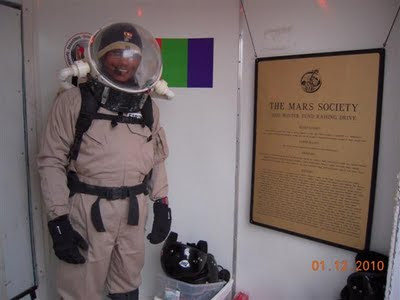
Four of five crew members blogged during their Mars sim, discussing the Green Habitat, pressurized tunnels, water recycling systems, plant farms for water purification, inverter and power systems, generators, ATV "rovers", etc. Ever wondered what it would be like to perform a simulation with such strict protocols that you cannot go outdoors unless you're wearing a full space suit? The crews go to great lengths to ensure the simulations are as accurate as possible to off-planet exploration! Crew #88 included:

1. Commander Steven Wheeler
2. Chief Engineer Laksen Sirimanne - BLOG: The Sky Is Not The Limit (English)
3. Health & Safety Officer Bianca Nowak - BLOG: Bianca Goes To Mars (Dutch)
4. Chief Biologist DiegoUrbina - BLOG: Déjame mi Espacio (Colombian Spanish)
5. Chief Astronomer Paul McCall - BLOG: Never-Ending Journey (English)

MDRS Habitat

I noticed that among your four masters degrees, one is in Aerospace engineering and Astronautics; is that what drew you toward The Mars Society?
LAKSEN SIRIMANNE: Actually, I have been in the BioMedical field for about 20 years now. Since I am not in the space field, I wanted to contribute in some way towards furthering human spaceflight, and I thought a simulated missions was a great start. When I was growing up in Sri Lanka, my dad used to take me to the American Center where Arthur C. Clark gave talks and showed images of Saturn and Jupiter, taken from Voyager. I was 5 years old when Armstrong landed on the moon and am a huge fan of the shuttle program, so I feel like I grew up with NASA. I have always been drawn to spaceflight. Now I am following Elon Musk and SpaceX too, so you will see more blog posts about them. I am certain that I'll at least fly a sub-orbital flight (probably with Virgin Galactic), but my real goal is an orbital flight.

I also returned to MDRS in June as part of Crew #95, on a refurbishment and refitting mission to prepare the habitat for this year's crew seasons, and had a chance to work with some of the pioneers: Artemis Westenberg, Keith Keiplinger, Josh Nelson and Gary Fisher (who now own Explore Mars, Inc).

You were the most dedicated blogger during crew habitation, and anyone interested in Mars should definitely read the book! One crew before yours had thermal, electrical, plumbing and computer malfunctions, so you had your work cut out for you. Would it be difficult to be an engineer on Mars?
LAKSEN SIRIMANNE: Yes, it's going to take a lot of work to keep equipment running at all times. Similar to actual Mars conditions, the desert around the MDRS is very harsh and there are a high number of equipment failures. Engineers need to be "hands-on" "nuts and bolt" types who can figure out the problem and implement the solution. They have to be knowledgeable in mechanical, electrical, plumbing and a variety of other skills. Small problems can rapidly escalate into bigger problems; engineers have to know the systems inside and out. About the third day, I could tell which faucet was running (upstairs or downstairs) by the sound of the water pump and water pressure, I could tell when the furnace came on or off, and could tell which outer hatch was being opened just by the sound. We had less trouble than most crews because we stayed on top of the issues several times a day.

MDRS Crew Patches
My favorite post was your "Day in the Life of a Chief Engineer" where you give describe the conditions, temperature, tasks and your Spacesuit Mobility Experiment. Did you feel like you met all your research objectives? Would you have stayed longer?
LAKSEN SIRIMANNE: We had a great mission. The crew really clicked even though we came from such different backgrounds. The common themes were a love for space exploration (or anything related to space), smart, funny people with a team player type attitude. Everyone picked their area of responsibility before the mission and worked very hard to perfect their experiments and also share and educate the other members (i.e. astronomer, biologist, engineer etc).

Among the highlights were assembling the Radio telescope, the EVA Suit Mobility Experiment and the GPS/GeoTagging Experiment. So we accomplished almost all of our research objectives. One other thing that played in our favor was the weather. We had mostly sunny days with blue skies with rain or snow only on the last few. But the crew previous to us suffered very cold weather, and the crew after us many days of snow with high winds.

Part of me would liked to have stayed longer. But another part wanted to go home and back to work. I guess mentally I was prepared for only a 2 week mission. It gets pretty lonely even if you are around other people constantly, and the sense of isolation was very real. I did feel like we were on another planet.

Utah

My favorite picture in the book is Diego's farm label: "Eat the fruit but don't eat the plant!" I remember from my sims that food becomes an enormous pleasure in one's day, and I imagine in an extreme environ like you experienced, it's even more so. How were your moods based on whether edibles were appetizing or not?
LAKSEN SIRIMANNE: We were asked to participate in a food study that was run by Cornell University and the University of Hawaii. The details are in the book. We had rehydratable foods, and on alternating days we could add hot water to the packs, or add water and use a gas cooker. Breakfast was the worst. I did not like the oatmeal, or the MRE bread and jam... but the soups were absolutely fantastic. The Texas BBQ chili was terrible. Then someone found cans of corned beef which broke up the vegetarian diet and we thoroughly enjoyed beef with rehydrated potatoes, peas and onions. Sprouts grew in the greenhab by the second week, so we had fresh sprouts with one of the dinners. That was fantastic. I am sure that on a mission to Mars the spaceship will have a greenhab with fresh fruits and vegetables. The mood definitely lifted when we had tasty food to eat. But when it was not, nobody complained because everyone knew it was a short mission. I am sure this will be different on longer missions.

What do you think overall about our chances to get to Mars? The challenges are intense… do you think humans will set foot on the red planet?
LAKSEN SIRIMANNE: Yes, I do believe that humans will not only set foot on Mars but colonize! Unlike the Moon, which is very close, such that you can make a 10 day visit, the trip to Mars will be too long and expensive for "flag & footprints" type missions. As described in Dr. Zubrin's book The Case for Mars – we will not just travel to Mars, but crews will be sent to colonize it with a second crew landing before the first crew returns to Earth. The other important consideration is that unlike the Moon, which has no atmosphere, we can use the atmosphere of Mars and the solid CO2 to make oxygen, water, and rocket fuel. I think the first settlers will not be test pilots but electricians, plumbers, masons, carpenters, engineers and technicians. They will be followed by scientists, then families, teachers and journalists. I am hoping that humans will set foot on Mars in my lifetime.