Showing posts with label NASA Ames. Show all posts

Saturday, September 7, 2013

Count Meteors for the LADEE Mission!

Share

LADEE, the Lunar Atmosphere and Dust Environment Explorer is a robotic lunar orbiter that will fly into the moon's atmosphere to sample its composition and structure and look for dust lofted into the lunar sky.  Determine the size, charge, and spatial distribution of electro-statically transported dust grains? She's on it!

LADEE Mission Patch

During LADEE's time over the surface-boundary exosphere (an atmosphere that is so thin and tenuous that molecules don't collide with each other), her UV Spectrometer will determine the global density, composition, and spatial variability of the fragile lunar atmosphere before it is perturbed by future human activity.

It may also shed light on the atmospheric species 20-150 kilometers above the lunar surface. Are these species at orbital altitudes there by virtue of solar wind? Released from lunar soil? Can we discover the cycles and sources of these species? LADEE may tell us!
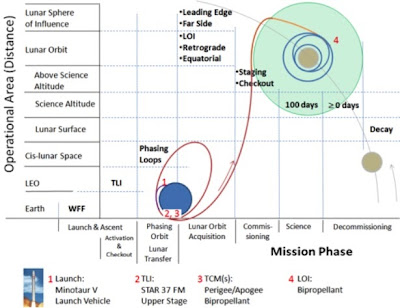
LADEE Mission Phases

I think the most exciting portion of the mission will be the optical communications experiments. While in orbit, it will demonstrate the first 2-way high-rate long-range laser communications.  The Lunar Laser Communications Demonstration (LLCD) will test how spacecraft may be able to use lasers to send movies, high-resolution photographs and even 3D images to ground controllers, someday

LADEE launched yesterday evening from NASA Wallops Flight Facility in Virginia, though over 8,000 west-coasters also watched the launch event at an epic party at NASA Ames Research Center

And now now that LADEE is flying, NASA needs your help!
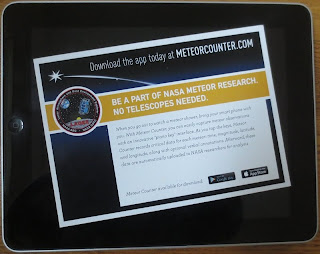
Meteor Counter for iPad and iPhone

During the LADEE Mission, NASA would like to have as many people as possible submitting meteor counts so scientists can compare that data to what LADEE's instruments record. And of course, there's an app for that.

Download the NASA Meteor Counter app, which allows observers to use their iPhones, iPads, or Androids to record meteor count observations, and send the data directly to NASA.

When you watch a meteor shower, just take your smart phone with you! (As if you leave it home anyway, right?)  Capture meteors with the "piano key" interface. As you tap the keys, Meteor Counter records critical data for each meteor: time, magnitude, latitude and longitude, along with optional verbal annotations.  These data are uploaded to researches at NASA for analysis.

Meteor Counter

Anothe great way to get involved is with your 8 to 14-inch aperture telescope to detect meteoroid impacts, as monitored by the NASA Meteoroid Environment Office, and the Lunar Impact Monitoring Program. In both entities, lunar scientists seek to determine the rate of meteoroid impacts on the Moon, as they are an important source for the lunar exosphere and dust.

The LADEE mission is a also a participant in the International Observe the Moon Night, and the Student Spacecraft Tracking and Monitoring effort, so visit LADEE Mission Opportunities page to pick a project!

Wednesday, September 4, 2013

Lunar Atmosphere Dust Environment Explorer

Share

Is everyone prepared for the historic launch of NASA's Lunar Atmosphere and Dust Environment Explorer this week? This will be the first of TEN launches in September! Busy rocket season.


This historic robotic mission to the moon will mark the very first lunar blast-off from a place that is not-Cape-Canaveral. It will also clear up many of the Moon Mysteries we humans have wondered about since the Apollo program.

NASA Wallops Flight Facility in Virginia is very excited to host the launch of LADEE (pronounced Laa-dee, as opposed to "lady") on a USAF Minotaur V. NASA Ames is holding an event at their parade grounds, and 8,000 people have purchased tickets! NASA TV will also carry pre-launch activities, so find a place to watch: 

NASA LADEE Lunar Launch
Friday, September 6th
NASA TV Coverage Begins 6:30pm PT / 9:30pm ET
LAUNCH WINDOW 11:27-11:31pm ET

Click to embiggen Launch Visibility map

Designed and built at NASA Ames, the Lunar Atmosphere and Dust Environment Explorer (LADEE) is a robotic mission that will orbit the moon to gather detailed information about the composition, density and variability of the thin (but glowing!) lunar atmosphere.

LADEE will  study conditions near the surface and environmental influences on lunar dust, and also test new laser communications technology that could potentially bring broadband speeds to planetary space missions!


The LADEE 3-phase animation, by Dana Berry at NASA Ames, first shows the Lunar Dust Experiment (LDEX) instrument, which operates by detecting ions generated when dust particles impact at high speeds. Data will be used to calculate the mass, density and electrical charge of lunar dust.  Phase 2 depicts orbital flight path variations, and phase 3 shows light from the sun scattering through the lunar atmosphere.

Why are such explorations important?

Interestingly, our Moon may be the most common type of atmosphere in the solar system -- perhaps in most solar systems. Known as a "surface boundary exosphere," a very similar type surrounds Mercury, the moons of our gas giants Jupiter and Saturn, all the largest asteroids observed, and even minor celestial bodies beyond the orbit of Neptune. 

Given that we have an SBE so close, we really ought to be exploring it!  In the future, the data may help probes land on Jovian moons!

Follow the NASA LADEE action on Twitter, and of course, I will be live-tweet all the action from the Pillownaut Twitter account, too.

Monday, August 5, 2013

The Year of Curiosity

Share

One year ago today, Curiosity Rover, carrying the Mars Science Laboratory (MSL), landed on Mars. There were 127 landing parties in the USA and 15 other countries, and thousands of people watched breathlessly until news of the successful landing gave way to raucous celebrations all over the globe!

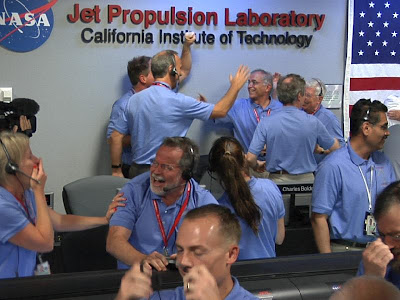
NASA JPL Mission Control
NASA Television had a record number of viewers. NASA.gov went DOWN. Ustream froze. Live data feeds tanked due to the onslaught of online demand. The world watched. Together. And believe it or not, the fun has just barely begun...!

Neil deGrasse Tyson predicted the risky Entry, Descent, & Landing (EDL) would fail. Many of us writers considered preparing two articles -- one for success and one for a crash. I spent days feeling sick to my stomach at the idea of what would happen to the NASA budget for Mars missions if Curiosity didn't land safely. (Humanity doesn't exactly have a stellar success rate with missions to the red planet!)

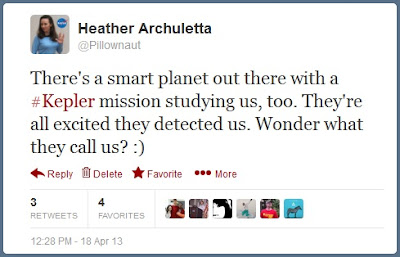
MSL Tweet

Everything that could have gone right, went right. Every expected signal arrived. Everyone who worked on this magnificent mission of space exploration can be proud, choked up, relieved and sleepless-for-days jubilant! And millions of us who had followed this mission for years could finally say that our most cutting edge technology now roves on the fourth rock from the sun.

I saw the very first images on a huge screen at the largest landing party on Earth. By the time the EDL was in progress, more than 7,000+ people had congregated at NASA Ames Research Center near Moffett Field in California. The cheer that rose from that crowd when we knew Curiosity had landed safely was utterly EPIC!  The roar upon receiving the first photograph on Martian terrain...? Well, I'm pretty sure people in Las Vegas heard us.

Curiosity Rover Lands on Mars
MSL Curiosity has since drilled rocks, fired lasers at soil target, photographed landslides, ound streambeds, and even photographed the Martian moon Phobos overhead!

From Bradbury to Glenelg,from Rocknest to Point Lake, from Shaler to Cumberland, and on to the base of Mt, Sharp, MSL is making herself at home in Gale Crater, teaching us more about Mars than we ever thought possible: radiation, what was once under water, volcanic vs. sedimentary rocks, determined temperature and humidity, nature of Martian minerals, and most importantly -- what is now almost certainly proof of ancient habitability.


This advanced rover found evidence that geochemical conditions were once suitable for microbial life.  MSL Curiosity detected water, carbon dioxide, oxygen, sulfur dioxide, hydrogen sulfide, chloromethane, and dichloromethane.What happened to the Martian atmosphere over the last billion years? We know it was there.  And now, thanks to MSL, scientists finally know why Mars changed!

Curiosity, which may last as long as a decade on Mars, may be able to tell us so much more! So stay tuned for good science.  A toast to the first 354 sols!  May there be thousands!

NOTE: The anniversary being celebrated today and tomorrow represent one Earth year. 668 sols of the Martian year (687 equivalent Earth days) would put the Martian Anniversary on July 14, 2014 .

Monday, July 29, 2013

NASA Ames K10 Telerobotics Test from the ISS

Share

This has been so exciting! I finally joined Instagram! Just kidding. Well, I did join Instagram, but that was the exciting part. I decided to try it out, and use it to publish all my pictures while visiting NASA Ames Research Center for the Rover tests by the Intelligent Robotics Group.

K10 rover
K10 Rover at NASA Ames Roverscape
Click to see album of pictures!

I also dusted off my YouTube channel and took some videos of the most amazing rover test I've ever seen up close!

With coordinated help and checklists from NASA Ames Multi-Mission Operations Center (MMOC), and NASA Marshall's ISS Payload Operations, ESA astronaut Luca Parmitano remotely tested the K10 Telerobotics Lunar Rover from the International Space Station (ISS)!

Every time you see this little guy move, it was being controlled from an astronaut in orbit around the Earth! So very awesome. Listen for the Mission Control chatter at the end, as well as the amusing Pac-Man sound effects.  It did a funny R2-D2 impression as well, though I didn't happen to catch it on-camera.


Note the giant Wind Tunnel in the background of the NASA Ames Roverscape, the research facility used to design and test new (commercial and military) aircraft, as well as NASA space vehicles, including the Space Shuttle. At 80x120, it's the largest wind tunnel in the world!

After Luca Parmitano completed his remote Telerobotics tests, and a survey of the terrain that will hopefully someday be used on the Moon, we went out into the roverscape to see the K10 up close.  Close enough to touch, even. And, when it started moving again, to hear it hum and beep. Can't wait for one of these to explore the Lunar surface!


After the robot fun in the morning, we also saw the IRIS and LADEE mission control centers, the new exhibits at the Ames Visitor Center, and the Lunar Science Institute. Not a bad way to pass the time in sunny California!

To see the robotics tests video clips in larger frames, visit my Pillownaut YouTube Channel, and to see the rest of our day in pictures, please visit my Pillownaut Picasa photo albums.

Friday, July 26, 2013

NASA Social Number Nine!

Share

I'm truly blessed to be able to attend or work so many amazing NASA events, and today, it's back to NASA Ames! I grew up in the shadow of Hangar One, so the Ames Research Center (ARC) holds a special place in my heart.

NASA ARC at Moffett Field, California

Today's event will be all about NASA's newest moon project, the robotic Lunar Atmosphere and Dust Environment Explorer. The acronym for the mission, LADEE, is generally pronounced "laa-dee" (as opposed to "lady") by the designers and scientists.

The hardware will launch on a Minotaur V to our beautiful Moon from the NASA Wallops Flight Facility in Virginia this September (and there is another social for the launch, too!)

NASA LADEE Vibration Testing

This is actually one of the smaller socials held, with only 15 attendees given social media credentials to learn about current Ames projects.

Aside from LADEE launch preparations, tours will include spacecraft hardware and missions operations facilities, and also a trek to the Ames "Roverscape" field, where astronauts on the International Space Station will remote control telerobotics rovers!

Try moving this from... ORBIT!

Throughout the day, follow these accounts and hashtags on Twitter to see all the moony and roboty goodness: @NASASocial, @NASAAmes, and @NASALADEE.

Of course, I'll be live-tweeting all day long from Ames, so you can also follow Pillownaut twitter for commentary. My fellow tweeters for tomorrow's events are listed on the LADEE / Rovers Test Twitter list, follow any and all of them for NASA Social updates!

Friday, April 19, 2013

Name That Kepler Planet

Share

Such an exciting media briefing from NASA Ames!  Live from the Bay Area of California, Mission Manager Roger Hunter offered the Reader's Digest recap of how the Kepler Space Telescope determines orbital periods via transits, then Principal Investigator William Borucki wasted no time in tantalizing us with newly-found planets in the habitable zone of a red star!

They turned the stage over to Research Lead Lisa Kaltenegger, and BAER Institute scientist Thomas Barclay, who emphasized the amazing diversity of solar systems we are finding in our universe, a beautiful example being the newly detected Kepler-62 system.

Kepler Mission
Starlight on Kepler 62E and F

Two of the system's five planets, 62E and 62F, are the smallest exoplanets yet found, almost certainly rocky, with possible land masses and water. In fact 62E may be a "waterworld" of sorts, and 62F has polar caps. Surely with such alluring possibilities, we could come up with better names for these beauties?

 (Lively tangential conversations on Twitter during the media briefing were afire with naming possibilities instead of simply catalogue numbers. While I don't believe in "dumbing down" the science, that doesn't mean we can't make the discoveries more colloquially accessible.)

Nerds will be excited about possible "life signatures" on a faraway sphere, no matter what it's called. But will the general public embrace Kepler finds without nicknames? Of course, interest and coverage would explode a hundred-fold if we started naming them after Star Wars characters. Sad but true, so hopefully there can be a happy medium, when we see planets capable of sustaining life.

Kepler Telescope
Awesome Animated Infographic from the New York Times.
Click to embiggen and mouse over each Orrery for details!

Barclay said it best: "This is no longer an academic or theoretical exercise."

True. We have actually FOUND habitable planets. That alone is mind-blowing! Add to that the idea that either world may not just be habitable, but absolutely HABITED! With every new possibility, we see less and less reason to consider ourselves a rarity.

Kepler consistently examines over 150,000 stars in the Cygnus / Lyra field of the Milky Way –- merely one small area of one small galaxy. In a few short years, thousands of candidates and hundreds of confirmed habitable planets have been detected. Imagine then, the implications of the overall numbers in the greater multiverse!

Another amazing implication of these observations and bodies of research is that we could potentially surmise the future of our own Earth, once we understand the lifespans of stars, and their effect on planets within their habitable zones.

Kepler

Naturally, our excitement must be tempered with reasonable doubt. It's worth noting that if some faraway world is watching our solar system through a telescope, they would find both Earth and Mars in the "Galactic Habitable Zone" –- however, Mars gravity is unable to keep an atmosphere that would heat the planet surface. Just like us, they could only deduce possibilities, but at these distances, not know for sure.

However, each new project brings new data, each technological leap opens new possibilities, and as we add to our store of knowledge, our deductive powers of life signatures will only grow richer. The NASA TV session ended with press Q&A, and a novel opportunity to submit questions through social media, which I'm happy to see NASA centers embrace.

Many popular outlets such as New Scientist and Universe Today immediately covered the announcement with ample technical detail, and the original abstract for the Kepler-62 system can be found at the ScienceMag publication of the American Association for the Advancement of Science.  

Now, let's think of some names!


Friday, August 3, 2012

NASA Ames Social

Share

Back at the Cathedral of Flow! Yes, NASA Ames, land of the Wind Tunnels.

The last awesome event at Ames Research Center (ARC) centered around Kepler, but this time, it's all about the Mars Curiosity Rover!

Ames from the Air, from my Cessna Skyhawk Tour!

As per my description of all the onboard science equipment and the EDL sequence for the newest and largest-ever Mars rover, much of the design came from ARC!

Ames engineers conducted a full-scale MSL parachute deployment, small-scale verification tests, as well as supersonic tests to study the interaction between the MSL Capsule and parachute during atmospheric entry. All tested in the famed Supersonic Wind Tunnels... and rumor has it we may get to see one.

We are beginning bright and early today, and will start by hooking up with the other 5 NASA socials being held today in various NASA field centers. The lead center for the Mars Science Laboratory events will be the Jet Propulsion Laboratory in southern California.

Mars Curiosity Rover Patch
Mission Emblem & Pins, designed by Susan Bell

To follow along throughout the weekend, see the NASA Television Schedule for engineering and science briefings, live streams from the media socials, the Sunday landing, and recaps up until August 10th. Our sturdy MSL buddy should be roving madly by then, and taking all manner of awesome panoramic pictures near Gale Crater.

For my and Team Camilla's updates, you can follow @Pillownaut, @Camilla_SDO and @acwynn!

Tuesday, April 24, 2012

SF Bay Area Geek Flyover!

Share

Discovery had her #SpotTheShuttle trend, and my new pal from SpaceUpSF took me on a #SpotTheGeekStuff trip of our own!

With Pilot Rick!

So it's like this. I met this pilot on Twitter. No, really. We then met at a conference a few months later, whereupon he was kind enough to lend his flying expertise so we could enjoy all the great geek spots the Bay Area has to offer!

Rick @JetForMe had me report for nerd duty at Tradewinds Aviation at Reid-Hillview Airport in San Jose, where I was introduced to my first Cessna. I know all the jaws of my longtime friends just collectively dropped because I agreed to get on a plane, given the lengths I go to in order to avoid ANY type of flying machine.

NASA Ames from the air...
The National Full-Scale Aerodynamics Complex (NFAC)
(Fancy name for "Heap big wind tunnel where we test aircraft"!)

Let me just say that these planes don't climb high enough for me to experience ear pain or illness from pressure. I'll probably never be "comfortable" in the sky, but as I told Rick, I'm at the age where I've begun to believe that when you fear something, you should run toward it instead of away.

Well worth it! Flying all around NASA Ames and identifying the many historic buildings and test facilities was of particular interest. Of course, Hangar One is visible for miles all around, but on closer approach, I got a whole new appreciation for the Lunar Institute, Wind Tunnels used in aerodynamics research, NASA's newest green building known as Sustainability Base.

The DISH

Another great feature of our area is the 46-meter Radio Telescope in the Stanford foothills, off the Stanford Dish Hiking Trail, built in 1966 by the Stanford Research Institute. Look at the size of that thing compared to the surrounding buildings!

Called simply "The Dish" by locals, I was reminded I've never actually visited the darned thing on the ground. My next order of business should be seeking out some of these spots either for leggy or brainy exercise in the future.

Largest Linear Accelerator in the World!

Only a few seconds away from The Dish (by plane travel speeds, anyway) is the amazing Stanford Linear Accelerator Center (SLAC)... also now called the "National Accelerator Laboratory", the allegedly "straightest object" in the world.

On way back, we also had a view of the University of California's Lick Observatory, on the summit of Mount Hamilton, in the Diablo Range just east of San Jose. Our last nerd monument before landing!

To see the entire set, which also includes San Francisco, Alcatraz, the SF Bay and other angles of NASA Sustainability Base, Hangar One, etc., see my Pillownaut Galleries on Picasa!

Thursday, June 9, 2011

SOFIA

Share

The rock star of telescopes!!!

I love this. I have been following the SOFIA program for many moons on paper, and I think I have more glossy little PDFs on this than any other NASA task, save perhaps the Mars rovers.

Now I have two wonderful photos I love seeing side-by-side, from 2009 and 2011:

SOFIA
Me with model of SOFIA at NASA Ames Research Ctr in 2008


Stratospheric Observatory for Infrared Astronomy
Me with the real SOFIA at NASA Dryden Aircraft Ops in 2011

SOFIA is the Stratospheric Observatory for Infrared Astronomy, a modified Boeing 747 that will be NASA's and the DLR's premiere platform for airborne astronomy over her 20-year lifespan.

I can't wait to tell you all about it, and show you all my wonderful pictures from NASA Dryden when I get home! Must drive there first, however. On the road today!

Friday, March 4, 2011

NASA's Green Light

Share

Alert reader and longtime supporter Manuel Dornbusch of Munich, Germany, sent in a wonderful article about how a "Cutting-Edge NASA Research Center Goes Ultragreen", which described NASA's new "Green Building" – to be called "NASA Sustainability Base" when completed:

Ceiling panels that cool the air? Windows and shades that open automatically? A constant LCD display of energy Relevant Products/Services use? All this plus fresh air, solar and wind-turbine power, natural light, forward-osmosis recycled water (the same system installed on the International Space Station) and a passive geothermal system. For pictures of construction, see the "Multimedia" section of their official website.

NASA Sustainability Base
Yes, a building with a website of its own

The bottom line? A building they say is designed to produce more energy than it uses. Although perhaps a better term would be a "NET ZERO" system (before all the science brains out there start screaming about Newton's Law of Conservation of Energy en masse!) – because I'll admit that was one of my first thoughts before I read the details. ;)

As luck would have it, mere days after Manuel sent the link, I was able to visit the structure itself, currently under construction only yards from the NASA Ames Research Center Administration building. Before and after the Ames Tweetup, I drove around Sustainability Base to take photographs, now in my Picasa galleries. It looks like any other construction site, but is being touted as the "government's greenest building" according to the US Green Building Council Leadership in Energy and Environmental Design (LEED) rating system.

The government's greenest building
The plan is to save taxpayer money and be as environmentally friendly as possible by lowering utility bills and bring federal building standards to a new high, per executive orders – and spokespersons say such a building wouldn't have been possible even five years ago.

Software monitor and adjust building temperature, humidity and carbon dioxide as well as light and noise levels in the 50,000-square-foot NASA gem, which will use 75% less energy and 90% less potable water than regular code-built structures.

NASA Ames Research Center Sustainability Base
Love the golf carts around the Green Building, but
shouldn't they be in the shape of mini-Lunar Rovers??

Can we truly create a building that not only doesn't "hurt" the environment, but actually benefit its surroundings? Time will tell. I suppose to anyone outside of California, anything costing over $20 million doesn't sound like such a bargain… approximately $400 per square foot? What sounds reasonable on the West Coast for real estate probably sounds insane anywhere else – but if the water and electricity bills wind up being as "non-existent" as planned, this structure will be a historical landmark in human construction.

NASA already has one prototype "green building" at Kennedy Space Center, the Propellants North Administrative and Maintenance Facility, which is described in this great SCV Television clip.

Wednesday, March 2, 2011

Music of the Cosmos

Share

We don't often get to experience stars or other celestial phenomena from an audio perspective, because we think of space as silent, but almost all objects in the universe produce sounds from whistling to humming through various frequencies, i.e. their natural speeds of vibration.

Jon Jenkins Slideshow Music of the Spheres
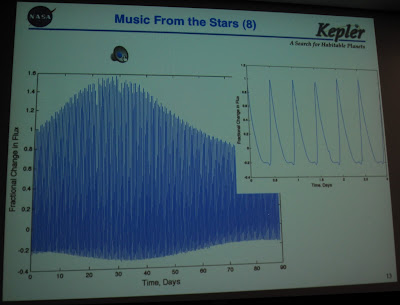
SETI scientist and Kepler Mission Co-Investigator Jon Jenkins hosted some of our groups at the NASA Ames Tweetup, and explained how his team detects transiting planets, including what they "sound" like:


The payoff comes around the 1:10 minute mark, where you actually hear the "buzz" of planet HATp-7b in the cosmos, oscillating at 8192 Hertz as it transits a star about 1,000 light years away from Earth.

Before the official start of science operations on the mission, data collected from this planet was used to demonstrate the high precision of measurements made by the Kepler telescope – even before completion of software testing and calibration!

Discovery of HATp-7b's brightness variations during occultation (when a planet passes behind a star) between transits proved that Kepler had the capability to find earth-size planets, and as we all know now from their recent findings, became even more precise! Who knew they would find so many in such a short time!

Jon Jenkins NASA Kepler SETI
I skipped one of Jon's greatest hits in the music category, because it was such a monumentally unpleasant sound (think giant tubas played backward through an electric razor), and picked up with some of the more melodic selections, including a pulsating star:


Awesome stuff! Why would we go around listening for harmonic components from Quarter 1 light curves of variable stars? The entire Milky Way is also oscillating, and using astro-seismology, we can gather data about the properties of various regions by the pressure level of those oscillation frequencies... deducing things like age, size, formation, and future oncoming radio disruptions or geomagnetic storms.

(Because we sure aren't listening in for the catchy beat!)


Kepler Co-Investigator Jon Jenkins
For those of you who don't know Jon Jenkins, he has been a fun staple of SETI's YouTube Channel in terms of star analysis and measurement based on light fluctuation.

Such talents made him perfect for the Kepler team, where he led the design and implementation of the Science Operations Center Science Pipeline, which processes the pixel data from Kepler to detect signatures of transiting planets.

He's also a pretty cool, humble guy who seems a bit stunned that some geeky people such as myself actually know him on sight and could pick him out of a line-up!

Tuesday, March 1, 2011

FutureFlight Central

Share

NASA's Future Flight Central, or FFC, offers 360-degree full-scale, real-time simulations. They can "re-create" and test various aircraft and landing patterns for airports in terms of design or flight control issues, or of planet Mars for remote rover drivers, etc.

During the NASA Ames Tweetup, our tour split into groups and allowed everyone some time in the FFC upper floor... and what an easy way to make yourself dizzy!


I was trying to spin in a dark room without falling or hitting anyone else, and I think I only barely managed it. What kept me from looking like a complete goon was the fact that everyone else was trying the same moves with their cameras at various points during the sims!

In this short video, our hosts ran one of many simulations, pointing out the airbag bounce marks and dust stirs on the planet Mars, following the Opportunity rover's not-so-soft landing at the Meridiani Planum, just south of the Martian equator.

Mars Opportunity RoverChallenger Memorial Station on Mars

The images around the lander were the first from the panoramic camera from mission MER-B, or "Mars Exploration Rover B" (Spirit was MER-A). It's really quite something to see when you have the benefit of 360-degree rover cam!

Once the rover became operational, it pulled back and focused its camera on the empty lander, the Challenger Memorial Station, forever commemorating the crew of Space Shuttle Challenger at Opportunity's landing site.

Floorplan of FFCFFC Floorplan

The FFC simulators' software packages, displayed simultaneously on twelve screens, can use artist renderings of surroundings or re-creations of actual airports or planetary terrains. The 3-D database is built up from:
- Digital Photography
- High-resolution aerial survey photography
- Digital Terrain Elevation Data (DTED)
- Airport AutoCAD (DXF) files

Future Flight Central SimulatorsSharing a laugh with the simulation technicians

Their operations also include monitoring of many kinds of radar displays, air traffic control, the maintaining of a large aircraft library, interactive performance experiments, data recording and measurements, summary statistics, and full integration with the Vertical Motion Simulator (VMS).

Friday, February 25, 2011

That Altair That Would Have Been

Share

Okay... final post for SimLabs! I meant to upload this material yesterday, as a sequel to Bo Bobko's explanation of simulations... but got a bit side-tracked because some Shuttle or other was launching ;)

Here I am in the Flight Simulation Lab (the building that houses the VMS) with @SpaceKate, a lovely young writer and space enthusiast from London who came to America for the original STS-133 Tweetup -- but never went home! When the November launch was scrubbed, she stuck around hoping for a new launch window, and has been fortunate enough to visit Ames, SpaceX and the Jet Propulsion Lab in the meantime. Talk about a dream vacation!

With SpaceKate and the Lunar Lander Cab
@SpaceKate and @Pillownaut

In a rare happy ending, SpaceKate did see the Shuttle launch yesterday when Discovery STS-133 took off from the Cape, as KSC kindly held a "Repeat Tweetup".

Rewind a week back to when we chatted at Ames: together we took a "tour" of the Lunar Lander cab with another Tweep, and a SimLabs employee. To put it mildly, four people inside that simulator is a tight squeeze! We tried to take video footage inside the cockpit, but I'll warn in advance that if you are claustrophobic, you probably shouldn't watch this.


The Lander interior is designed so the screens are the only thing truly lit, but I was able to focus upon seat restraints, joystick controllers, and so on. Our cohort laughed briefly at the slender amount of padding, because this contraption sure wouldn't be a very comfortable ride!

The consoles and controls are enticing, and a "rerun" of a previous simulation was showing where someone had landed on the moon at precise coordinates. Toward the end, I noticed the software accounted for a visual Earth Rise, which I thought was a great touch!

SimLabs Mission Control Rooms

I tried to back out of the Lunar Lander while I was still filming -- not my best idea ever, since you can see in the top photo that the the cab is in a very brightly lit warehouse, and I was momentarily blinded.

Each of the different types of cabs can be loaded into the lateral carriage of the Vertical Motion Simulator (VMS), and then varied flight simulations can be run with different ranges of movement in "six degrees of freedom". Say it with me now... Pitch, Yaw, Roll!

Wednesday, February 23, 2011

Vertical Motion Simulator

Share

One great thing about video posts is that the film does the talking for you! Even for someone who loves to write on a daily basis, video footage is great fun, and is so much clearer than complex descriptions. If only Youtube wasn't so intermittently disagreeable with uploads!

Persistence counts, and I was finally able to process this awesome clip of the huge six-degrees-of-freedom VMS, or Vertical Motion Simulator, with the Space Shuttle cab in the lateral carriage:

Shuttlespotting!

The VMS is the world's largest motion simulator, and used to mimic many types of flight situations at lower cost and better safety than actual flight hardware. Engineers can work out design-related or procedural issues via simulation rather than in the air, with much less risk to lives and valuable flying machines. Watching it skyrocket upward and plummet down, go side-to-side and spin the cab – wow, what a ride! I wish I could have a run at the cockpit and see what it's like to land a shuttle orbiter.

For a look inside the Shuttle cab, see this clip called "Buzzing The Tower".

Vertical Motion Simulator
Astronaut training in action at Ames:
Someone was in there, "flying" the Shuttle cab

We could only see the vertical platform (marked by the NASA logo) as it passed the window at various intervals. The catenary (that's Latin for "jaw-dropplingly gigantic chain") and support columns support movement as much as 60 feet up and down, and 40 feet across!

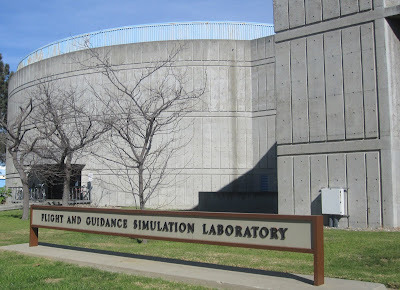
Flight & Guidance Simulator Laboratory
The FGSL at NASA ARC

For hardcore engineers who enjoy examining the nuts and bolts, the VMS Familiarization Guide (PDF document) has helpful descriptions and diagrams; I particularly enjoyed page 30, which features a list of all vehicles that can be simulated in the cabs' visual systems: tiltrotors, helicopters, carriers, refueling tankers, Destroyers, Russian aircraft, American assault aircraft, VTOL jets, and surface-to-air missile systems. Pretty versatile!

Shuttle Simulator
Shuttle Cab in the SimLab

Cabs are interchangeable, and we have pictures of both Shuttle cabs and a Lunar Lander cab in the Picasa Gallery for the NASA Ames Tweetup. Tomorrow, I'll feature the Altair Lunar Lander simulator.