Wednesday, May 15, 2019
Pillownaut Muse
After my follow-up DEXA Bone Scan last winter, and the nice article NASA's Human Research Program published about me and other past pillownauts in preparation for the new simulation protocols, I didn't expect much more to happen. It's been many years since my studies, and my blog is now only rarely updated.
I pondered perhaps "over-hauling" this site to be a #SciComm hub -- but honestly, I think there are so many great existing Science Communication sites, and I will work to amplify those. I figured I'd had my 15 minutes of fame, and decided to leave my old blog "as-is" as a historical record of how I lived through the unique experiences of Space Flight Simulations projects at NASA.
But. Every time I think I'll never hear about it again, another author or press outlet comes knocking. Last time it was Charles Wohlforth, and you should definitely still read his great book, "Beyond Earth: Our Path To a New Home in the Planet." My father was very impressed they devoted more space to me than to Neil Armstrong, so we may have to put that on my tombstone.
Along came Minute Number 16...
Muse Magazine asked to feature my studies and chose the same title, just spelled a bit differently! In "Beyawned Earth," writer Jen Mason compiled many of my past blog excerpts, a few older press turns, and many of my personal photographs from quarantine into an exceptional article designed to teach students about space flight and how it affects the "biological packages" that travel in spacecrafts.
Reading the finished product, I was definitely the happiest I've ever been with an interview. I've had TV and radio stations ask me exhaustingly inappropriate questions; sometimes even reputable outlets go for the sensationalist spin by giving the study clever little [incorrect] nicknames or dwelling on incidental details, like how we manage to shower during simulations, or that we cannot have sugar or caffeine or salt in quarantine. Sure, those things are challenging, but not life-threatening. They pale in the quest for good data.
However, MUSE Magazine hired a skilled and serious writer who truly nailed the science. After literally a decade of interviews in varied formats, and even being featured on the NASA website itself, this was really the first full-length article that revolved around MY OWN WORDS REGARDING MY OWN EXPERIENCES. This is the closest article to what I would have written myself. Maybe someday, some outlet will invite me to do so. Hope springs eternal.
I was gratified that this particular entity put the science in detailed and accurate terms, because it's directed at students and young adults potentially getting started in scholastic concentrations, and beginning to think about choosing majors.
Issue came out in March, and I was thrilled to receive copies by May, after I returned from my 6-week trek in Europe. You can order back issues of Muse Magazine yourself, or subscribe your teens, at Cricket Media.
My entire list of articles has been updated to include the last 2 years.
Thursday, May 2, 2019
AstroCappella
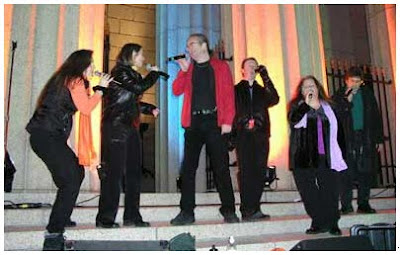
I've had such a fun time listening to "AstroCappella" music by an amazing group called The Chromatics, who recorded their first CD with the help of a NASA IDEAS grant (Initiative to Develop Education through Astronomy and Space Science).
NASA Goddard Space Flight Center, where the a-capella group originated, still features the singers on their website, where you can hear a lively version of The Sun Song...

Left to Right: Padi = AstroPhysicist Soprano
Karen = Solar Scientist Alto & Mezzo
Alan = AstroPhysicist Tenor
Barry = Architect Tenor
Deb = Database Designer Soprano
John = Satellite Astronomer Baritone
I also searched around YouTube (a bit of a trick, since there is also an Oregonian Synth-Punk band with the same name), but I found the AstroCap YT Channel, which features a few clips of the spacey-group's live performances.

This harmonious form of musical astronomy was developed by the members of the Chromatics for education and public outreach, and all of their tunes are "astronomically correct"! My favorite was their humorous "Bad Hair Day" -- but they also cover comets, asteroids, Mars exploration, the phases of the moon, the habitable zone of our solar system, gamma rays and even a Historical Overview of Telescopes in the "HST-Bop." Highly entertaining!
They were even commissioned by the Johannes Kepler Project to write a special song for the International Year of Astronomy in 2009 called "Shoulders of Giants", which detailed Galileo's first observations of space through his newly-developed telescope in 1609.

They even have a Christmas CD! I purchased this entire set on iTunes along with some of their other selections, and I'm rather partial to "Pachelbel's Tantrum" ;)
Join their Facebook Fan Page or follow the Chromatics Twitter Feed to see when and where they conduct public performances.
Or, check out their AstroCapella Project to see how you can make the most of "the marriage of music & astronomy" to entertain at schools or introduce unique entertainment to your science, museum or planetarium public event!
Friday, March 8, 2019
More Moon Tree Road Trips!
Seventeen trees down, 75 to go! I seriously bit off more than I could chew again. When I first learned about the Apollo Moon Trees, and resolved to go visit as many as I could, I figured there were a few dozen. The catalog wasn't all that long in 2009 when the tracking project revived.
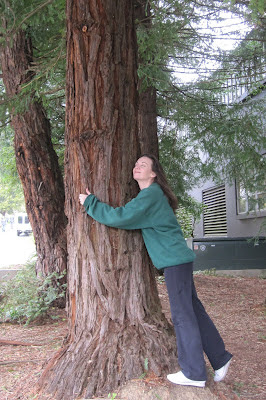
California 3 Redwoods (Sequoia sempervirens), 1974
While mapping all the moon trees in America and abroad, my list stretched to 80 in total! I'm glad to see more companies and universities submitting their records to be counted now, but I've since given up being able to see all of the known plantings. So far, the most I have managed is six sites in California, one of which had multiple moon trees, and a seventh tucked away in the Grand Canyon State... not easy to find! Many of the resources online only give general whereabouts, so it often requires some detective work to find the right spots.
California Redwood (Sequoia sempervirens), 1976
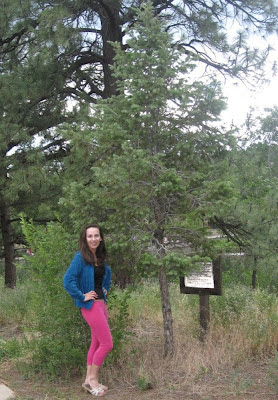
In many cases, the trees are marked with signs, commemorating the Apollo 14 mission in 1971, when NASA astronaut Stuart Roosa took the 500 tree seeds into space; however, many gifted with moon tree saplings in the 1970s lament that their signs have eroded or been stolen over the years. In a few cases, the trees have perished, leaving only the paperwork behind... and in one case, I found a tree that died -- but the plaque was still there.
Happily, the largest contingent are trees that have flourished, growing taller in some cases than the "control trees" planted adjacent or nearby. In the case of all the California Giant Sequoias, micro-gravity clearly had no effect on the seeds! After planting, they thundered upward hundreds of feet, and there is no difference in their health as opposed to trees germinated on Earth.
Arizona Douglas Fir (Pseudotsuga Menziesii), 1976
The majority of the trees were planted during various American Bicentennial celebrations in 1976, as noted by their signs. However, the earliest were planted in 1974, and after a sparse smattering in the 80s and 90s, some of the second-generation moon trees were planted as recently as 2011.
The Sycamores seemed the hardiest species in terms of survival, followed by the Redwoods, then the Loblolly Pines and Douglas Firs. The Sweetgums seemed to fare the worst, with only two known specimens left in existence.
California Redwood (Sequoia sempervirens), 1976
Next up, I still have some road trips to see the trees in Lockeford and San Dimas; perhaps I'll even head north to see a few in Oregon...
To see all the California moon trees I've visited, and their signs, plus the one I visited in Arizona on the way home from driving to the STS-135 Space Shuttle Launch, go to the Pillownaut Gallery, or simply click on any of the pictures.
Friday, February 22, 2019
Technicolor Moon Rocks
Moon rocks like you've never seen them before! We generally tend to think of the moon in... oh, about 50,000 shades of grey, as it were.
However, samples returned to Earth are just full of secrets at many levels. BEHOLD! The microscopic colors of Luna Selene...
These amazing images are the work of Stuart Forbes, taken when he was a geology student at Edinburgh University, in preparation for an exhibition at a public observatory to commemorate the 30th anniversary of the first moon landing.
Thanks to a loan scheme with NASA and PPARC (Particle Physics and Astronomy Research Council), Stuart obtained access to a pack of lunar material, containing a lucite disk of six whole moon rocks and twelve "thin sections" -- slices of rock cut so thin (30 microns) that light is able to pass through them.
Because of the optical properties of minerals, two polaroid filters, one above and one below, produce an interference pattern that results in the lovely colors; interpreting them is one of the core skills learned by geology students.
Apollo 16 astronaut John Young was scheduled for a lecture, whereby Stuart asked the hosting museum if they would like the exhibition re-created. THIS time, when they got their hands on the moon rocks, he had special equipment prepared to photograph them!
Stuart even had the pleasure of escorting Astronaut Young through the exhibition, and such was his exciting turn-of-the-century brush with planetary geology. These samples are available to borrow for schools, universities and museums in the USA & UK, so other educators should definitely feel encouraged to do wat Stuart did, if you are affiliated with spaces that hold science exhibits of any kind.
Click on any of the pictures in this post to see the entire lunar gallery by Stuart Forbes, where you can see other examples of basalt, regolith, breccias, soilin, anorthositein and gabbro… and thank you, Stuart, for generously sharing these beautiful photographs with everyone!