Friday, September 30, 2011

Open NASA

Share

Many of you have heard of OPEN NASA, billed by enlightened agency individuals as "A collaborative approach to open, direct and transparent communication about your space program."

As part of the greater Open Government Initiative, this entity's workforce strives to innovate on how the NASA does business by embracing new technologies and fostering "citizen engagement".

NASA is OPEN
No easy trick in today's brutal political climate fueled by skeptics, but their earnest efforts reminds me of that old proverb: "Tell me and I forget. Show me and I remember. Involve me and I understand."

Conspiracy theorists especially welcome! But remember that your tinfoil hat boots the signal.
Open NASA
The important thing is to participate!

The program management official behind OpenNASA is Nicholas Skytland (who wrote what I consider to be one of the best space presentations ever) and the newest blog writers include Ali Llewellyn of (you may remember her from MissionX!) and Chris Gerty, crew member on NASA's undersea mission aboard the NOAA Aquarius.

Other fresh faces include William Eshagh and Sean Herron, who are now contributing articles about projects in the Open initiative, such as NASA Internships, Mars mapping, NEEMO, the Nebula story, events like space camps or World Space Week, and astronaut initiatives such as Fragile Oasis.

OpenNASA.com has moved to their new official site at http://open.nasa.gov/, which everyone should check out along with their sister-site http://data.nasa.gov/. This "Open Data Project" portion provides access to amazing NASA digitized datasets, which represents only a small-but-continually-growing body of knowledge captured in nearly 100 years of US aeronautics and space endeavors.

OPEN NASA
…But choose your forms of participation wisely

Open source software? Check. Open source summit? Check. They make a great team all around; everyone will enjoy first pieces of writing on the new site!

And I'm not just saying that because one of their awesome writers asked to interview me about my space flight simulation experiences... but of course, that didn't hurt, either. ;)

Monday, September 26, 2011

Desperately Seeking Snoopy

Share

I'm not sure if this is a noble endeavor or fruitbat crackers in the classical sense, but it seems there is now an international Snoopy Search Party, and it just smacks of a lesser-known X-Files episode.

Snoopy Space Safety Poster by Charles Schulz
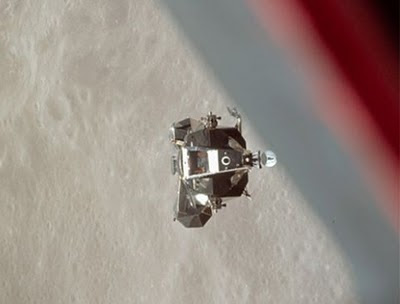
In May of 1969, astronauts Tom Stafford, John Young and Gene Cernan completed what was known as the "Dress Rehearsal" mission of Apollo 10. The crew completed 31 orbits of the moon in Command Module Charlie Brown, and tested the guidance and navigation systems of the Lunar Module Snoopy.

During trial maneuvers, the Snoopy LM came within 8.4 nautical miles of the moon's surface. The descent stage was deliberately crashed into the lunar surface; the ascent stage, after its crew exercises, was cast into heliocentric orbit, where it's been now for 42 years.

Lunar Module Snoopy
No other once-manned spaceships are still out there the in the black. Snoopy is the lone wolf. At present, Charlie Brown is in the Science Museum of London – so it's not hard to see why a British team learned all about this mission and decided they were going to track Snoopy down.

British amateur astronomer Nick Howes, who's passion normally lends itself to hunting asteroids, rounded up some heavy hitters with the intent of finding the tiny LM. NASA's JPL, Wales' Faulkes Telescope team, the Space Exploration Engineering Corporation, California's Jamesburg Earth Station and Italy's Remanzacco Observatory will be overseeing the project with schools across Britain, despite having no reliable orbital data after 1970.

Apollo 10 Crew. Guilty of littering.

The search area of this science project is over 135 million kilometers; the vast visual field will be examined with robotic telescopes and later, spectral analysis, if any potential possibilities are found in terms of hardware.

Wow. Needle. Haystack.

So says the Faulkes Education Director Sara Roberts: "There will be a huge search field to examine, so this is not something which will happen overnight. It could take weeks, months, years — or we may possibly never find it. But we're going to try, and as a bonus, the areas we'll be searching will hopefully turn up new asteroids, and maybe even some comets, so there will be useful results whether we find Snoopy or not."

Saturday, September 24, 2011

Space Over Time

Share

Technology Review, the magazine of the Massachusetts Institute of Technology, published one of those all-the-rage-now "infographics" in their Autumn issue.

It shows over 7,000 space launches, noted annually by nation and payload purpose: military, government non-military, commercial or amateur, including universities.

Space Launches by Nation
Click to Download Full-Sized PDF

Unsurprisingly, Russia and America dominate the visual field, with steady streams of launches interspersed with explosions of activity in particular eras. The remaining 50 countries hold some well-knowns as well as many surprises... (Really? Mauritius launched commercial payloads??)

Well done, I say. Even if they do have an ink-blot-versus-totem-pole sort of feel.

Space data from 1959 through the summer of 2011 was compiled by Harvard-­Smithsonian Center ­astrophysicist Jonathan ­McDowell, and arranged graphically by MIT Research Engineer Mike Orcutt and Tommy McCall, founder of Infographics.com.

Thursday, September 22, 2011

Pale Blue Dot

Share

When I was in elementary school, science teachers used the idiom "a speck in the universe" to describe planet Earth, trying to give us an idea of the vastness of space.

I don't often ponder the vastness of space, because really it's just vastly too vasting VAST. Like, raging vastocity. I know our human brains, having no realistic comparison, cannot possibly intellectualize the vastness, and here's why:


I thought I had it all figured out in 2nd grade when I memorized the order of the planets, as displayed by a poster in our classroom. It looked so simple, and the way people talked about space travel back then -- how everything would soon be "space age" and Star Trekian, well, I imagined we'd all be vacationing to Saturn by the time I was in high school.

Around 9th grade, I read a book that said solar system illustrations or general "depictions" are complete nonsense. You can't scale to size on a poster, or even a large wall.

Even if you shrank a drawing of Earth to the size of the average aspirin pill, Jupiter would be a thousand feet away. Pluto would be in the next town over. And that's just "space in between" objects, to say nothing of the vastness of the objects themselves!

Pale Blue Dot
Comparatively speaking, right around the time this video shows the largest known star in comparison to Earth, our beloved planet is ONE PIXEL. In the immortal words of the great Carl Sagan, pale blue dot.

In the digital age, I think it speaks more to our mentality to be a "pixel" now instead of a "speck". And, I laughed aloud at the extra little slap-in-the-face at the very end... CENTER OF THE UNIVERSE... hint: it isn't you.

Nice.