Thursday, July 28, 2011

Shuttle Successors?

Share

An odd phenomenon is going on across the space nerd community at the moment, a fascinating and funny and sad mixture of joyful experiences from the final Shuttle launch and severe worry about the future.

Amid the flurry, I keep wanting to write a post about my... feelings surrounding the current state of the space program, but so far it's been less emotionally taxing to focus on photographs, spacetweeps and related events.

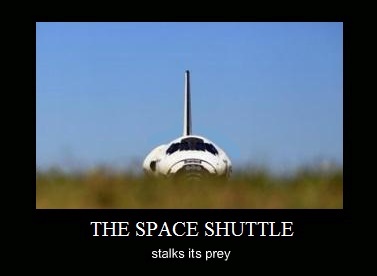
If go and get all opinionated, I run the risk of realizing the biting political cartoons published of late are a little too scary-accurate:

Space Shuttle Cartoon


Space Shuttle Toon

Cheerful, huh? And now hot on the heels of the biting American political rhetoric, the chief of Roskosmos (Russian Federal Space Agency), Vladimir Popovkin, was quoted as saying, "The shuttles turned out to be expensive toys which havent justified the investment made in them."

So what guarantee do we have that the Shuttle's possible successors will be cost-effective, efficient, well-managed, safe and successful in the long-term for science, for manned space-flight and for the overall betterment of humanity? Well, none really.

But quite a few companies have thrown their hats into the ring for a good try:

Space Shuttle Successors
BBC News picked the "Top 5" heirs to the Space Shuttle, short of someone shop-lifting a Russian Buran and considering it a fixer-upper.

CST-100 by The Boeing Company

Dragon Capsule by Space Exploration Technologies Corporation ("SpaceX")

Dream Chaser by Sierra Nevada Corporation

Multi-Purpose Crew Vehicle (MPCV) by Lockheed Martin Corporation

Secret (?) Space vehicle by Blue Origin LLC

And so I shall wrap up this month's Space Shuttle blog theme with some confirmations of the successes, sadness for the end and hope for the future. Time will tell if any of these crew and/or cargo potentials will become the Next Big Thing. Perhaps some other dark horse of the CCDEV (NASA's Commercial Crew Development Program) will come forward?

Whatever happens... some of us will be supportive, but ever impatient with the pace of development...
Space Shuttle Turtle

Tuesday, July 26, 2011

The First At The Last

Share

On the morning of the Atlantis STS-135 launch, we were treated to a talk by four-time Shuttle vet Robert Crippen, who piloted STS-1, and commanded STS-7, STS-41C, and STS-41G (once on Columbia and thrice on Challenger). We media nerds had just settled back into the Tweetup tent after watching the Astrovan take the shuttle crew to the launch pad when he strolled in!

So, at a little after 8:30am in the morning, we were literally listening to the first Shuttle pilot speak right when the last Shuttle pilot was being strapped in for take-off! Quite chilling. Bob Crippen spoke for perhaps 30 minutes about his experiences with different orbiters and astronauts, garnering both laughter and tears from the crowd – and from himself, when he choked up a few times speaking about the end of the shuttle program.


"When the solid rockets light, you know they're headed
someplace… and you just hope it's in the right direction!"

Columbia STS-1 scrubbed once, and lifted off on the second attempt on April 12, 1981. This maiden flight of the most complex space craft built to-date was, of course, also the precise 20th anniversary of Yuri Gagarin's first space flight. In 37 orbits around the Earth, Bob Crippen and John Young performed thorough checks of all the shuttle systems, recorded the orbiters "stresses" and overall performance, and returned to Earth safely, proving the space-worthiness of a craft that would take us to LEO for the next three decades.

In his retrospective above, Bob also scored a few points with the ladies, as indicated by the cheers, for being all space-feministy. We appreciated the nod to Sally Ride (first American woman in space) and Kathryn Sullivan (first American woman to perform an EVA).

John Young and Bob Crippen in 1981

Interestingly, in a related six-degrees-of-separation kinda thing, I once interviewed a Hubble guru at NASA Goddard named Ed Rezac, who tested Bob Crippen's space suit gloves in 1980, prior to their first true christening on STS-1.

And on this same trip, after many moons on Facebook and email, Ed and I finally got to meet at the epic Endless BBQ in Florida! Social Media has truly made the world a much smaller place! So if you are a space fan, and you have not yet attended one of the NASA center media events or Tweetups, keep an eye on the @NASATWEETUP feed for when new ones are announced! You will be amazed at how they bring people together from all over the world, and all throughout the space industry!

Endless BBQ
Space Geeks Unite!


Monday, July 25, 2011

Space Shuttle Tile In Hand

Share

And I mean that literally. I held a Space Shuttle tile in my hand. This was actually back in June at the Tweetup media event at the Jet Propulsion Laboratory, but looking back now, I am surprised they didn't have these all over the place at KSC!

These, of course, are what constitute the Thermal Protection System applied to each shuttle orbiter so that their integrity stays sound throughout missions.

Space Shuttle Tile
Side A and Side B

Many of us will get to see Shuttle Orbiters up close soon in nearby museums, and I'm betting they will have some tiles to handle... so remember these fun facts!

- TPS tiles form the skin that separates the shuttle craft and its crew from temperatures over 2,000 degrees Fahrenheit (1090 Celsius) as it moves through Earth's atmosphere.

- About 70% of the orbiter's exterior must be covered, requiring over 22,000 tiles per craft. No two tiles are alike, and each must be applied by hand.

- The color scheme of the Space Shuttle isn't accidental. It is separated into black and white, as are its tiles, so engineers know what to use and where!

- White areas are covered with "Low-Temperature Re-usable Surface Insulation" or LRSI, designed for temperatures 650 C or 1,200 F or below.

- Black areas are covered with "High-Temperature Re-usable Surface Insulation" or HRSI, designed for temperatures above the the limit of the LRSI and on up to 1275 C and 2300 F! WOW.

Shuttle Tiles Display
Click for Original Size

There are wonderful displays about the TPS at NASA Stennis and NASA Kennedy, and many thousands will continue to be distributed to schools around the USA.

Back at the JPL, I had the honor of meeting Todd Barber, a veteran and/or ongoing guru for some of the most amazing projects NASA has going: Galileo, Stardust, Cassini, EPOXI... and most recently, he has been working on the Mars Exploratino Rover (MER) missions.

It's no exaggeration to say he is not just a propulsion engineer; he is THE propulsion engineer! And here he is, babysitting the Tweeps with a shuttle tile...


NASA Propulsion Engineer Todd Barber

And Todd's right! You really can do this with a Shuttle Tile. Here is a video of someone who put it to the test with a blowtorch and their own hand.

While poking around to research the history of TPS development, I found some fascinating old videos from the 1970s showing the development of the tiles, as well as more recent explanations of abalation and how the tile structure evolved over time with the use of sand... watch the engineers cook up a batch of modern tiles!

Friday, July 22, 2011

Onward to Mars!

Share

It is tempting to keep saturating myself in all the minutiae of the Space Shuttle. Many space geeks are certainly experiencing a reluctance to let go, particularly if we were lucky enough to be spectators at the launch or landing. Atlantis had a picture perfect touch down early yesterday, and since then, Twitter and Facebook groups have exploded with tributes, memorials of the fallen astronauts of the Shuttle program, and general gratitude toward NASA for 30 years of Shuttle activity... but...


Happy Mars Day! We're moving on, as we always do. Exploration never stops, and pioneering new frontiers shouldn't either. An advanced probe will soon launch for Jupiter in August, and this winter, the Mars Science Laboratory, aboard the Curiosity Rover, will conduct the most sophisticated tests upon the planet Mars.

Who knows what this will bring us in terms of astrobiology? What is the overall biological potential of the red planet? How can we conduct detailed measurements on the surface?

This morning, NASA and the Smithsonian's National Air & Space Museum hosted a press conference where geologists, project engineers and MSL scientists announced that Curiosity will land near the Gale Crater on Mars.

Gale Crater
Gale Crater is 154 kilometers in diameter (about 96 imperial miles) and includes within it a 5-kilometer high mountain (3 miles of layers) above the crater floor. Three different environmental settings are thought to exist in and around Gale, which may indicate overall habitability of the planet in terms of the water cycle.

Is Gale an ancient lake deposit? Was there microbial life there? Orbiters have detected "signatures" of clay minerals and sulfate salts, known for being distributed by water. The scientists who spoke stressed that this was not a "life detection mission" and MSL is not necessarily looking for fossils -- but simply carbon traces, in terms of determining habitability.

Google Mars
Named in 1991 after Australian astronomer Walter F. Gale, the Gale Crater is in the Elysium Planitia, is the second largest volcanic region on Mars, and estimated to be about three and a half billion years old.

Definitely check out Google Mars for precise coordinates of the Gale Crater from varied distances, and also click here for the Topographic elevation map of Gale. It's going to be hard to wait until 2012 to hear all about the landing and roving adventures!