Tuesday, July 14, 2009

Mars500: First Mission Complete!

Share

Taking a break from my Apollo "count up" today. Also taking an apparent break from watching Space Shuttle Endeavour NOT launch... (it's been scrubbed five times now!) to report an update on a very exciting simulation study. Of course, at the core, my blog is all about the details of "spaceflight simulation," and I'm always excited to see new developments in any category.

This past March, I read about a fascinating program being conducted by the Russian and European Space Agencies called the Mars500. A crew of six cosmonauts entered an amazing facility meant to act as a self-sustaining spacecraft, and study the effects of isolation, finite food and water, artificial atmosphere and communications during a trip to Mars. Their first 105-day simulation concluded today!

Mars500
The crew has undergone a range of scenarios as if they were traveling to the Red Planet – including launch, the initial journey, arrival on Mars, transfer to and from the Martian surface and the return trip home.

I've followed their adventures in medical testing, data collection, keeping up their greenhouse, exercising, conducting scientific experiments, running through daily “spacecraft” tasks as if they were in-flight, simulated "emergencies" and continual questionnaires about the effects of loneliness on their mood and motivation.

They’ve done a great job, and none of the guys seem worse for wear, in spite of not seeing the sun for 105 days!

Mars 500
Their second simulation is scheduled for early 2010. This next program will isolate crew members for 520 days (the time needed to travel to Mars, stay for a month, and travel back to Earth)... but for the time being, they are just looking forward to seeing their girlfriends and enjoying the novelty of being outdoors.

Each member of the team took turns writing in their collective Mars500 Diary, which is truly a great read for anyone interested in the practical concerns we face in preparing to reach Mars.

Monday, July 13, 2009

Apollo 9

Share

Date: March 3-13, 1969
Crew: Commander James McDivitt (39)
Command Module Pilot David Scott (36)
Lunar Module Pilot Russell Schweickhart (33)


Command Module Call Sign: Gumdrop
Lunar Module Call Sign: Spider


Mission Distinctions: First test of a Lunar Module in space after first rendezvous and docking of a LM and CM; the first two-man space walk EVA, and also the first test of "portable life support system" suits.

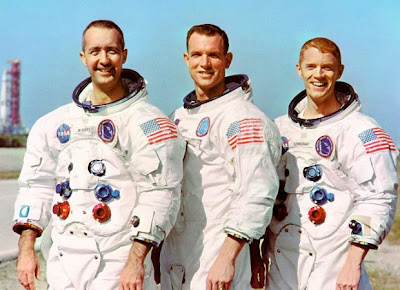
Apollo 9 CrewThe crew was authorized to name their crafts again, and Apollo 9 crewmen chose titles based on the craft shapes, saying the capsule looked like a gumdrop and the lunar module looked like a giant spider. Later, McDivitt would admit those were, "not very glamorous, but they fit the picture."

The first Lunar Module, or the "15 ton taxi" as it was sometimes called, cost $41 million dollars, and was the first vehicle built to operate in the vacuum of space. The LM fuel weighed 3 times the hardware itself. It had no heat shield and could not be used for re-entry to Earth.

There had been no LM on Apollo 7 or 8 – and there would be no future moon landing if this module did not operate as expected. Rusty and Jim piloted Spider through various maneuvers about 100 miles away from the command module, describing her as an "ungainly beast."


Apollo 9 Space Walk
Schweickhart was tasked with testing the full space suit that would later be used on the moon, though his spacewalk was shortened and certain tests were scratched because of his continued space sickness on the mission – vomitting would be disastrous if it occurred while he was suited up.

In 1990, English perfomer Adam Ant featured a song called "Apollo 9" on his album "Antics in the Forbidden Zone" and performed a music video for the track dressed in a silver space suit. And if anyone can ever explain those lyrics to me... I'm all ears ;)

Currently, the Apollo 9 command module Gumdrop is on display at the Air & Space Museum in San Diego, southern California.

Friday, July 10, 2009

Apollo 8

ShareApollo 8 Crew

Date: December 21-27, 1968
Crew: Commander Frank Borman (40)
Command Module Pilot Jim Lovell (40)
Lunar Module Pilot Bill Anders (35)

Command Module Name: CM-103
Service Module Name: SM-103

Mission Distinctions: First manned launch of a Saturn V rocket. First manned space flight to leave the gravitational field of planet Earth and travel to our satellite. The first humans to journey to the moon for a “circumlunar” tour! The crew took the first pictures of Earth from deep space, first live television footage of the lunar surface, and the craft set a new speed record: 24,200 MPH.

It's impossible to overstate the historical significance of Apollo 8. Borman, Lovell and Anders were the first human beings to witness and personally photograph an "Earthrise." Their mission was the most widely covered by the media since the first American orbital flight by John Glenn in 1962. Over 1200 journalists covered the mission, which was broadcast in 54 countries in 15 languages. The Apollo 8 broadcasts later won an Emmy.

Famed pilot Charles Lindbergh visited the crew the day before they launched.

In the first successful "translunar injection," it was the goal of Apollo 8 to test all craft facilities, communications, mid-course corrections and consumables for a possible landing mission. They were also tasked with taking clear photographs of proposed future landing sites and locations of scientific interest on the Moon.

Apollo 8 Trajectory
The Lunar Orbital Plan. Click to enlarge...

At the 69 hour mark, the propulsion system ignited and burned for what the crew would later describe as "the longest four minutes of our lives." If the burn was not precisely accurate, they could be flung off into space; if it last too long, they could crash into the moon. After ensuring they did achieve a proper path, they finally had a chance to look at the Moon, which they would orbit 10 times for the next 20 hours.

Jim Lovell’s first impression of the moon was that, "It looks like plaster of paris, or sort of grayish beach sand."

Upon the recovery after splashdown, helicopter pilot Don Jones asked what the moon was truly made of cheese? Frank Borman quipped, "It’s not made of green cheese, it’s American cheese."

Apollo 8 InsigniaPersonally, one of my favorite mission insignia designs, as it showed home, the goal away from home, the trajectory in an interesting incorporation of the mission number... and it’s the only one in the shape of an Apollo Capsule.

Currently, the Apollo 8 command module is on display at the Museum of Science and Industry in Chicago, Illinois.

Thursday, July 9, 2009

Apollo 7

Share

Date: October 11 – 22, 1968
Crew: Commander
Wally Schirra (45)Command Module Pilot Donn Eisele (38)Lunar Module Pilot Walter Cunningham (36)
Command Module Name: CM-101
Service Module Name: SM-101

Mission Distinctions: First manned mission of the Apollo program; first American 3-man mission; first live public broadcast from space.

Apollo 7 Crew During 163 orbits, the crew was tasked with testing the engineering systems, firing module engines and other critical tests to see if the hardware and life-support measures would be "moonworthy."

Apollo 7 spent 11 days in space – more than all the Soviet missions combined at that time, and it appeared the US program was finally beginning to "pull ahead."
Apollo 7, 8, 9 and 10 each carried a lunar module pilot, even though there were no Lunar Modules yet.

It was the Wally Schirra show! A veteran of Mercury 5 & Gemini 6, he was at that time the oldest man to fly in space, and the first to fly a third mission.

It was no bed of roses, however; Schirra was against having a TV camera in the spacecraft, calling it both a distraction and invasion of privacy. NASA Director Chris Kraft was equally adamant that command modules should begin live broadcasts to the American public.

Apollo 7 Live Broadcast Wally developed the first head cold in space and had to perform the first two broadcasts while congested and cranky. By day 3, he refused to air another, saying there would be no discussion.

Upon return splashdown, the module flipped upside-down prior to retrieval, giving crews and controllers some heart-stopper moments until radio contact was re-established... but the entire crew was extracted safely.

In January 1969, the Apollo 7 command module was displayed on a NASA float in the inauguration parade of President Richard M. Nixon. Currently, the Apollo 7 module is on loan to the Frontiers of Flight Museum in Dallas, Texas.