Tuesday, August 6, 2019

Moving To Planet Mercury


For any international readers, you may have noticed American social media buzz yesterday about a curious little holiday we call "Thanksgiving", which we pretend is about Pilgrims and Natives preparing meals together at the dawn of our colonial period. It's kinda not, but as with most holidays, we like myths more than we like historical facts.

This excuse to over-eat  is held each year on the third Thursday of November. Then, on the third FRIDAY of each November, we celebrate an even more curious custom known as... Wishing We Could Move To Planet Mercury.


Your Weight On Other Worlds
There is a great contraption at the San Francisco Exploratorium, where you can step on a large scale and see what you weigh on all the planets. I've been on it, and it's quite a fun experience. They also have their calculator on a web page, so you can see Your Weight On Other Worlds.

(I think it goes without saying, there will never be a book fad known as "The Jupiter Diet".)

Why the discrepancies? In simple terms, gravity is the force of attraction between objects. Gravitational pull is what makes the Earth orbit the sun, or the moon orbit the Earth. Suns, moons and planets are all surrounded by fields of gravity. These fields will be different, depending on things like planet size, mass, speed, its location in any solar system, and any other objects around it in space.

If Earth's force of gravity is measured at 1.00, force on other planets would be:

List of Planets and their Gravitational Forces
We'll include Pluto for the purists. And so I don't have to listen to any arguments.

More complex components of gravity come into play, but in general: the larger the object, the greater the gravity. However, the further away you travel from an object, the less you are affected by its gravitational field. Jupiter is the largest planet in our solar system, so it has the strongest field (except for our Sun, which is over 27+!). You cannot stand on Jupiter, because it's mostly gas. However, if it had a surface, the force holding your body on the planet would be much greater. This increases your weight, even though your mass remains the same.

At any rate, multiply your weight by any of these numbers, and you will see what you weigh on that planet.  Oh goody, math homework!


Monday, June 17, 2019

Scale of the Universe


THIS. IS. AWESOME.

Truly one of the most amazing pieces of visual art I have ever encountered in my life, and if you do nothing else on the internet today in your spare browsing time, visit this site to see The Scale of the Universe!

The Scale of the Universe
Cary and Michael Huang of HTWINS.NET released "The Scale of the Universe" in 2010, but recently updated their interactive visualization to include handy clickable descriptions... in twenty different languages!

The Scale of the Universe 2
Using objects varying in size from elementary particles up through the enormity of the entire universe, the scrolling "tunnels" help viewers grasp relative sizes in relation to creatures, known architecture, states and continents and finally planets and galaxies.

The Scale of the Universe
Ever wanted to know the difference between a Charm Quark or a Top Quark? Want to see the Cat's Eye Nebula? The Oort Cloud? Distance to the Hubble Deep Field?

Just click on the icons as you travel between Planck Lengths and Gigaparsecs.

The Scale of the Universe 2
Use the scroll bar along the bottom of the screen to move in and out of size comparisons, or simply flick the wheel of the mouse... if there is, in fact, a wheel on your mouse.

Don't go play The Scale of the Universe until you have some time on your hands, because you may get stuck there for hours!

Wednesday, May 15, 2019

Pillownaut Muse


After my follow-up DEXA Bone Scan last winter, and the nice article NASA's Human Research Program published about me and other past pillownauts in preparation for the new simulation protocols, I didn't expect much more to happen. It's been many years since my studies, and my blog is now only rarely updated.

I pondered perhaps "over-hauling" this site to be a #SciComm hub -- but honestly, I think there are so many great existing Science Communication sites, and I will work to amplify those. I figured I'd had my 15 minutes of fame, and decided to leave my old blog "as-is" as a historical record of how I lived through the unique experiences of Space Flight Simulations projects at NASA.

But. Every time I think I'll never hear about it again, another author or press outlet comes knocking. Last time it was Charles Wohlforth, and you should definitely still read his great book, "Beyond Earth: Our Path To a New Home in the Planet." My father was very impressed they devoted more space to me than to Neil Armstrong, so we may have to put that on my tombstone.

Along came Minute Number 16...

http://pillownaut.com/muse/muse.html


Muse Magazine asked to feature my studies and chose the same title, just spelled a bit differently! In "Beyawned Earth," writer Jen Mason compiled many of my past blog excerpts, a few older press turns, and many of my personal photographs from quarantine into an exceptional article designed to teach students about space flight and how it affects the "biological packages" that travel in spacecrafts.

Reading the finished product, I was definitely the happiest I've ever been with an interview. I've had TV and radio stations ask me exhaustingly inappropriate questions; sometimes even reputable outlets go for the sensationalist spin by giving the study clever little [incorrect] nicknames or dwelling on incidental details, like how we manage to shower during simulations, or that we cannot have sugar or caffeine or salt in quarantine. Sure, those things are challenging, but not life-threatening. They pale in the quest for good data.

http://pillownaut.com/muse/muse.html


However, MUSE Magazine hired a skilled and serious writer who truly nailed the science. After literally a decade of interviews in varied formats, and even being featured on the NASA website itself, this was really the first full-length article that revolved around MY OWN WORDS REGARDING MY OWN EXPERIENCES. This is the closest article to what I would have written myself. Maybe someday, some outlet will invite me to do so. Hope springs eternal.

I was gratified that this particular entity put the science in detailed and accurate terms, because it's directed at students and young adults potentially getting started in scholastic concentrations, and beginning to think about choosing majors.

Issue came out in March, and I was thrilled to receive copies by May, after I returned from my 6-week trek in Europe. You can order back issues of Muse Magazine yourself, or subscribe your teens, at Cricket Media.

My entire list of articles has been updated to include the last 2 years.

Thursday, May 2, 2019

AstroCappella


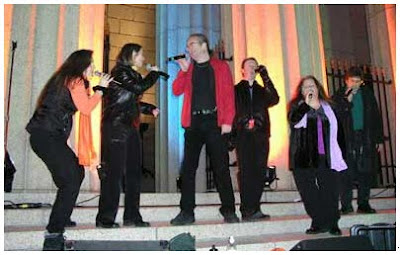
I've had such a fun time listening to "AstroCappella" music by an amazing group called The Chromatics, who recorded their first CD with the help of a NASA IDEAS grant (Initiative to Develop Education through Astronomy and Space Science).

NASA Goddard Space Flight Center, where the a-capella group originated, still features the singers on their website, where you can hear a lively version of The Sun Song...

The Chromatics

Left to Right: Padi = AstroPhysicist Soprano
Karen = Solar Scientist Alto & Mezzo
Alan = AstroPhysicist Tenor
Barry = Architect Tenor
Deb = Database Designer Soprano
John = Satellite Astronomer Baritone

I also searched around YouTube (a bit of a trick, since there is also an Oregonian Synth-Punk band with the same name), but I found the AstroCap YT Channel, which features a few clips of the spacey-group's live performances.

The Chromatics CD Covers
This harmonious form of musical astronomy was developed by the members of the Chromatics for education and public outreach, and all of their tunes are "astronomically correct"! My favorite was their humorous "Bad Hair Day" -- but they also cover comets, asteroids, Mars exploration, the phases of the moon, the habitable zone of our solar system, gamma rays and even a Historical Overview of Telescopes in the "HST-Bop." Highly entertaining!

They were even commissioned by the Johannes Kepler Project to write a special song for the International Year of Astronomy in 2009 called "Shoulders of Giants", which detailed Galileo's first observations of space through his newly-developed telescope in 1609.

Chromatics Christmas CD
They even have a Christmas CD! I purchased this entire set on iTunes along with some of their other selections, and I'm rather partial to "Pachelbel's Tantrum" ;)

Join their Facebook Fan Page or follow the Chromatics Twitter Feed to see when and where they conduct public performances.

Or, check out their AstroCapella Project to see how you can make the most of "the marriage of music & astronomy" to entertain at schools or introduce unique entertainment to your science, museum or planetarium public event!