Monday, August 9, 2010

Mice-tronauts

Share

"Taking animals into space requires great planning. What will mice need on a Space Shuttle mission? Space mice have wire mesh cages so their toes can grip a rougher surface. This way, they won't be floating all of the time. Wood chips can't be used for bedding. They wouldn't stay in place. Gravity-fed water bottles won't work, so pressurized water containers are needed instead. Food bars are provided for the animals. A special waste containment system is used to clean cages."
- Laura Lewis, Johnson Space Center Animal Care and Use Committee

On August 31, 1950, the United States launched a mouse into space aboard a Vergeltungswaffe 2, or a V-2 rocket. An Aerobee rocket carried two more mice, Mildred and Albert (one of the few recorded instances of the test mice being named) in 1952, to test the effects of acceleration, weightlessness and deceleration.

Many more lab genus Mus rodentia followed throughout the 1950s, some of which were video-recorded inside their pressurized capsules.

Test Mouse
The Soviet Union in the Vostok 3A flights of 1961 launched mice, as did China in 1964-65 in their T-7A launch vehicles. Apollo 17 carried five pocket mice to the moon in 1972 (although one died on the circumlunar trip), and Skylab 3 also carried pocket mice. During the 1990s and our current decade, many different species of mice have been flown on Shuttle missions and ISS expeditions -- too many to count in a blog post (especially since they were rarely given names!), so perhaps I'll put together a timeline elsewhere on the domain.

Mice, more so than any other animals, appear to adapt extraordinarily quickly to micro-gravity. Within only a few minutes, they orient themselves and float calmly in their living spaces, eating and sniffing and grooming themselves, just as they would in normal gravity.

In February 2010, Iran became the latest nation to launch mice (as well as worms and turtles aboard a Kavoshgar 3 rocket) into space and return them alive to Earth.

Nicole Stott on the ISS with the Mice Drawer System (MDS)

Given their size, how much can we actually learn from these tiny mammals ? You'd be surprised… I continually am!

Even just a short browsing scan of past NASA rodent research, and the scope of the current Mice Drawer System (MDS) of the Italian Space Agency, show incredible amounts of information yielded in terms of bone mass, tissue and molecular studies; skeletal, cardiovascular, and immune system comparisons; knowledge gained in spaceflight for particular changes in endocrine, cardiopulmonary and circadian systems, and applicable evidence for how to better cope with muscle atrophying conditions, such as those caused by immobility, cancer, diabetes and renal failure.

The "Mouse Hotel" alone will continue to have a huge medical impact, as noted in their goals for "Space Applications" and "Earth Applications."

We owe a great deal to these little rodents – for if they had not fared so well on the first flights in the 1950s, nothing larger would have followed them!

Thursday, August 5, 2010

Animals In Space

Share

China, France, Iran, Japan, Russia (previously the USSR), and the United States have all launched animals beyond Earth's atmosphere, initially to answer the crucial question: is it possible to survive in space?

In launch manifests, these are generally referred to as "biological packages." Most people know about and have seen photographs of the famous dogs and chimpanzees who have flown, but most people might be surprised at the entire list.

Up into the modern day, many animals have been part of craft payload, to study the effects of micro-gravity on their biological processes. Here are all the members of the Kingdom Animalia who have left Earth and traveled into space:

Space Animals

Bacteria
Tardigrades (Water Bears)
Meal Worms
Nematodes (Round Worms)
Silk Worms
Harvester Ants
Fruit flies
Wine flies
Wasps
Beetles
Crickets
Cockroaches
Butterflies
Spiders
Scorpions
Snails
Sea Urchins
Brine Shrimp
Jellyfish
Mummichogs (killifish)
Danios (zebra fish)
Oyster Toadfish
Carp
Swordtail Fish
Frogs
Newts
Turtles
Tortoises
Mice
Rats
Hamsters
Guinea Pigs
Cats
Dogs
Cynomolgus Monkeys
Squirrel Monkeys
Macaques (Rhesus Monkeys)
Chimpanzees
Humans

Space Animals

Aside from the living creatures, many different kinds of ova have also been flown, in order to study developmental effects: frog eggs, stick insect eggs, chicken embryos, quail eggs, gypsy moth eggs and butterfly larvae.

Overall launch records show activity, but no biological packages thus far, from the space agencies of Australia, Brazil, India, Indonesia, Israel, New Zealand, North Korea, Norway, Pakistan, Romania, South Africa, South Korea, Sweden, Syria, Taiwan and the United Kingdom.

Wednesday, August 4, 2010

Animal House

Share

Last week, while trying to think of a scientific blog "theme" to keep myself busy in August, I was creating a moving-slideshow of all my wildlife photography. Then I had one of those forehead-slap moments... how about animals? I love animals. I'll sit for hours watching a hole in the ground, camera ready, waiting for a tarantula or a prairie dog to appear. I've gotten hazardously close to free-roaming bears and alligators during these ventures, and even some arguably "tame" tigers.

Coincidentally, that same day, the Houston Chronicle featured an article about April Evans, who says she has recently chosen to leave NASA because of their involvement in animal testing. This former ISS engineer recently ground her career to an abrupt halt when she learned of the space agency's plan to irradiate squirrel monkeys as part of an experiment to assess health risks from deep space radiation. Imagine how strongly you'd have to feel (or how guilty, in her words) about any issue to walk away during a recession like this one?

NASA, of course, counters animal rights activists by highlighting their conservative internal policies, namely the NASA Principles for the Ethical Care and Use of Animals, and pointing out the reality that radiation exposure is the greatest hurdle we face in successfully performing long-duration flight, such as that required to reach Mars. Experiments with primates have always been considered critical to safeguarding the health and lives of astronauts. Similar to the goals in testing flight analogs such as myself, NASA hopes to understand how radiation affects primate physiology and psychology, in order to develop counter-measures.

The difference, of course, was that I could assess all the risks, sign a form agreeing to the tests, and make the choice to participate. Animals cannot. Thus, the comments following the article contained predictable debates. The extremists on one end engaged in a flame war with the extremists on the other, but most people (myself included) sit on the fence.

Discussions about this divisive issue tend to be a degenerative lose-lose affair; here's just a taste of the few "clean" comments:

"Wack Job. Maybe PETA will feed her family."

"A principled and courageous woman. There should be other ways to assess the health risks of radiation other than killing primates."

"Admire her conviction, but if she wasn't directly involved with the radiation tests, why would she quit NASA? No big company and no gov't agency is w/o some unsavory or controversial aspects."

"Let her tell her story as she likes. The fact is she was about to get laid off and this was her way of getting some attention."

"I'm amazed at this lady's principle and guts. Very few people would do what she's done and whether you agree with her or not you have to respect her."

"I applaud Ms. Evans standing up for her own beliefs. Yet I have to ask, what else would you do? Give up space travel? What mystical alternative testing regime makes these radiation experiments unnecessary?"

"Personally I'm divided. I would much rather an animal 'suffer' than a human but at the same time I'd rather no one suffer. I wish there was some middle ground."

I could have written that last comment. Many people simply don't form a strong opinion over the idea of animal testing. We'd prefer it didn't exist, but aren't torn enough to quit a job or wave a picket sign, understanding the history of animals in medicine, toxicology, space flight, and the greater biological food chain.

Initially, this wasn't how I planned to kick off my theme about animals in relation to the space program, but I wanted to acknowledge the ethical debate that I know exists over this subject. I don't presume to know the answer. For the rest of the month, I'll be honoring the animals that have increased our scientific knowledge and paved the way for human pioneering.

Tuesday, August 3, 2010

Call Sign: Rezac

Share

I'm always excited when I convince someone to overcome natural camera-shyness, because frankly, I'd do a "NASA Employee Spotlight" once a week if I could get away with it. Most folks are too modest, and longtime NASAman Ed Rezac is no different, but he was kind enough to share stories and photos!

Starting in 1976, Ed supported Space Shuttle era Extravehicular Mobility Unit (EMU) development at ILC Dover and astronaut hardware development at ILC Space Systems in Houston. Then up into the 1980s, he was a Payload Integration Engineer at JSC & KSC, supporting NASA Life Science Space Lab payload development.

Feel like a slacker yet? I was getting ready for my senior prom around the time he became a Space Station Utilization Engineer at Grumman Aerospace, and had just earned my first college degree when he moved to the Center for Space & Advanced Technology at NASA Headquarters to manage the subcontract in support of Microgravity and Life Sciences in the early 90s.

Hubble Space Telescope Mockup
Standing in the High Fidelity Mechanical Simulator (HFMS, a full size mock-up of the Hubble Space Telescope's aft shroud) in Building 29 at the Goddard Space Flight center in Greenbelt, Maryland

For the last decade, he's been at Lockheed Martin as an EVA Systems Engineer, working with engineers, scientists and NASA astronauts to plan, train for, and execute servicing missions to maintain the Hubble Space Telescope.

I could spend about 18 blog posts pestering him with questions about any number of tasks he performed at any of these jobs, but for the sake of him actually being able to escape my evil clutches and get back to work, I'll just share a few episodes in line with my blog themes of simulations and ground testing.

Hence, my favorite photo sets:

NASA - Ed Rezac
Ed again, with what he lovingly calls his "Ron Burgundy moustache."
Sweet Lincoln's mullet! (click to embiggen)

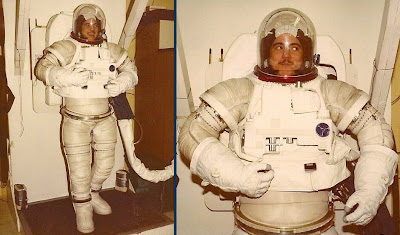
Above is a shot of Ed in 1980, as a suited tester. Definitely click to see the larger version, and see all the details of this EMU.

You were probably sitting in a theatre somewhere, watching Caddyshack. Then maybe you went home and played your Atari 2600 or the new Andy Gibb album. Yeah, Ed was conducting actual certification runs of the pre-flight testing of astronaut Bob Crippen's gloves that were flown on STS-1 in April 1981!

When I emailed Ed to ask if I could use these wonderful pictures on my blog, he replied:
"I suspect that what you may find more interesting than the activities of 30 years ago are the more recent hardware design, procedure development, and crew activities conducted in preparation for the Hubble Space Telescope (HST) Servicing Mission. I was the HST Project's EVA Lead for two of the tasks completed during the last Hubble servicing; changing out the three Rate Sensing Units (RSUs) that contain the gyros that keep the telescope steady during viewing operations, and repair of the Advanced Camera for Surveys (ACS) science instrument."

"Both tasks required design, development and testing of hardware; development of both nominal and contingency procedures; and instruction, training and on-orbit choreography development for the astronaut crew and ground personnel. I worked with the astronaut instructors at JSC to train the astronauts using 1-G simulators, VR, the Neutral Buoyancy Laboratory, and put in many hours "on the loops" at Mission Control for pre-mission simulations as well as actual flight console support."

Mike Good, John Grunsfeld, Ed Rezac, Mike Massimino, Andrew Feustel
L to R: Mike Good, John Grunsfeld, Ed, Mike Massimino & Drew Feustel.
The STS-125 spacewalkers in front of the mock-up HST aft shroud following a training session in Houston, TX.

I was going to do a "write-up" on all that, but it actually works better in Ed's own words, and all the amazing photographs truly speak for themselves. Click on any to move to a page where you can see the whole photo sets, Hubble mockups, astronauts and all!

Thanks so much for giving folks a view into your world, Ed... we love having looks behind the scenes at the real people who keep the space program running!