Monday, June 29, 2009

New Astronauts!

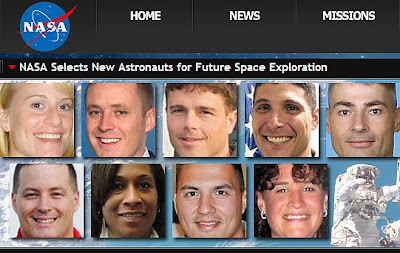
Exciting news! NASA announced their selections for the 2009 astronaut class, THE CHUMPS, who will begin training at Houston's Johnson Space Center in August. These are the first new hires in 5 years!

NASA Astronauts
The new astronauts are:
Serena M. Auñón (33) of League City, Texas
Jeanette J. Epps (38) of Fairfax, Virginia
Jack D. Fischer (35) of Reston, Virginia
Michael S. Hopkins (40) of Alexandria, Virginia
Kjell N. Lindgren (36) of League City, Texas
Kate Rubins (30) of Cambridge, Massachusetts
Scott D. Tingle (43) of Hollywood, Maryland
Mark T. Vande Hei (42) of El Lago, Texas
(Gregory) "Reid" Wiseman (33) of Virginia Beach, Virginia


That's three new women and six new men who hold a combined 23 college degrees! Like, wow. Other interesting tidbits? Lindgren and Auñón are Flight Surgeons, Epps is a CIA intelligence officer; and Vande Hei (Army) and Wiseman (Navy) have both served in the Middle East.

A few days back, one of my blog posts featured Major Jack Fischer, excerpting an inspiring essay he penned about humanity's continued exploration in space.

For the full article, as well as profiles on each new astronaut, see the 2009 Astronauts Class section of the NASA website...

Thursday, June 25, 2009

Resume?

Some funny comments from one of the many forums discussing the NASA bedrest studies at present...

Pillownaut
Hmm. Job title. Y'think? ;)

Tuesday, June 23, 2009

Weightless Heather

Not me Heather. Another Heather.

Heather R. Smith of NASA's Marshall Space Flight Center was on my blog last September, when she wrote a great article about the spaceflight simulation studies for the Education section of the NASA.gov website family, called "Lying Around."

This time, she got to be the test subject! Or at least a willing witness – in the Reduced Gravity Flight Program at NASA Hangar 990, Ellington Field, Houston. There she joined a group of students from the University of Colorado, as well as NASA engineers and scientists, for an experience in weightlessness.

Reduced Gravity
The UC students flew two Wilberforce pendulums, to observe behavior under compression and subsequent release into micro-gravity – an experiment inspired by a similar analysis flown on Skylab III in 1973. Heather kept a brief but exciting "Freefalling" blog of 12 posts, describing the teams’ experiences.

Wouldn’t it be incredible to go into the Hypobaric Altitude Chamber where astronauts train?? Their physiological training required that they do just that, to simulate flying at 25,000 feet and experiencing mild hypoxia (oxygen deficiency). She describes spinning exercises as well, trying to do math problems after these difficult tests, and she has comments from all the team members about what they experienced physically and mentally… (sure makes you appreciate what astronauts have to endure repeatedly).

After training, they flew 30 parabolas in a C-9 Airplane. Weightlessness occurs as the plane crests upward toward the top of a parabola curve and begins falling. Each episode of a 10,000 foot drop lasts for perhaps 30 seconds. The plane will then pull out of the fall and start flying back upward. (Ron Howard used this technique to film much of the Apollo 13 movie.)

Heather Smith
I love how Heather described the experience: "Now I understand what people mean when they struggle to find the words to describe microgravity. Words like “cool,” “amazing” and “awesome” come to mind, but even those are not good enough... I remember thinking, during those serene moments where I was just looking around, that this must be what it’s like on the International Space Station… with people moving around by “flying” through the air. It’s quite awesome to experience even just a fraction of what astronauts in space feel. After experiencing how difficult it can be to control your body and do simple tasks, I am able to appreciate more fully the superb work astronauts do up there in their unique environment of space."

To read the rest, go to her section of Blogs.Nasa.gov…!

Sunday, June 21, 2009

Astronaut(s) For Hire

I follow a blog called Astronaut For Hire and it's author, Brian Shiro, is also one of my blog followers. Yesterday while I was NOT writing, and lazing around the house groaning about my achy muscles (got a little ahead of my capabilities with the free weights and probably need to dial it back a notch), one of his buddies from astronaut screening was writing a truly exhilarating guest post.

Major Jack Fischer, one of the finalists awaiting NASA's 2009 selection decision, penned an artful essay entitled "Passion For Space," which I highly recommend. These are the calibre of people striving to be your next Earth representatives, people! ;) My two favorite excerpts:

"People do not typically get involved with space because they want to be wealthy or because they yearn for fame – they do it because they love the constant challenge of a changing environment, because they want to be part of something bigger than themselves ... because they are inspired dreamers. "

Astronaut For Hire
Major Jack Fischer (right), 411th Flight Test Squadron F-22 Raptor pilot, explains controls in an F-16 Fighting Falcon cockpit to 14-year-old Avi Khanian during the "Pilot for a Day" tour at Edwards Airforce Base.


"We have an opportunity, with the Constellation program, that we have not had for decades. An endeavor that can ignite the most noble aspects of the human soul, so that we might elevate our vision beyond the everyday, and help the human race take its next evolutionary step. No longer confined to Low Earth Orbit, mankind can once again explore – the Moon, Mars, and beyond..."

Spend some time and look through Brian's previous posts, he has some great material on his own experience with NASA, the astronaut selection processes across Europe and Canada, and hey, we'll all be able to see him on the Discovery Science Channel soon!

He is going to be on the 12th team to simulate a "mission to Mars" in the Flashline Mars Arctic Research Station (FMARS), a habitat on Devon Island.

In order to prepare for Mars exploration, the Mars Society equips and trains volunteers to serve in rotations in the Canadian arctic. Talk about the ultimate in analog research! This and many other habitats around the world are crucial "live laboratories" where scientists can simulate how to live and work on Mars. NASA has even tested prototype lunar rovers there.

Good luck Brian, stay warm!